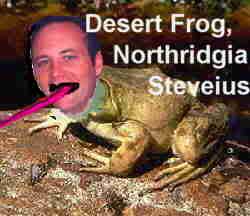
Herr Doktor Mike Von Fleichmann: Judo Coach, Shakespearean, and CrimeFighter
Perhaps you’ve heard of C-SUB Professor Mike Fleichmann. A Shakespeare Instructor and Judo coach (no kidding) on the Cal State dole, Fleichmann also considers Ed Jagels (the notorious Kern DA slammed in Rolling Stone a few months ago) a close friend. Mike, like Jagels and any decent California neo-fascist, works real hard at his job and has been rewarded for his service to Truth and Judo with awards from the John Birch Society or something—-he's also been a recipient of the prestigious Cal State Bootlicker of the Year award numerous times.
Mike somehow got it in his head, back at the University of Skokie or whereever he purchased his PhD, that Literature might be profitably implemented for right-wing ideological ends; thus he makes a living passing off his Shakespeare/Himmler pep rallies to those gullible Kern citizens who flock to lit. classes in search of Culture. Kernoids, however, don't receive much Culture in Mike's classes--though they do get Fleichmann’s lectures in "How To Be A Terrific Salesman", with the MikeMeister often using Antonio from the Tempest as his machiavellian role model, though Mike does have some problems with the Bard's polysyllabic syntax.
If you have read Ellison’s Invisible Man you remember the cynical and corrupt college administrator Bledsoe. Like the usual Cal State professorial hack, Fleichmann IS another Bledsoe, but lacking Bledsoe’s irony and verbal sophistication. CSUB has plenty of other Bledsoes, other incompetent hatchetmen and women, some of them quite pathological if not psychotic in character, such as Big Mama Plugowski. Big Mama P. (a feminist member of the politically correct Kern Vichy French, contrasted but not opposed to Fleichmann's Wehrmacht), could not divide fractions correctly, but she does know some French and has read lots of Ginny Woolfe, and manages, in a very consistent manner, to consistently distort the Deep Thinkers in the name of “post-structuralism” or “hermeneutics” or some crap. Confronting Big Mama P. with a syllogism would most likely cause her to have a nervous breakdown, but better some entertainment from the resident Crazy Circus Lady of C-SUB than to suffer through a Seminar in Drama of the 3rd Reich with Herr Fleichmann. As with most CSU apparatchiks, both of them should be brought up on racketeering charges.
C-SUB: They earn money the old-fashioned way: They Swindle it
Frog Doc
Thursday, September 29, 2005

Wednesday, September 28, 2005
An eccentric neo-positivist David Stove, an Australian, produced some great writing attacking western idealism (e.g. Plato and Kant) as well as the more egregious absurdities of marxism. Stove was a bit conservative (supposedly he was leftist in his youth), but seems materialist, more or less; his scathingly humorous attacks on postmod., marxism, feminism, etc. are sort of Jonathan Swift-like, but a bit more philosophically informed.
Stove
Stove
Saturday, September 17, 2005
Saturday, September 10, 2005
Sick of Sports Hysteria, Redux
It’s Fall again and that means Football, sports fans. Er, well, baseball is not quite over though. And basketball and hockey are just around the corner. In the spectator democracy of the USA, fans are provided with some form of “Ball” each and every season of the year. Of course, the newpapers and media are promoting this season’s gridiron “prospects” as usual. Beer is being sold. Coaches are giving pep rallies. Cheerleaders are working up fight songs for their heroes! And the local public high schools have new gangs of thugs ready to WIN. The private “Christian” high schools are contenders as well. Rah rah shish boom bah for Jee-sus, the greatest pro of ‘em all.
Coaches may sentimentally claim that “the important thing is that you do your best,” but what really counts to them is winning. That’s what sports at all levels teaches: Victory at any cost--useful training for creating obedient, robotic soldiers as well as go-getter alpha males. The celebrity athletes make the big bucks by being the baddest, most violent players on the field. It's rather questionable that's an attribute we should be instilling in our youth.
More respect should be given to the student who wins the science fair, or to the chess club champion, or the math or French honors student. Solving trigonometry problems requires more skills and is more useful to both society and to the individual than being a great free throw shooter or running back. I, for one, have much greater respect for say an Anatoly Karpov or Bertrand Russell than for Mark MacGuire or Deion Sanders.
It’s Fall again and that means Football, sports fans. Er, well, baseball is not quite over though. And basketball and hockey are just around the corner. In the spectator democracy of the USA, fans are provided with some form of “Ball” each and every season of the year. Of course, the newpapers and media are promoting this season’s gridiron “prospects” as usual. Beer is being sold. Coaches are giving pep rallies. Cheerleaders are working up fight songs for their heroes! And the local public high schools have new gangs of thugs ready to WIN. The private “Christian” high schools are contenders as well. Rah rah shish boom bah for Jee-sus, the greatest pro of ‘em all.
Coaches may sentimentally claim that “the important thing is that you do your best,” but what really counts to them is winning. That’s what sports at all levels teaches: Victory at any cost--useful training for creating obedient, robotic soldiers as well as go-getter alpha males. The celebrity athletes make the big bucks by being the baddest, most violent players on the field. It's rather questionable that's an attribute we should be instilling in our youth.
More respect should be given to the student who wins the science fair, or to the chess club champion, or the math or French honors student. Solving trigonometry problems requires more skills and is more useful to both society and to the individual than being a great free throw shooter or running back. I, for one, have much greater respect for say an Anatoly Karpov or Bertrand Russell than for Mark MacGuire or Deion Sanders.
Sunday, August 28, 2005
Friday, August 26, 2005
Literary agents and particulars
For part of what being an agent is (always) like, apparently, is being caught up in an irreducible oscillation between typicality and particularity: between (on one side) the forms of action that an agent must understand in order to make sense of herself as the possible performer of certain actions, and (on the other side) the concrete history without which the agent could not distinguish herself from those who might, otherwise, just as well replace her.
A Raskolnikov does not neatly fit into any such categories as “agent” or “type”: the character determines the type; the existential situation with which he’s confronted--i.e. Raskolnikov feverish, brooding on his couch, “should I whack and rob this wretched crone and landlady or not"--is not easily specified as some jungian or freudian myth, “coming of age” crap--a literary crisis of this type is more individual specific, as is our own life. One could call it ethics, mention “intentionality,” free will, et al.--or, ala Watson/Skinner, inquire as to whether Raskolnikov (a poorly conditioned lad) was perhaps reacting naturally (or not) to some stimulus--yet there are no outside frames of reference that the character (or agent) can extract from a realm of right actions, some platonic realm of “goodness” or obligation, which Raskalnikov can insert into his mind---Raskalnikov until his imprisonment does not realize or acknowledge a Kantian imperative, and he’s refusing any sort of liberal social contract--neither rationalist or empiricist, he more or less refuses to make the liberal association--the “identity function” that precedes an ethics discussion or any putative social contract--that he has some characteristics in common with his fellow humans: you could perhaps refer to him as a sort of uebermensch and he is--Die Raubtiere--one who cares little for helping either the starving or the bourgeois: he chooses to subvert all “normal” bourgeois values (and any imagined marxist ones as well really)), though still beset with some anxiety, and whack the hag, content that his reality is a subjective and solipsistic construct.
For part of what being an agent is (always) like, apparently, is being caught up in an irreducible oscillation between typicality and particularity: between (on one side) the forms of action that an agent must understand in order to make sense of herself as the possible performer of certain actions, and (on the other side) the concrete history without which the agent could not distinguish herself from those who might, otherwise, just as well replace her.
A Raskolnikov does not neatly fit into any such categories as “agent” or “type”: the character determines the type; the existential situation with which he’s confronted--i.e. Raskolnikov feverish, brooding on his couch, “should I whack and rob this wretched crone and landlady or not"--is not easily specified as some jungian or freudian myth, “coming of age” crap--a literary crisis of this type is more individual specific, as is our own life. One could call it ethics, mention “intentionality,” free will, et al.--or, ala Watson/Skinner, inquire as to whether Raskolnikov (a poorly conditioned lad) was perhaps reacting naturally (or not) to some stimulus--yet there are no outside frames of reference that the character (or agent) can extract from a realm of right actions, some platonic realm of “goodness” or obligation, which Raskalnikov can insert into his mind---Raskalnikov until his imprisonment does not realize or acknowledge a Kantian imperative, and he’s refusing any sort of liberal social contract--neither rationalist or empiricist, he more or less refuses to make the liberal association--the “identity function” that precedes an ethics discussion or any putative social contract--that he has some characteristics in common with his fellow humans: you could perhaps refer to him as a sort of uebermensch and he is--Die Raubtiere--one who cares little for helping either the starving or the bourgeois: he chooses to subvert all “normal” bourgeois values (and any imagined marxist ones as well really)), though still beset with some anxiety, and whack the hag, content that his reality is a subjective and solipsistic construct.
Monday, August 15, 2005
Russell vs. Shakespeare
Huemer quotes Russell on Hamlet: “the propositions in the play are false because there was no such man.”
Bravo! Here Lord Russell not only rejects the idylls of the bourgeois, but provides a brief primer on definite descriptions. Study this, gals & goys, and you may come to realize that English PhD holders are a bit lower in the food chain than the average RN.
Huemer quotes Russell on Hamlet: “the propositions in the play are false because there was no such man.”
Bravo! Here Lord Russell not only rejects the idylls of the bourgeois, but provides a brief primer on definite descriptions. Study this, gals & goys, and you may come to realize that English PhD holders are a bit lower in the food chain than the average RN.
Sunday, August 07, 2005
H.L. Mencken on Lawyers
"All the extravagance and incompetence of our present Government is due, in the main, to lawyers, and, in part at least, to good ones. They are responsible for nine-tenths of the useless and vicious laws that now clutter the statute-books, and for all the evils that go with the vain attempt to enforce them. Every Federal judge is a lawyer. So are most Congressmen. Every invasion of the plain rights of the citizens has a lawyer behind it. If all lawyers were hanged tomorrow, and their bones sold to a mah jong factory, we'd be freer and safer, and our taxes would be reduced by almost a half."
–H.L. Mencken (1880-1956), "Breathing Space", The Baltimore Evening Sun, 1924 Aug 4.

Spike!
"All the extravagance and incompetence of our present Government is due, in the main, to lawyers, and, in part at least, to good ones. They are responsible for nine-tenths of the useless and vicious laws that now clutter the statute-books, and for all the evils that go with the vain attempt to enforce them. Every Federal judge is a lawyer. So are most Congressmen. Every invasion of the plain rights of the citizens has a lawyer behind it. If all lawyers were hanged tomorrow, and their bones sold to a mah jong factory, we'd be freer and safer, and our taxes would be reduced by almost a half."
–H.L. Mencken (1880-1956), "Breathing Space", The Baltimore Evening Sun, 1924 Aug 4.
Spike!
Wednesday, August 03, 2005
Frau Marilee Shrider of the Californian
Although Annie Coulter does a decent job holding down the current American media's position of shrieking right-wing hag-pundit, there exist perhaps a few freaks (like moi) who might miss old-school conservative warrior women such as Phyllis Schafly or Marilyn Quayle. So imagine my pleasure when perusing a few of the Bakersfield Californian blogs and encountering "Right Thinking," featuring the wit and wisdom of one Marilyn Shrider (rightwing gals always have such cool Teutonic names). Predictably, she's lambasting Hanoi Jane Fonda--one of the rightwing's most beloved pastimes. Though Frau Shrider does the Phyllis Schafly schtick quite well she's not too informed about the Vietnam war--"Hanoi Jane" was not some isolated individual protesting it; nor was it only drug-crazed hippies or other "morally irresponsible" humans.
Nobel prize winners were included among the 'Nam protesters--including famed British philosopher and writer Bertrand Russell (as well as Chomsky and Sartre). But I doubt Lord Russell would impress the likes of Frau Shrider: she appears to be another flagwaving Walmartian--a bootlicker, in old-left parlance--who believes the US Military and veterans can do no wrong, an all-too-common sentiment in Kern.
(Frau Shrider also has some dittoheads posting to her blog entries, such as one "fatboy" who, like many hawkish sentimentalists, hasn't quite realized that wars involve the deaths of thousands of innocents.) Perhaps if she or her fans were to take the time to do some research and perform a body count of say the combined North Vietnamese military and civilian casualites, she might begin to get a glimpse of what it was about (conservative estimates are around 3 NV million deaths, which implies about 50 of them dead for every one of ours).
I am still waiting for all those conservatives (many upstanding "Xtians" as well) who supported the liberation of Iraq to start discussing and justifying the deaths of at least 30,000 iraqi civilians which occured during the "liberation." ("cut their people a check, maynard"). Granting that Saddam was a bloody-handed tyrant, that doesn't imply that the US was required to play world cop and take him and the Baathists out. The premise of Blair and Bush's actions were the existence of WMDs and that Saddam was connected to Al Qaida. That was not conclusively proven in the least. Going into Afghanistan after 9-11 may have been justified to some degree, but Iraq was a different issue; the Baathists were tyrants, but that probably was a UN issue. Second guessing at this stage is sort of pointless, but the US will be dealing with the consequences--and the resentment and rage of the middle east and muslims--for decades.
Let's hope that Frau Shrider, She-Wolf of the Gingerfornian, provides some more yuks with more rightwing-whack job essays, maybe something on "precious bodily fluids" or why she worships Ayn Rand, or denying the holocaust: all the sorts of topics dear to Kern County's ranks of rabid conservatives.
Although Annie Coulter does a decent job holding down the current American media's position of shrieking right-wing hag-pundit, there exist perhaps a few freaks (like moi) who might miss old-school conservative warrior women such as Phyllis Schafly or Marilyn Quayle. So imagine my pleasure when perusing a few of the Bakersfield Californian blogs and encountering "Right Thinking," featuring the wit and wisdom of one Marilyn Shrider (rightwing gals always have such cool Teutonic names). Predictably, she's lambasting Hanoi Jane Fonda--one of the rightwing's most beloved pastimes. Though Frau Shrider does the Phyllis Schafly schtick quite well she's not too informed about the Vietnam war--"Hanoi Jane" was not some isolated individual protesting it; nor was it only drug-crazed hippies or other "morally irresponsible" humans.
Nobel prize winners were included among the 'Nam protesters--including famed British philosopher and writer Bertrand Russell (as well as Chomsky and Sartre). But I doubt Lord Russell would impress the likes of Frau Shrider: she appears to be another flagwaving Walmartian--a bootlicker, in old-left parlance--who believes the US Military and veterans can do no wrong, an all-too-common sentiment in Kern.
(Frau Shrider also has some dittoheads posting to her blog entries, such as one "fatboy" who, like many hawkish sentimentalists, hasn't quite realized that wars involve the deaths of thousands of innocents.) Perhaps if she or her fans were to take the time to do some research and perform a body count of say the combined North Vietnamese military and civilian casualites, she might begin to get a glimpse of what it was about (conservative estimates are around 3 NV million deaths, which implies about 50 of them dead for every one of ours).
I am still waiting for all those conservatives (many upstanding "Xtians" as well) who supported the liberation of Iraq to start discussing and justifying the deaths of at least 30,000 iraqi civilians which occured during the "liberation." ("cut their people a check, maynard"). Granting that Saddam was a bloody-handed tyrant, that doesn't imply that the US was required to play world cop and take him and the Baathists out. The premise of Blair and Bush's actions were the existence of WMDs and that Saddam was connected to Al Qaida. That was not conclusively proven in the least. Going into Afghanistan after 9-11 may have been justified to some degree, but Iraq was a different issue; the Baathists were tyrants, but that probably was a UN issue. Second guessing at this stage is sort of pointless, but the US will be dealing with the consequences--and the resentment and rage of the middle east and muslims--for decades.
Let's hope that Frau Shrider, She-Wolf of the Gingerfornian, provides some more yuks with more rightwing-whack job essays, maybe something on "precious bodily fluids" or why she worships Ayn Rand, or denying the holocaust: all the sorts of topics dear to Kern County's ranks of rabid conservatives.
Thursday, July 28, 2005
Inheritance Taxes: Not the greatest but preferable to Maoism
Though the American yahoo typically views taxation as part of some communist plot, arguments in favor of estate taxes and inheritance taxes are not far from the premises of the American revolution. Stripping away the grammar school myths and yankee nationalist gloss, the intelligent observer may perceive that the Founding Fathers were quite similiar, at least in motivations, to the "red republican" Jacobins agitating in the Paris streets: both collectively rejected hereditary aristocracy and the absurd inequalities of wealth that characterized pre-Revolutionary France and Britain. Alexis de Tocqueville, visiting America in the early 19th century, asserted "The American experiment presupposes a rejection of inherited privilege." The exorbitant wealth of a Bill Gates or Paris Hilton or other billionaires is in a very real sense a return to the aristocratic privilege and dynasties which the Founders overthrew.
That is not to say that the moderately successful small-town businessman should not be able to hand down a large portion of his estate to his child or to whomever he deems fit. But the children of Bill Gates or Conrad Hilton are not simply obtaining some college funds and a nice car—they are obtaining, through no efforts of their own, a financial or corporate empire. (ironically, Bill Gates himself has argued in favor of the estate tax). Those economists and citizens who argue in favor of progressive estate taxes (and against aristocratic or corporate dynasties) are therefore following the Jeffersonian tradition, more or less, which is opposed to the finance and property schemes which led to the gross disparities of wealth and property of pre-Revolutionary Europe. The American yahoo might unthinkingly refer to Jeffersonian egalitarianism as “socialism,” but more correctly would be to refer to the Paris Hiltons of the world as decadent, idle aristocrats, if not seditionists.
Though the American yahoo typically views taxation as part of some communist plot, arguments in favor of estate taxes and inheritance taxes are not far from the premises of the American revolution. Stripping away the grammar school myths and yankee nationalist gloss, the intelligent observer may perceive that the Founding Fathers were quite similiar, at least in motivations, to the "red republican" Jacobins agitating in the Paris streets: both collectively rejected hereditary aristocracy and the absurd inequalities of wealth that characterized pre-Revolutionary France and Britain. Alexis de Tocqueville, visiting America in the early 19th century, asserted "The American experiment presupposes a rejection of inherited privilege." The exorbitant wealth of a Bill Gates or Paris Hilton or other billionaires is in a very real sense a return to the aristocratic privilege and dynasties which the Founders overthrew.
That is not to say that the moderately successful small-town businessman should not be able to hand down a large portion of his estate to his child or to whomever he deems fit. But the children of Bill Gates or Conrad Hilton are not simply obtaining some college funds and a nice car—they are obtaining, through no efforts of their own, a financial or corporate empire. (ironically, Bill Gates himself has argued in favor of the estate tax). Those economists and citizens who argue in favor of progressive estate taxes (and against aristocratic or corporate dynasties) are therefore following the Jeffersonian tradition, more or less, which is opposed to the finance and property schemes which led to the gross disparities of wealth and property of pre-Revolutionary Europe. The American yahoo might unthinkingly refer to Jeffersonian egalitarianism as “socialism,” but more correctly would be to refer to the Paris Hiltons of the world as decadent, idle aristocrats, if not seditionists.
Wednesday, July 27, 2005
Operation Mindf*ck: Jack Parsons, L. Ron Hubbard and Uncle Al Crowley
This shit is just too weird to even believe. Cal Tech and JPL, founding member Aleister Crowley? And Tommy Cruise and Scientology, brought to you by black magician L Ron Hubbard.
L Ron the Magus
This shit is just too weird to even believe. Cal Tech and JPL, founding member Aleister Crowley? And Tommy Cruise and Scientology, brought to you by black magician L Ron Hubbard.
L Ron the Magus
Monday, July 04, 2005
Jefferson Day Rant: Enthusiasm
Following some blog-duels with various seminarians and preachers-in-training, I have noted that there is an issue which many religious people overlook, which the English writers formerly referred to as Enthusiasm. If religious faith is purely a matter of personal conscience and subjective belief, what is to prevent a Manson or Koresh (someone like Locke would have termed them Enthusiasts of the most virulent type) from thinking that his own "visions"--which may or may not be madness--are not the Word of Gott on high? Madison optimistically asserted that "the Religion then of every man must be left to the conviction and conscience of every man," yet if one person's religion--say Koresh's-- involves inflicting his own views and irrationalism on other non-believers or gentiles or "liberals", and endangering their health if not actually killing them in accord with some subjective madness, then perhaps his religious rights should be limited (and most would agree it would have been good had Koresh's religious rights been curtailed and his church been closed early on).
When some biblethumping conservative begins discussing the Book of Revelation and assuming that it is his duty to help bring it about (since his "God" told him to) anyone who values the secular principles of the Constitution has reason to be concerned, just as we might be concerned if muslims were to become more powerful in US politics and began to try to institute some Koranic laws as public policy, or if new-age types were to try to attempt to institute some pagan holidays. There are many sound secular reasons--reasons based on logical and scientific principles, not dogma--to limit or at least question religious freedoms and institutions, as Madison's more skeptical colleague Jefferson well realized.
Following some blog-duels with various seminarians and preachers-in-training, I have noted that there is an issue which many religious people overlook, which the English writers formerly referred to as Enthusiasm. If religious faith is purely a matter of personal conscience and subjective belief, what is to prevent a Manson or Koresh (someone like Locke would have termed them Enthusiasts of the most virulent type) from thinking that his own "visions"--which may or may not be madness--are not the Word of Gott on high? Madison optimistically asserted that "the Religion then of every man must be left to the conviction and conscience of every man," yet if one person's religion--say Koresh's-- involves inflicting his own views and irrationalism on other non-believers or gentiles or "liberals", and endangering their health if not actually killing them in accord with some subjective madness, then perhaps his religious rights should be limited (and most would agree it would have been good had Koresh's religious rights been curtailed and his church been closed early on).
When some biblethumping conservative begins discussing the Book of Revelation and assuming that it is his duty to help bring it about (since his "God" told him to) anyone who values the secular principles of the Constitution has reason to be concerned, just as we might be concerned if muslims were to become more powerful in US politics and began to try to institute some Koranic laws as public policy, or if new-age types were to try to attempt to institute some pagan holidays. There are many sound secular reasons--reasons based on logical and scientific principles, not dogma--to limit or at least question religious freedoms and institutions, as Madison's more skeptical colleague Jefferson well realized.
Thursday, June 30, 2005
Quine's Two Dogmas of Empiricism
Quine's Two Dogmas of Empiricism appears on my reading list about once every 6 months. I admit to my dilettante status in regards to these matters, but Quine seems so concerned with semantic issues that he overlooks other analytical issues. Those regular consumers of Contingencies who care about such things might recall that the analytic/synthetic divide originates with Kant:
"Either (1) the predicate B belongs to the subject A as something that is (covertly) contained in this concept A; or (2) B lies entirely outside the concept A, though to be sure it stands in connection with it. In the first case, I call the judgment analytic, in the second synthetic."
Two examples which show the difference to some degree:
"Lawyers are attorneys" is 1 (analytic--synonymous in broad sense)
"Lawyers are professionals" is 2 (synthetic--or empirical in broad sense)
Quine denied the distinction. But there's more to it, it would seem. For instance, are logical connectives to be defined synthetically--Is the premise of an argument no different than the conclusion? Obviously the end result of a derivation or deductive argument is not the same as confirming a premise: and defining a variable is not the same as say putting some variable into a function and getting a result. Is the answer to a calculus problem done the way one traces the presence of toxins out in a grove of pine trees above LA? I think not.
As I am not a mystic or idealist, I agree with "physicalism" (and with Quine's arguments in TDOE for most part) usually, yet I do think there is a difference between truth via equations and functions and truth via empirical confirmation. But specifying the cash value of analyticity is not so easy; however, even a hard-core materialist or behaviorist, say like Skinner, needs to establish his own ontology, and thus needs to know what he is attacking. If you do deny analyticity and really platonic realism and "mind" it does seem that a Darwinian meat popsicle view of human nature follows, or at least is much more plausible.
So, in effect, I am not completely sure what Quine's removal of the analytical/syntheic divide "entails" as the good Panglosses say. Is it just semantic and linguistic--that "meaning" (or reference) must proceed by synthetic means? I follow his linguistics to a degree: the definitions of words are always changing (if not ostensible in many cases), thus it is not impossible that "lawyers are attorneys" may be, eventually, as synthetic as say a "lawyers are corrupt."
Additionally, given the Quinean emphasis on variables, predication, and statements instead of ordinary language--"to be is to be the value of a variable"--the move away from analytical statements might be read as affirming a view of nouns and names as variables. At least he's suggesting that--the language (any language) may evolve to where "oh X, he's a married bachelor" is acceptable semantically; though "oh X, he's a bachelor and he's not a bachelor" will not likely be acceptable. The claim that terms and thus sentences have no inherent or stable meaning also seems a bit Wittgensteinian--a sort of colder version of the language game.
Quine's Two Dogmas of Empiricism appears on my reading list about once every 6 months. I admit to my dilettante status in regards to these matters, but Quine seems so concerned with semantic issues that he overlooks other analytical issues. Those regular consumers of Contingencies who care about such things might recall that the analytic/synthetic divide originates with Kant:
"Either (1) the predicate B belongs to the subject A as something that is (covertly) contained in this concept A; or (2) B lies entirely outside the concept A, though to be sure it stands in connection with it. In the first case, I call the judgment analytic, in the second synthetic."
Two examples which show the difference to some degree:
"Lawyers are attorneys" is 1 (analytic--synonymous in broad sense)
"Lawyers are professionals" is 2 (synthetic--or empirical in broad sense)
Quine denied the distinction. But there's more to it, it would seem. For instance, are logical connectives to be defined synthetically--Is the premise of an argument no different than the conclusion? Obviously the end result of a derivation or deductive argument is not the same as confirming a premise: and defining a variable is not the same as say putting some variable into a function and getting a result. Is the answer to a calculus problem done the way one traces the presence of toxins out in a grove of pine trees above LA? I think not.
As I am not a mystic or idealist, I agree with "physicalism" (and with Quine's arguments in TDOE for most part) usually, yet I do think there is a difference between truth via equations and functions and truth via empirical confirmation. But specifying the cash value of analyticity is not so easy; however, even a hard-core materialist or behaviorist, say like Skinner, needs to establish his own ontology, and thus needs to know what he is attacking. If you do deny analyticity and really platonic realism and "mind" it does seem that a Darwinian meat popsicle view of human nature follows, or at least is much more plausible.
So, in effect, I am not completely sure what Quine's removal of the analytical/syntheic divide "entails" as the good Panglosses say. Is it just semantic and linguistic--that "meaning" (or reference) must proceed by synthetic means? I follow his linguistics to a degree: the definitions of words are always changing (if not ostensible in many cases), thus it is not impossible that "lawyers are attorneys" may be, eventually, as synthetic as say a "lawyers are corrupt."
Additionally, given the Quinean emphasis on variables, predication, and statements instead of ordinary language--"to be is to be the value of a variable"--the move away from analytical statements might be read as affirming a view of nouns and names as variables. At least he's suggesting that--the language (any language) may evolve to where "oh X, he's a married bachelor" is acceptable semantically; though "oh X, he's a bachelor and he's not a bachelor" will not likely be acceptable. The claim that terms and thus sentences have no inherent or stable meaning also seems a bit Wittgensteinian--a sort of colder version of the language game.
Saturday, June 25, 2005
Economic equity and conservatism
If conservatism is at least tangentially concerned with justice and proportion, then conservatives might themselves have reasons to criticize laissez-faire economics and "big business." The shortcomings if not absurdities of a pure laissez-faire economy are fairly clearly indicated in the California housing market and development business; with their man Ahhnuld at the reins, the contractors and brokers of LA and the Bay Area are presently raking it in. Yet teachers, engineers, and technical people are not faring so well, at least in California--I will leave it to devoted readers of Contingencies to locate the stats. Laborers and construction guys earn 30 bucks an hour while quite a few people with master's degrees in math or comp. science or history work as tutors for half that much.
Should conservatives simply applaud as housing prices soar and a few contractors and realtors make it big and the state educational and technological infrastructure collapses? Privatization--and the real estate racket is in some sense the epitome of privatization--in and of itself is not just or equitable; and that may be one reason why those children of conservative parents, after moving from the 'burbs to Westwood or Palo Alto or Berkeley, often join with the liberals and socialists--they realize that it is unlikely they ever will be able to afford the $500,000+ villa in the hills of Hollywood or Saratoga. Joining up with the marxists would, I agree, be a mistake, but the impulse to introduce some reason and planning into the market economy--say in regards to employment and rational development-- is not entirely misguided.
If conservatism is at least tangentially concerned with justice and proportion, then conservatives might themselves have reasons to criticize laissez-faire economics and "big business." The shortcomings if not absurdities of a pure laissez-faire economy are fairly clearly indicated in the California housing market and development business; with their man Ahhnuld at the reins, the contractors and brokers of LA and the Bay Area are presently raking it in. Yet teachers, engineers, and technical people are not faring so well, at least in California--I will leave it to devoted readers of Contingencies to locate the stats. Laborers and construction guys earn 30 bucks an hour while quite a few people with master's degrees in math or comp. science or history work as tutors for half that much.
Should conservatives simply applaud as housing prices soar and a few contractors and realtors make it big and the state educational and technological infrastructure collapses? Privatization--and the real estate racket is in some sense the epitome of privatization--in and of itself is not just or equitable; and that may be one reason why those children of conservative parents, after moving from the 'burbs to Westwood or Palo Alto or Berkeley, often join with the liberals and socialists--they realize that it is unlikely they ever will be able to afford the $500,000+ villa in the hills of Hollywood or Saratoga. Joining up with the marxists would, I agree, be a mistake, but the impulse to introduce some reason and planning into the market economy--say in regards to employment and rational development-- is not entirely misguided.
Thursday, June 23, 2005
Feds crack down on medical pot
The Baronial Masters of the US Supreme court have delivered the Truth on Pot. Pot Puffin' is, if not Evil Incarnate, damn near, regardless if you have no other drugs to alleviate the pain from glaucoma or cancer treatment. Millions of humans--not all hippies or freaks either--voted in med. pot; a few months later the Courtly powers simply reverse that popular decision with a few waves of their corpulent hands and send out their Fed boys to bust some ma and pa head shops in California. That the Court would so blithely dismiss the will of the people should be a bit alarming to anyone who values the concept formerly known as democracy.
Although libertarianism might not be so great across-the-board, there are quite a few decent reasons to legalize drugs, or at least cannabis: eliminating the black market on drugs and offering addicts/drug abusers treatment instead of prison are two such reasons. Alcohol obviously is generally a far more dangerous drug than is pot, and yet society and courts have no problem letting fools buy a gallon of whiskey prior to some wifebeating and a wrong-way drive on the Interstate. Pot is illegal, I believe, due to judges or prosecutors' petty, fratboy-like desires to control other people's lives (and access to relaxants)--the judges are not so concerned with justice (much less human psychology), or with preserving Jeffersonian concepts of individual freedom, but with affirming their own Authori-TAY.
(Of course, most of the various cowards and frauds who call themselves California "democrats" could care less about another infringement on individual liberty.)
Sunday, June 12, 2005

Wednesday, June 08, 2005
On Power, Russell
"The orthodox economists, as well as Marx, who in this respect agreed with them, were mistaken in supposing that economic self-interest could be taken as the fundamental motive in the social sciences. The desire for commodities, when separated from power and glory, is finite, and can be fully satisfied by a moderate competence. The really expensive desires are not dictated by a love of material comfort. Such commodities as a legislature rendered subservient by corruption, or a private picture gallery of Old Masters selected by experts, are sought for the sake of power or glory, not as affording comfortable places in which to sit. When a moderate degree of comfort is assured, both individuals and communities will pursue power rather than wealth: they may seek wealth as a means to power, or they may forgo an increase of wealth in order to secure an increase of power, but in the former case as in the latter their fundamental motive is not economic.
This error in orthodox and Marxist economics is not merely theoretical, but is of the greatest practical importance, and has caused some of the principal events of recent times to be misunderstood. It is only by realizing that love of power is the cause of the activities that are important in social affairs that history, whether ancient or modern, can be rightly interpreted."
Russell, On Power
Tuesday, June 07, 2005
The Jacko the Chester Show
Another episode in the Cali cartoon court system comes to a close. We may not care for Jacko or his cheap pop product-- I don't-- but when putting Jacko's actions in context, you realize the conservative "media" (tho neo-cons continually proclaim it's the "liberal media") have in effect tarred and feathered the freak.
Minds more acute than mine might speculate on whether these show trials are some sort of duplicitous, deceptive right-wing stunt that keeps the plebes from contemplating, say, the sight of Iraqi cities turned to rubble and decorated with human hamburger. The show trial has become some group ritual akin to cyber-stoning, wherein the selected chi chi celeb is put on display for the excoriation process; the Cali court as much a prime-time Reality Show as it is a form of due process.
As any one who has spent some time in the hands of the Black Gown Gang realizes, justice is about as dependent on a judge's or prosecutor's hangover status--or his whore's "complicity" status--as it is on the Constitution. Indeed were some magic lantern available--the old Twilight Zone truth serum, say-- to reveal the presence of Chesterness among various human-primates, one suspects most Judges and prosecutors would rate "Certifiable Chester," if not "Canberra-bound."
Another episode in the Cali cartoon court system comes to a close. We may not care for Jacko or his cheap pop product-- I don't-- but when putting Jacko's actions in context, you realize the conservative "media" (tho neo-cons continually proclaim it's the "liberal media") have in effect tarred and feathered the freak.
Minds more acute than mine might speculate on whether these show trials are some sort of duplicitous, deceptive right-wing stunt that keeps the plebes from contemplating, say, the sight of Iraqi cities turned to rubble and decorated with human hamburger. The show trial has become some group ritual akin to cyber-stoning, wherein the selected chi chi celeb is put on display for the excoriation process; the Cali court as much a prime-time Reality Show as it is a form of due process.
As any one who has spent some time in the hands of the Black Gown Gang realizes, justice is about as dependent on a judge's or prosecutor's hangover status--or his whore's "complicity" status--as it is on the Constitution. Indeed were some magic lantern available--the old Twilight Zone truth serum, say-- to reveal the presence of Chesterness among various human-primates, one suspects most Judges and prosecutors would rate "Certifiable Chester," if not "Canberra-bound."
Saturday, June 04, 2005
Prospect Theory 101 and the Irrational Man Standard
Roger, the guy at Limited, Inc., has been lately engaged in a discussion of Prospect Theory (PT). Figures associated with PT, such as Kahneman and Tversky, assessed data from psychological testing in attempts to demonstrate patterns in human decisions relating to a person's perspective of probabilities, or imagined probabilities; the results from such testing altered the way economists and other social scientists think of the Rational Man Standard as it formerly was known. (Keynes, I believe, also addressed this issue somewhere--or at least questioned the objectivity of the standard.}
Paraphrasing Mr. Roger's paraphrase of Kahneman and Tversky, K & T discovered that certain patterns of error occured across groups, and that responses to certain questions seemed dependent on the wording or "framing" of the question, as some semanticists call it. As Mr. Roger said, "given a constant probability of a course of action, one can manipulate responses to that course [of action] by framing it in terms of gain or loss. K and T developed what is called the Asian disease problem. Using students and professors as their pool of respondents, they posed this problem:
"Imagine that the US is preparing for the outbreak of an unusual Asian disease, which is expected to kill 600 people. Two alternative programs to combat the disease have been proposed. Assume that the exact scientific estimates of the consequences of the programs are as follows:
If Program A is adopted, 200 people will be saved.
If Program B is adopted, there is 1/3 probability that 600 people will be saved, and 2/3 probability that no people will be saved.
72 percent chose A, 28 B.
Then K & T proposed this problem:
Problem 2
If Program C is adopted 400 people will die.
If Program D is adopted there is 1/3 probability that nobody will die, and 2/3 probability that 600 people will die.
Which of the two programs would you favor?”
22 percent went for C, and 78 percent went for D."
Note that the programs offer the same probability of people being killed or saved, yet it appears that a majority of people prefer the frame of 200 people being saved to the frame of 400 being killed. Andre Breton might have applauded.
Here's more of Roger's analysis of the results of K & T's investigation: "The first question was framed in such a way that it brought out risk averseness: “the prospect of certainly saving 200 lives is more attractive than a risky prospect of equal expected value, that is, a one-in-three chance of saving 600 lives.” The second question brought out risk taking: “the certain death of 400 people is less acceptable than the two in three chance that 600 will die.”"
Any semi-awake undergraduate social-studies type would ask to review the sample and the distribution of the data--including the number of people questioned, their education, race, gender, and geographic location--but the research may at the very least provide more anecdotal evidence of the pathological status of your fellow primates.
Roger, the guy at Limited, Inc., has been lately engaged in a discussion of Prospect Theory (PT). Figures associated with PT, such as Kahneman and Tversky, assessed data from psychological testing in attempts to demonstrate patterns in human decisions relating to a person's perspective of probabilities, or imagined probabilities; the results from such testing altered the way economists and other social scientists think of the Rational Man Standard as it formerly was known. (Keynes, I believe, also addressed this issue somewhere--or at least questioned the objectivity of the standard.}
Paraphrasing Mr. Roger's paraphrase of Kahneman and Tversky, K & T discovered that certain patterns of error occured across groups, and that responses to certain questions seemed dependent on the wording or "framing" of the question, as some semanticists call it. As Mr. Roger said, "given a constant probability of a course of action, one can manipulate responses to that course [of action] by framing it in terms of gain or loss. K and T developed what is called the Asian disease problem. Using students and professors as their pool of respondents, they posed this problem:
"Imagine that the US is preparing for the outbreak of an unusual Asian disease, which is expected to kill 600 people. Two alternative programs to combat the disease have been proposed. Assume that the exact scientific estimates of the consequences of the programs are as follows:
If Program A is adopted, 200 people will be saved.
If Program B is adopted, there is 1/3 probability that 600 people will be saved, and 2/3 probability that no people will be saved.
72 percent chose A, 28 B.
Then K & T proposed this problem:
Problem 2
If Program C is adopted 400 people will die.
If Program D is adopted there is 1/3 probability that nobody will die, and 2/3 probability that 600 people will die.
Which of the two programs would you favor?”
22 percent went for C, and 78 percent went for D."
Note that the programs offer the same probability of people being killed or saved, yet it appears that a majority of people prefer the frame of 200 people being saved to the frame of 400 being killed. Andre Breton might have applauded.
Here's more of Roger's analysis of the results of K & T's investigation: "The first question was framed in such a way that it brought out risk averseness: “the prospect of certainly saving 200 lives is more attractive than a risky prospect of equal expected value, that is, a one-in-three chance of saving 600 lives.” The second question brought out risk taking: “the certain death of 400 people is less acceptable than the two in three chance that 600 will die.”"
Any semi-awake undergraduate social-studies type would ask to review the sample and the distribution of the data--including the number of people questioned, their education, race, gender, and geographic location--but the research may at the very least provide more anecdotal evidence of the pathological status of your fellow primates.
Wednesday, June 01, 2005
The McSynthetic A Priori and Fries please
Here's a big issue with Kant, that I, low-rent Voltairean inductivist, discover when skimming through the 1st Critique: apart from the use of the categories from Aristotle's Physics (perhaps themselves sufficient grounds for Kant's inclusion into the Historical Interest Only category), the synthetic a priori argument is, as men more qualified than I have pointed out, resting on some rather flimsy support.
This is synthetic a priori according to Kant: "Every event must have a cause." Kant seems to be saying that the subject "Event" has within it the necessary predicate of causality, and that this is not something we learn by looking at the world. Yet as he says knowledge starts in experience. How do children learn this fact? THey learn the word and understand causality? It would seem the child does not undertand causality until he perceives it working in the world: he sticks a knife into the outlet and gets a nasty shock. Ouch--avoid it. Not all learning is like this, perhaps, but most is. And learning the meaning of the word "event" means looking at something--actions in the world as well as definitions, synonyms.
It is also unclear whether Kant means the fact of causality as it is in our brains, vs. the fact of causality in the world. If he simply means there are physical laws independent of our brains which are a priori, that seems an obvious empirical point and anyone (apart from extreme mystics or platonists) would agree. If he is saying a human's understanding of this fact--every event must have cause--is a priori and known without reference to the world, a type of innateness, then I think Herr Kant is to be rejected. There may be innateness--genetic and biochemical--but epistemological innateness of the sort Kant proposes seems implausible.
Mathematical terminology does not just appear in our brain, and it is not unrelated to physical events. At the very least Kant's definition seems as much linguistic as ontological. Consider any basic truth of classical physics--say Newton's equation stating weight as inversely proportional to the square of its distance from the center of the earth--it is synthetic a posteriori , derived from facts about matter and force, gravity etc. And if this is the case--that physical "laws" of nature come to be known to humans by inference, experience, and testing, it seems the edifice of the Critique is substantially ruined. Persons with more expertise in quantum physics than myself might advance some arguments in support of Kant's "noumena," but it should be remembered that Werner Heisenberg himself was rather critical of Kant, apres-Copenhagen.
One of Kant's favorite targets was the skeptic Hume; Hume held to a material causality though with reservations; he's Newtonian, I think, but would have said Newton's laws were not necessarily true but more a matter of probability. Nonetheless the general methods of Humean inductivism, refined by statisticians and figures such as Popper or Kuhn, are far more relevant to biology and economics--any sort of empirical endeavor--than is Kant's ghost architecture.
Here's a big issue with Kant, that I, low-rent Voltairean inductivist, discover when skimming through the 1st Critique: apart from the use of the categories from Aristotle's Physics (perhaps themselves sufficient grounds for Kant's inclusion into the Historical Interest Only category), the synthetic a priori argument is, as men more qualified than I have pointed out, resting on some rather flimsy support.
This is synthetic a priori according to Kant: "Every event must have a cause." Kant seems to be saying that the subject "Event" has within it the necessary predicate of causality, and that this is not something we learn by looking at the world. Yet as he says knowledge starts in experience. How do children learn this fact? THey learn the word and understand causality? It would seem the child does not undertand causality until he perceives it working in the world: he sticks a knife into the outlet and gets a nasty shock. Ouch--avoid it. Not all learning is like this, perhaps, but most is. And learning the meaning of the word "event" means looking at something--actions in the world as well as definitions, synonyms.
It is also unclear whether Kant means the fact of causality as it is in our brains, vs. the fact of causality in the world. If he simply means there are physical laws independent of our brains which are a priori, that seems an obvious empirical point and anyone (apart from extreme mystics or platonists) would agree. If he is saying a human's understanding of this fact--every event must have cause--is a priori and known without reference to the world, a type of innateness, then I think Herr Kant is to be rejected. There may be innateness--genetic and biochemical--but epistemological innateness of the sort Kant proposes seems implausible.
Mathematical terminology does not just appear in our brain, and it is not unrelated to physical events. At the very least Kant's definition seems as much linguistic as ontological. Consider any basic truth of classical physics--say Newton's equation stating weight as inversely proportional to the square of its distance from the center of the earth--it is synthetic a posteriori , derived from facts about matter and force, gravity etc. And if this is the case--that physical "laws" of nature come to be known to humans by inference, experience, and testing, it seems the edifice of the Critique is substantially ruined. Persons with more expertise in quantum physics than myself might advance some arguments in support of Kant's "noumena," but it should be remembered that Werner Heisenberg himself was rather critical of Kant, apres-Copenhagen.
One of Kant's favorite targets was the skeptic Hume; Hume held to a material causality though with reservations; he's Newtonian, I think, but would have said Newton's laws were not necessarily true but more a matter of probability. Nonetheless the general methods of Humean inductivism, refined by statisticians and figures such as Popper or Kuhn, are far more relevant to biology and economics--any sort of empirical endeavor--than is Kant's ghost architecture.
Subscribe to:
Posts (Atom)

Custom Search