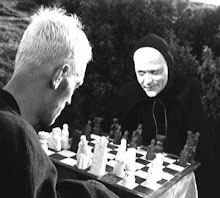
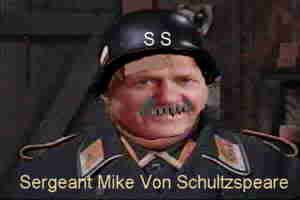
Starship Troopers, Inc.
Contrarian readings of literary classics--whether Hemingway or RA Heinlein--often may be more informative, or, at the very least, more entertaining than the usual hagiographic type of analysis common to the lit. professor. The literary contrarian, at least one of a skeptical rather than dogmatic nature, generally begins with the realization, as did that great contrarian Bertrand Russell, that literature is never to be mistaken for Truth itself, whether that flavor of Truth be historical, scientific, or logical; whatever "Hamlet" is, neither the play nor the character has the same, as they say, ontological status in reality as the facts pertaining to the life of a Nero or a Napoleon.
Since literature--specifically fiction--does not really point at facts as say a history --or biology-- text does, one might ask what precisely is a literary narrative. Of course many varied answers might be given: it's an art-form, akin to say a musical composition, with metaphors intended to demonstrate something about human existence, or the narrative suggests something about psychology, or it’s a tale about Oppression, or in the case of science fiction, the narrative concerns technology, and perhaps the political consequences of applied technology. Literary types indeed specialize in extracting codes from literary texts: whether they are obvious or not, and with a writer such as Robert Heinlein, the code seems fairly detectable--though that is not necessarily a fault in a writer.
Heinlein's fictional code is not so innovative; RAH himself admitted he wrote for money (he was, granted, fairly qualified to write on scientific topics, given his experience in the Navy, and his studies in mathematics--for a semester or two, at least--at UCLA). One might term the
Heinleinian code militaristic-stoical, but there is more to it than that--a valuing of science
and mathematics, along with the Semper Fidelis trumpet blast: imagine a Marcus
Aurelius who spins partial differentials, and also pilots spacecraft, and leads a platoon against "The Bugs." (Lucas's Hans Solo a rather Heinleinian sort of icon as well, tho' perhaps a bit too capricious compared to the iron-willed Heinleinian officer).
Starship Troopers, both the novel and the film adaptation, reveals much of the Heinleinian code (tho' one might grant RAH softened a bit later, with say Time Enough for Love--yet RAH's anti-pacifist address to the cadets in Annapolis in '73, as well as comments in favor of the US
presence in the Vietnam War and in support of Reagan’s Star Wars dreams might indicate otherwise). ST features a fairly complicated if somewhat pulpish plot; the movie sort of ramped up the original pulp vision (some might say improved upon it). Apart from the narrative details, the pronouncements of one-armed Lieutenant Colonel Jean V. Dubois are often read as Heinlein himself speaking. Dubois is the protagonist Johnny Rico's high school instructor in History and Moral Philosophy. Indeed, compared to some action-packed sci-fi, the novel ST features quite a bit of dialogue concerning moral and political themes, and the shortcomings of democracy; and there are some who have interpreted Starship Troopers as somewhat fascistic, which is certainly not an impossible reading. Like many conservative writers attacking democracy, Dubois-Heinlein insists on the necessity of individual sacrifice--and the masses are generally held to be of quite less importance than the heroic officer-scientist. The novel--though it's been some years since last perusal--though hardly reaches a Mein Kampf level of exterminator prayer: Rico himself is a Filipino--there is a somewhat Americanist-like suggestion of meritocracy; that is, if Johnny Rico himself masters those partial derivatives and his flight training, as well as, presumably, his Latin Gradus Ad Parnassum via Marcus Aurelius, he too will join the elite. But the Terran Federation of ST is a police state of sorts, or at least a society ruled by the military: only those citizens willing to serve their society by enlisting for two years of Federal Service are really "free."
This sort of Grunt-worship is a common enough theme in sci-fi and popular culture: the Soldier as Everyman--and the non-soldier as schlemiel, more or less. For Heinlein the soldier of course is not merely a grunt (as he is say for most Hollywood war epics, or say Hemingway's stories--tho' Krebs in Soldier’s Home is a fairly bright if shell-shocked chap); Grunt is a
quantum physicist, expert pilot AND soldier: a yankee Uebermensch of
sorts--and RAH's one-time pal and partner in El Lay diablerie, L-Ron, Big Daddy of Scientology, also not far from that "Social Darwinism with integrals" perspective.
The popular success of both RAH's novel and the film adaptation years
later should not surprise us. (there are, of course, more than a few Heinlein fans who have objected to Verhoeven's Starship Troopers Movie ) The code appeals to most Americans--old or young; and the film version demonstrates that the cast can be made more multicultural and sexxay (perhaps there are others who might agree the high point of the flick was Denise Richards showing her tits), and the code remains intact--and of perennial interest and marketability.
Thursday, November 30, 2006

Monday, November 27, 2006

Saturday, November 25, 2006
Kid Galilee at the University of Chi-town? Say it ain't so
Ipsa quidem virtus pretium sibi
Rawls if not Hobbes and the utilitarians begin with an acknowledgment of ethical relativism; or, shall we say, instead of theology or Platonism (or the Marxist state), utilitarians and contractualists proceed from a secular and naturalist perspective based on individual needs and desires. The point is to overcome the relativism by something other than making obvious "pragmaticist" points such as "Ethical principles vary from society to society," or "the law of gravity seems substantially different than a statement about ethics."
There are problems with the utilitarian tradition, of course: if 25% of the population of the state of, er, Gonzalopolis were illegal immigrants from Tazmania, and they were committing the great majority of crimes (and say getting away with it, usually), liquidating the Tazmanians as a whole would produce a greater good for the rest of the State (and perhaps would be lent support by an Off the Tasmanian proposition on the Gonzalopolis Ballot), yet that would hardly be considered Just. That'a bit obvious, but anyone arguing for a non-objective, ethics-by-consensus (or say ethics as Wittgensteinian language game, multiculturalism etc.) perspective runs into that problem. Nonetheless, utilitarian considerations--consequentialism, in other words--apply to most political or ethical decisions, especially at the macro level. Who would deny that in many if not most circumstances that a possible act or policy decision--at either personal level or political -- must be assessed in regards to the possible effects entailed by implementing the proposed policy? ( environmental concerns--say regarding cattle , or petroleum---would hardly seem capable of being put into a pure "deontological" framework). But consequentialism doesn't appear to work in ALL circumstances (i.e. Justice), and consequentialism could possibly be injust in certain situations (a tyranny of the majority etc.). And justifying egalitarianism, or perhaps denying it--does not seem to be purely a matter of consequentialism (Hobbes assumes some degree of egalitarianism as a given, and Rawls seems to suggest that is the rational choice).
Consider this situation: Somebody has raped Mrs. Higginsbottham at the mall--. The town is up in arms. Vigilante squads form: and yet no one is found matching her description. After a few months, the cops locate a bum, X, who vaguely looks like the suspect, but who is in fact innocent (say he has a criminal record as well). They arrest X and the DA files charges against him, and put him up for trial; X doesn't have much cash, and he takes the public defender and the jury finds him guilty. (Or imagine more sinister scenarios--falsified evidence, etc.--not uncommon). The townspeople are relieved; the newpaper features the bum as Hannibal Lector du jour etc. X's off to Pelican Bay.
What can the ethical relativist/hedonist or anti-foundationalist really say about this? More pleasure was provided to the community by not upholding justice; the "facts" of the matter it could be argued were shaped for a good purpose; it was more useful to deny the truth (doesn't "use" have something to do with effects, and effects with pleasure/satisfaction, yada yada yada), put away the innocent, then it was to allow the evil to go unpunished. Regardless of the amount of pleasure or satisfaction provided, however, the injustice of the DA's actions is not simply a matter of what a majority of people would say about it (in other words, if the majority of a town voted in a rule in effect claiming that "it's ok to put away the innocent when it's good for the community," that would still be injust--thus a Justice "universal" seems to hold apart from individual opinion/choice).
Related to the problems of ethical relativism is Hume's celebrated dictum that one cannot derive an "ought from an is." (the fact/value distinction). There have been arguments offered against Hume's skeptical chestnut. One of Rorty's mentors, Gewirth, argued for a rationalist ethics which he felt was sufficient to overturn the Humean/util./hedonist school. Gewirth's argument is quite convincing, though it's probably not so appealing to literary hepcats, nor to Starship Troopers of the USA, nor to postmods: his argument is based on what sorts of rights (or a freedom from being constrained) any rational agent claims--and values-- simply by being an agent. Most normal humans value a "right" of some sort--or at least the absence of constraints and limitations--to pursue and attain their economic/biological/social needs and requirements (say, like, education, employment, a mate etc). Thus it's reasonable to assume other normal human agents value their own freedom to attain their ends as well; indeed, Gewirth argues that's its necessary for people to do so (though one could imagine various Malthusian/anarchistic scenarios where that identity is erased). There may be ways to counter Gewirth, but there does seem to be a "moral fact" involved in an agent's own pursuit of the goods and resources needed to sustain his own life, and his own valuing of his freedom to act--and it's not a great stretch to see that other agents also need (and value) the same freedom to pursue their own ends, and that agent X is obligated to recognize agent Y's own entitlement as it were, given a sort of human-identity criteria--and Gewirth's rational ethics are not too distant from Kant's imperative (though Kant's arguments leave something to be desired), nor so different from J.C. AKA Kid Galilee's injunction, in that old collection of poesy, the Beatitudes: "do unto others as you would have them do unto you, man." During a war-- or a Katrina--or for a Pol Pot or Nuremberg trial, it might be difficult to uphold such a view, and marxists or mafiosi would probably object; at the very least, Gewirth put Master Hume in check.
Rawls offers another method for getting around the fact/value issue, related to Hobbes: asked to choose a society (and with a high probability of living in the world he chooses), one would probably choose various policies (or Hobbes' covenants) which are more or less "just" in conventional terms (say, to honor contracts/promises): that one should honor the contracts one consents to does seem to be a "fact" of civil society (and justifiable on utilitarian grounds as well)--most rational humans would choose to live in a society where their contracts were honored (that's a simplication, but will suffice for a blog post).
Thus there are various ways to get around Hume (and utilitarianism, instrumentalism--which may owe something to Hume--and amoralism), however quaint or moralistic or tendentious they appear. (and one might say there is a determinist--naturalist ala Darwin--if not Nietzsche and BF Skinner--perspective denying ethics of any sort--or at least those based on agency or choice). If one simply takes the Humean dictum--or say a pure egoism-- as faith (and many humans--even ones in philosophy departments--obviously do take amoral hedonism or machiavellianism as an item of faith) then, well, it is as pointless to discuss the issue, as it would be to discuss religion with a fundamentalist Xtian or mooslim. Of course, the Machiavellian-Aristotelian school (and Nietzsche also not far from a sort of updating of the Nichomachean Ethics) cares little for any sort of axiomatic ethics, deontological, contractural or otherwise; and in a very real sense, most American institutions--whether education, business, bureaucracy, journalism--uphold that vaguely stoical and nationalistic "force-policy" to some degree, and one doesn't have to empathize with some fancy French deconstructionists to perceive that. And even a hip Stanford-like pragmatist--or literatteur-- probably prefers some flavor of Machiavelli to, like, Kant's imperative, "Act as if every act was a maxim to be applied to all."
Ipsa quidem virtus pretium sibi
Rawls if not Hobbes and the utilitarians begin with an acknowledgment of ethical relativism; or, shall we say, instead of theology or Platonism (or the Marxist state), utilitarians and contractualists proceed from a secular and naturalist perspective based on individual needs and desires. The point is to overcome the relativism by something other than making obvious "pragmaticist" points such as "Ethical principles vary from society to society," or "the law of gravity seems substantially different than a statement about ethics."
There are problems with the utilitarian tradition, of course: if 25% of the population of the state of, er, Gonzalopolis were illegal immigrants from Tazmania, and they were committing the great majority of crimes (and say getting away with it, usually), liquidating the Tazmanians as a whole would produce a greater good for the rest of the State (and perhaps would be lent support by an Off the Tasmanian proposition on the Gonzalopolis Ballot), yet that would hardly be considered Just. That'a bit obvious, but anyone arguing for a non-objective, ethics-by-consensus (or say ethics as Wittgensteinian language game, multiculturalism etc.) perspective runs into that problem. Nonetheless, utilitarian considerations--consequentialism, in other words--apply to most political or ethical decisions, especially at the macro level. Who would deny that in many if not most circumstances that a possible act or policy decision--at either personal level or political -- must be assessed in regards to the possible effects entailed by implementing the proposed policy? ( environmental concerns--say regarding cattle , or petroleum---would hardly seem capable of being put into a pure "deontological" framework). But consequentialism doesn't appear to work in ALL circumstances (i.e. Justice), and consequentialism could possibly be injust in certain situations (a tyranny of the majority etc.). And justifying egalitarianism, or perhaps denying it--does not seem to be purely a matter of consequentialism (Hobbes assumes some degree of egalitarianism as a given, and Rawls seems to suggest that is the rational choice).
Consider this situation: Somebody has raped Mrs. Higginsbottham at the mall--. The town is up in arms. Vigilante squads form: and yet no one is found matching her description. After a few months, the cops locate a bum, X, who vaguely looks like the suspect, but who is in fact innocent (say he has a criminal record as well). They arrest X and the DA files charges against him, and put him up for trial; X doesn't have much cash, and he takes the public defender and the jury finds him guilty. (Or imagine more sinister scenarios--falsified evidence, etc.--not uncommon). The townspeople are relieved; the newpaper features the bum as Hannibal Lector du jour etc. X's off to Pelican Bay.
What can the ethical relativist/hedonist or anti-foundationalist really say about this? More pleasure was provided to the community by not upholding justice; the "facts" of the matter it could be argued were shaped for a good purpose; it was more useful to deny the truth (doesn't "use" have something to do with effects, and effects with pleasure/satisfaction, yada yada yada), put away the innocent, then it was to allow the evil to go unpunished. Regardless of the amount of pleasure or satisfaction provided, however, the injustice of the DA's actions is not simply a matter of what a majority of people would say about it (in other words, if the majority of a town voted in a rule in effect claiming that "it's ok to put away the innocent when it's good for the community," that would still be injust--thus a Justice "universal" seems to hold apart from individual opinion/choice).
Related to the problems of ethical relativism is Hume's celebrated dictum that one cannot derive an "ought from an is." (the fact/value distinction). There have been arguments offered against Hume's skeptical chestnut. One of Rorty's mentors, Gewirth, argued for a rationalist ethics which he felt was sufficient to overturn the Humean/util./hedonist school. Gewirth's argument is quite convincing, though it's probably not so appealing to literary hepcats, nor to Starship Troopers of the USA, nor to postmods: his argument is based on what sorts of rights (or a freedom from being constrained) any rational agent claims--and values-- simply by being an agent. Most normal humans value a "right" of some sort--or at least the absence of constraints and limitations--to pursue and attain their economic/biological/social needs and requirements (say, like, education, employment, a mate etc). Thus it's reasonable to assume other normal human agents value their own freedom to attain their ends as well; indeed, Gewirth argues that's its necessary for people to do so (though one could imagine various Malthusian/anarchistic scenarios where that identity is erased). There may be ways to counter Gewirth, but there does seem to be a "moral fact" involved in an agent's own pursuit of the goods and resources needed to sustain his own life, and his own valuing of his freedom to act--and it's not a great stretch to see that other agents also need (and value) the same freedom to pursue their own ends, and that agent X is obligated to recognize agent Y's own entitlement as it were, given a sort of human-identity criteria--and Gewirth's rational ethics are not too distant from Kant's imperative (though Kant's arguments leave something to be desired), nor so different from J.C. AKA Kid Galilee's injunction, in that old collection of poesy, the Beatitudes: "do unto others as you would have them do unto you, man." During a war-- or a Katrina--or for a Pol Pot or Nuremberg trial, it might be difficult to uphold such a view, and marxists or mafiosi would probably object; at the very least, Gewirth put Master Hume in check.
Rawls offers another method for getting around the fact/value issue, related to Hobbes: asked to choose a society (and with a high probability of living in the world he chooses), one would probably choose various policies (or Hobbes' covenants) which are more or less "just" in conventional terms (say, to honor contracts/promises): that one should honor the contracts one consents to does seem to be a "fact" of civil society (and justifiable on utilitarian grounds as well)--most rational humans would choose to live in a society where their contracts were honored (that's a simplication, but will suffice for a blog post).
Thus there are various ways to get around Hume (and utilitarianism, instrumentalism--which may owe something to Hume--and amoralism), however quaint or moralistic or tendentious they appear. (and one might say there is a determinist--naturalist ala Darwin--if not Nietzsche and BF Skinner--perspective denying ethics of any sort--or at least those based on agency or choice). If one simply takes the Humean dictum--or say a pure egoism-- as faith (and many humans--even ones in philosophy departments--obviously do take amoral hedonism or machiavellianism as an item of faith) then, well, it is as pointless to discuss the issue, as it would be to discuss religion with a fundamentalist Xtian or mooslim. Of course, the Machiavellian-Aristotelian school (and Nietzsche also not far from a sort of updating of the Nichomachean Ethics) cares little for any sort of axiomatic ethics, deontological, contractural or otherwise; and in a very real sense, most American institutions--whether education, business, bureaucracy, journalism--uphold that vaguely stoical and nationalistic "force-policy" to some degree, and one doesn't have to empathize with some fancy French deconstructionists to perceive that. And even a hip Stanford-like pragmatist--or literatteur-- probably prefers some flavor of Machiavelli to, like, Kant's imperative, "Act as if every act was a maxim to be applied to all."
Friday, November 24, 2006

Wednesday, November 22, 2006

Monday, November 20, 2006
Victor "Doc" Laxateur: Royal Nonesuch, Emeritus
Cal Skank, in conjunction with La Iglesia Catolica de Kern, Inc. is proud to announce that this year's Lifetime MENDACITY Award has gone to Victor "Doc" Laxateur, a Cal Skank English professor and lay priest who has, in the words of Dr. Hector Cabronando, director of the CSU Ad Hoc Committee on CA Literature and Bureaucratic Support Services, "done good work in furthering the cause of Catholic bureaucracy and Truth at CSUK, the Peoples' College of Kern." Doc Laxateur was especially known for his ability to teach the masterpieces of American literature from a Catholic perspective: indeed, as one former Cal Skank student, LaSheequa Johnson, claims, "Doc Laxateur showed me that a writer like Mark Twain was not just another dead cracker, and Doc L. also took the time to explain the details of the ROYAL NONESUCH to me. He keeps it real for the peeps." Doc Laxateur's lifetime companion, Steven "Canberra" Cartier, was awarded the ROYAL NONESUCH in 1998 for his contributions to California bureaucracy.
A celebration of Doc Laxateur's lifetime MENDACITY achievement award is scheduled for May 23 at Nuestra Señora de Guadalupe Banquet Hall and Bingo Parlor, with notable CSUK Professors Mike and Kim Assclown also scheduled guests.
Cal Skank, in conjunction with La Iglesia Catolica de Kern, Inc. is proud to announce that this year's Lifetime MENDACITY Award has gone to Victor "Doc" Laxateur, a Cal Skank English professor and lay priest who has, in the words of Dr. Hector Cabronando, director of the CSU Ad Hoc Committee on CA Literature and Bureaucratic Support Services, "done good work in furthering the cause of Catholic bureaucracy and Truth at CSUK, the Peoples' College of Kern." Doc Laxateur was especially known for his ability to teach the masterpieces of American literature from a Catholic perspective: indeed, as one former Cal Skank student, LaSheequa Johnson, claims, "Doc Laxateur showed me that a writer like Mark Twain was not just another dead cracker, and Doc L. also took the time to explain the details of the ROYAL NONESUCH to me. He keeps it real for the peeps." Doc Laxateur's lifetime companion, Steven "Canberra" Cartier, was awarded the ROYAL NONESUCH in 1998 for his contributions to California bureaucracy.
A celebration of Doc Laxateur's lifetime MENDACITY achievement award is scheduled for May 23 at Nuestra Señora de Guadalupe Banquet Hall and Bingo Parlor, with notable CSUK Professors Mike and Kim Assclown also scheduled guests.
Wednesday, November 15, 2006
Hitchens on the flawed reasoning of the Lancet Report
"Make the assumption that some percentage of those killed by the coalition are the sort of people who have been blowing up mosques, beheading captives on video, detonating rush-hour car bombs, destroying pipelines, murdering aid workers, bombing the headquarters of the United Nations, and inciting ethnic and sectarian warfare. Make the allowance for the number of bystanders and innocents who lost their lives in the combat against these fanatics (one or two, alas, in the single case of the precision bombing of Abu Musab al-Zarqawi, just to take one instance). But who is to say how many people were saved from being murdered by the fact that the murderers were killed first?"
Hitchens/Lancet
Hitchens raises an important point about the Lancet report, a point typically disregarded by the Mommycrats of blogland: only about 1/3 of the casualties estimated (but not proven) by the Lancet crew are attributable to US/Brit. forces. Hitchens also alludes to the fact that Dr. Richard Horton, the editor of the Lancet magazine, is "a full-throated speaker at rallies of the Islamist-Leftist alliance that makes up the British Stop the War Coalition." That a marxist-muslim might have an interest in exaggerating (or "skewing" the data, as the stats people say) the number of deaths and showing the US/Brit. forces in a poor light should not be surprising: like fundamentalists of all types (Islamic or Christian), most marxists have no problem bending the truth when necessary to suit their needs. The Lancet "methodology" was based not on verified deaths, anyway; instead the researchers counted the deaths in a few urban areas in Iraq, and then, merely by analogy, extended the death ratio to other areas, where they did not perform any research. This is known as "cluster" sampling, and there are more than a few researchers who have expressed doubts about the accuracy of the results.
"Make the assumption that some percentage of those killed by the coalition are the sort of people who have been blowing up mosques, beheading captives on video, detonating rush-hour car bombs, destroying pipelines, murdering aid workers, bombing the headquarters of the United Nations, and inciting ethnic and sectarian warfare. Make the allowance for the number of bystanders and innocents who lost their lives in the combat against these fanatics (one or two, alas, in the single case of the precision bombing of Abu Musab al-Zarqawi, just to take one instance). But who is to say how many people were saved from being murdered by the fact that the murderers were killed first?"
Hitchens/Lancet
Hitchens raises an important point about the Lancet report, a point typically disregarded by the Mommycrats of blogland: only about 1/3 of the casualties estimated (but not proven) by the Lancet crew are attributable to US/Brit. forces. Hitchens also alludes to the fact that Dr. Richard Horton, the editor of the Lancet magazine, is "a full-throated speaker at rallies of the Islamist-Leftist alliance that makes up the British Stop the War Coalition." That a marxist-muslim might have an interest in exaggerating (or "skewing" the data, as the stats people say) the number of deaths and showing the US/Brit. forces in a poor light should not be surprising: like fundamentalists of all types (Islamic or Christian), most marxists have no problem bending the truth when necessary to suit their needs. The Lancet "methodology" was based not on verified deaths, anyway; instead the researchers counted the deaths in a few urban areas in Iraq, and then, merely by analogy, extended the death ratio to other areas, where they did not perform any research. This is known as "cluster" sampling, and there are more than a few researchers who have expressed doubts about the accuracy of the results.
Monday, November 13, 2006

Saturday, November 04, 2006
Quine's Two Dogmas of Empiricism
Quine's Two Dogmas of Empiricism appears on my reading list about once every 6 months. I admit to my dilettante status in regards to these matters, but Quine seems so concerned with semantic issues that he overlooks other analytical issues. Those regular consumers of Contingencies who care about such things might recall that the analytic/synthetic divide originates with Kant:
"Either (1) the predicate B belongs to the subject A as something that is (covertly) contained in this concept A; or (2) B lies entirely outside the concept A, though to be sure it stands in connection with it. In the first case, I call the judgment analytic, in the second synthetic."
Two examples which show the difference to some degree:
"Lawyers are attorneys" is 1 (analytic--synonymous in broad sense)
"Lawyers are professionals" is 2 (synthetic--or empirical in broad sense)
Quine denied the distinction. But there's more to it, it would seem. For instance, are logical connectives to be defined synthetically--Is the premise of an argument no different than the conclusion? Obviously the end result of a derivation or deductive argument is not the same as confirming a premise: and defining a variable is not the same as say putting some variable into a function and getting a result.
There is a difference-- fairly important difference--between working towards a deductive truth via equations, functions, reductio ad absurdum, etc., and, on the other hand, establishing "truth" via empirical confirmation, whether in a chemistry lab or economics research paper. But specifying the cash value of analyticity is not so easy. Even a hard-core materialist or behaviorist, say like Skinner, needs to establish his own ontology, and thus needs to know what he is attacking. If you do deny analyticity and really platonic realism and "mind" it does seem that a Darwinian meat popsicle view of human nature follows, or at least is much more plausible.
So, in effect, we are not completely sure what Quine's removal of the analytical/syntheic divide "entails" as the good Panglosses say. Is it just semantic and linguistic--that "meaning" (or reference) must proceed by synthetic means (observation, really)? I follow his linguistics to a degree: the definitions of words are always changing (if not ostensible in many cases), thus it is not impossible that "lawyers are attorneys" (analytic) may be, eventually, as synthetic as say a "lawyers are corrupt."
Quine's Two Dogmas of Empiricism appears on my reading list about once every 6 months. I admit to my dilettante status in regards to these matters, but Quine seems so concerned with semantic issues that he overlooks other analytical issues. Those regular consumers of Contingencies who care about such things might recall that the analytic/synthetic divide originates with Kant:
"Either (1) the predicate B belongs to the subject A as something that is (covertly) contained in this concept A; or (2) B lies entirely outside the concept A, though to be sure it stands in connection with it. In the first case, I call the judgment analytic, in the second synthetic."
Two examples which show the difference to some degree:
"Lawyers are attorneys" is 1 (analytic--synonymous in broad sense)
"Lawyers are professionals" is 2 (synthetic--or empirical in broad sense)
Quine denied the distinction. But there's more to it, it would seem. For instance, are logical connectives to be defined synthetically--Is the premise of an argument no different than the conclusion? Obviously the end result of a derivation or deductive argument is not the same as confirming a premise: and defining a variable is not the same as say putting some variable into a function and getting a result.
There is a difference-- fairly important difference--between working towards a deductive truth via equations, functions, reductio ad absurdum, etc., and, on the other hand, establishing "truth" via empirical confirmation, whether in a chemistry lab or economics research paper. But specifying the cash value of analyticity is not so easy. Even a hard-core materialist or behaviorist, say like Skinner, needs to establish his own ontology, and thus needs to know what he is attacking. If you do deny analyticity and really platonic realism and "mind" it does seem that a Darwinian meat popsicle view of human nature follows, or at least is much more plausible.
So, in effect, we are not completely sure what Quine's removal of the analytical/syntheic divide "entails" as the good Panglosses say. Is it just semantic and linguistic--that "meaning" (or reference) must proceed by synthetic means (observation, really)? I follow his linguistics to a degree: the definitions of words are always changing (if not ostensible in many cases), thus it is not impossible that "lawyers are attorneys" (analytic) may be, eventually, as synthetic as say a "lawyers are corrupt."
Thursday, November 02, 2006
Humiliation Incorporated
"Democrats" who make use of the same cutthroat tactics that the right-wing GOPers do--character attacks, scandal mongering, the usual snickering sexual insinuations, etc.--in effect defeat their own cause. Foleygate amply demonstrated that machiavellian aspect of new-school liberals who will do nearly anything to tarnish the other side. Instead of hammering on BushCo for, say, possible lies or misrepresentations about intelligence regarding WMDs or the "safe haven", many liberals now seem preoccupied with getting the dirt on someone from the opposing side. That sort of ID politics is not merely juvenile but an inverted sunday school morality itself--one might call it Norma Raeism. Marxists themselves are often as capable of a sort of do-gooder morality as nauseating as that of dixie biblethumpers.
Foleygate was mostly a non-issue, except for the hysterical sort of soccer mommy common to Kos or DU or TeeVee (or this clown's site ). OK Yeah he's slimy etc. but Foley wasn't even charged with a crime. However unsavory, he could have done what he allegedly did in Toronto legally. Whether Bush and Co. lied about or greatly misrepresented intelligence data regarding Iraqi WMDs or the "safe haven" idea: that's a f-n issue. Whether Lay and Enron or other energy powerbrokers met with Schwarzenegger and somehow arranged the Recall: another case. Some of the more bizarre aspects of 9-11--the crash into the Pentagon especially: that's a case. Possible vote fraud in Florida 2000: a case.
In the Brave New World of Media, Inc. anyone suspected of a crime or moral failing is found guilty as soon as his face appears online or on TeeVee: bada bing, Public Enemy #1. And Mommycrat hypocrites deny the presumption of innocence clause to suspects nearly as often as conservatives do....even fundie morons such as the Colorado preacher Haggard have a right to a fair trial. And Haggardgate has the makings of another pseudo-scandal which will play well with liberal pundits and populist muckrakers who have yet to realize that a Feinstein or Hillary are to the right of most hick conservatives.
"Democrats" who make use of the same cutthroat tactics that the right-wing GOPers do--character attacks, scandal mongering, the usual snickering sexual insinuations, etc.--in effect defeat their own cause. Foleygate amply demonstrated that machiavellian aspect of new-school liberals who will do nearly anything to tarnish the other side. Instead of hammering on BushCo for, say, possible lies or misrepresentations about intelligence regarding WMDs or the "safe haven", many liberals now seem preoccupied with getting the dirt on someone from the opposing side. That sort of ID politics is not merely juvenile but an inverted sunday school morality itself--one might call it Norma Raeism. Marxists themselves are often as capable of a sort of do-gooder morality as nauseating as that of dixie biblethumpers.
Foleygate was mostly a non-issue, except for the hysterical sort of soccer mommy common to Kos or DU or TeeVee (or this clown's site ). OK Yeah he's slimy etc. but Foley wasn't even charged with a crime. However unsavory, he could have done what he allegedly did in Toronto legally. Whether Bush and Co. lied about or greatly misrepresented intelligence data regarding Iraqi WMDs or the "safe haven" idea: that's a f-n issue. Whether Lay and Enron or other energy powerbrokers met with Schwarzenegger and somehow arranged the Recall: another case. Some of the more bizarre aspects of 9-11--the crash into the Pentagon especially: that's a case. Possible vote fraud in Florida 2000: a case.
In the Brave New World of Media, Inc. anyone suspected of a crime or moral failing is found guilty as soon as his face appears online or on TeeVee: bada bing, Public Enemy #1. And Mommycrat hypocrites deny the presumption of innocence clause to suspects nearly as often as conservatives do....even fundie morons such as the Colorado preacher Haggard have a right to a fair trial. And Haggardgate has the makings of another pseudo-scandal which will play well with liberal pundits and populist muckrakers who have yet to realize that a Feinstein or Hillary are to the right of most hick conservatives.
Sunday, October 15, 2006
All-American Mobster
More than a few reporters and journalists have suggested that many celebrated pro athletes–including All-American heroes such as Joe DiMaggio–had dealings with the Mafia which were unknown to the public at large. In 2000 Richard Ben Cramer published a book in which he claimed that DiMaggio, the "Yankee Clipper" and one-time husband of Marilyn Monroe (herself suspected of Mob ties), had a connection to the Mafia via Frank Costello, a mobster fairly well-known to anyone who has read a bit about the real history of La Cosa Nostra (and the Five-Points gang, specifically). Costello at one time apparently functioned as Dimaggio's "financial advisor": "Dimaggio was able to walk away from baseball and his $100,000-a-year salary with the Yankees in 1951 because mobster Frank Costello had set up a "trust fund" at the Bowery Bank for him."
To some sentimental fans of pro baseball, this information might be troubling –in fact, Ben Cramer was subject to numerous personal insults and attacks when his book on DiMaggio appeared; yet to other, more cynical sports connoissieurs–say those familiar with the facts surrounding the mobster-rigged World Series of 1919 (John Sayles' film "Eight Men Out" does a decent job in presenting the broad details of the "thrown" series)–evidence suggesting that the Yankee Clipper associated with a big-time mobster such as Frank Costello–AKA "the Prime Minister" of Murder, Inc.–was probably not too alarming or unexpected.
Indeed, it could be argued quite convincingly that an athlete's shadowy associations to organized crime figures, to mobsters or gangster mollies- –or the contemporary athlete's association to drugs, drug dealers, or prostitutes–may provide part of the allure of the game for many consumers of the athletic spectacle. Pro athletes are not merely superb specimens of physical conditioning and discipline; they are America's official par-tay boys, with high-powered actors and actresses watching them at bat, running up and down the gridiron, shooting hoops; and various corporations (the corporate execs themselves sort of the sugar-daddies behind the scenes) paying millions to sell beer or razors during the ad-breaks of the Gladiator-fests. Baseball, or Beer; bimbos or organized crime: it's all part of the Sports, Inc. show.
More than a few reporters and journalists have suggested that many celebrated pro athletes–including All-American heroes such as Joe DiMaggio–had dealings with the Mafia which were unknown to the public at large. In 2000 Richard Ben Cramer published a book in which he claimed that DiMaggio, the "Yankee Clipper" and one-time husband of Marilyn Monroe (herself suspected of Mob ties), had a connection to the Mafia via Frank Costello, a mobster fairly well-known to anyone who has read a bit about the real history of La Cosa Nostra (and the Five-Points gang, specifically). Costello at one time apparently functioned as Dimaggio's "financial advisor": "Dimaggio was able to walk away from baseball and his $100,000-a-year salary with the Yankees in 1951 because mobster Frank Costello had set up a "trust fund" at the Bowery Bank for him."
To some sentimental fans of pro baseball, this information might be troubling –in fact, Ben Cramer was subject to numerous personal insults and attacks when his book on DiMaggio appeared; yet to other, more cynical sports connoissieurs–say those familiar with the facts surrounding the mobster-rigged World Series of 1919 (John Sayles' film "Eight Men Out" does a decent job in presenting the broad details of the "thrown" series)–evidence suggesting that the Yankee Clipper associated with a big-time mobster such as Frank Costello–AKA "the Prime Minister" of Murder, Inc.–was probably not too alarming or unexpected.
Indeed, it could be argued quite convincingly that an athlete's shadowy associations to organized crime figures, to mobsters or gangster mollies- –or the contemporary athlete's association to drugs, drug dealers, or prostitutes–may provide part of the allure of the game for many consumers of the athletic spectacle. Pro athletes are not merely superb specimens of physical conditioning and discipline; they are America's official par-tay boys, with high-powered actors and actresses watching them at bat, running up and down the gridiron, shooting hoops; and various corporations (the corporate execs themselves sort of the sugar-daddies behind the scenes) paying millions to sell beer or razors during the ad-breaks of the Gladiator-fests. Baseball, or Beer; bimbos or organized crime: it's all part of the Sports, Inc. show.
Sunday, October 08, 2006

Saturday, September 30, 2006
Zizek, perhaps
"Zizek explores how an ideological edifice is sustained by underground transgressions: "Law can be sustained only by a sovereign power which reserves for itself the right... to suspend the rule of law(s) on behalf of the Law itself.""
The Zizekian bon mot regarding sovereignity does not seem entirely off-topic in regards to the present torture bill: the sovereign as Law-enforcer, whether judicial or clerical (i.e. the Catholic Church, Inc.), assumes for itself the monarchical right to enforce laws and codes (which were never agreed to via an egalitarian, social contract), but grant itself whatever exemptions it needs, at least in potentia--the judge or priest pedophile/adulterer; a Scalia enforcing theocracy [state approved displays of Decalogue, etc.], and then watching porno. (An undergraduate yippie-in-training shrieks "Hypocrisy", but Z. suggests the judicial/clerical sovereign's Janus face is a bit more subtle and detailed than the sentimental liberal might believe). The legal sovereign may also at any time view any code as provisional, regardless of possible infringement of presumed contractural rights: at once upholding the liberal's feel-good concept of "due process" and then modifying/denying its "scope" when necessary. (Zizek, like many a empirically-minded Hegelian, really addressing issues similar to those raised by Hobbes in Leviathan--if not a Platonic dialogue somewhere).
One might ask, though, how the Marxist-statist argues in favor of retaining Habeas Corpus laws at all: from a purely statist viewpoint, the ruling would be (if Congress were comprised of hip leftists) thought to be quite acceptable, HC being the remnants of a liberal entitlement based on decadent views of the individual. The statists and Zizekians objecting to the torture bill (and it should be objected to) are showing their own janus-face: Lenin had no problem ending due process not merely for the aristos but for anyone who posed a threat to bolshevik power: the bipolarity of the sovereign reveals itself either in fascist/monarchy or communism.
Thursday, September 28, 2006
The "Creeping Threat of Jihadism"
Mr. Hitchens in the house again. He's is one of the few western journalists willing to fight the zealots, be they dixie Xtians, mafioso-like Catolicos, or wild-eyed muslim fanatics. Hitchens takes some getting used to, but he's generally correct, and the representative of a moderate secularism based , one might say, on Enlightenment principles. And he's the possessor of a fairly wicked Swiftian prose style as well.
"As a journalist Mr. Hitchens extensively covered the Bosnian war and the Gulf War, yet describes 9/11 as "an exhilarating moment" because it crystallized his views. "Everything I hate is on one side, and everything I love is on the other. I'm never going to get bored with this."
What does he hate?
"Religion. I quite simply identify it with barbarism and backwardness and human stupidity. The methods of theocracy in action are a cult of death." The jihadists, he says, "say they love death more than we love life, and we have to prove that wrong. They're right on the first; they love murder, in which they exult, and suicide, in which they take pride." Osama bin Laden and al-Qaeda, he says, want to turn the Islamic world back to the seventh century and take the West with them. "Opposed to these and hated by them is scientific inquiry and philosophical inquiry, the emancipation of women, the secular state, and other very hard-won achievements of civilization. And it's good to be reminded they are fragile, they can be destroyed. We can be pushed back into the childhood of our species again."
Turning back clocks doesn't interest Mr. Hitchens, who began his political life as a member of the British Labor Party and joined a Marxist faction even before arriving at Oxford to push revolution in the turmoil of 1968. "The promises of the '60s came true in 1989—in exactly the way we would not have imagined," he notes. The Cold War and leftist politics left him drained, he says, by the mid-'70s, and by the fall of the Berlin Wall he was ready for something "kind of banal, like how to bring together a market economy and democratic society." When the Cold War ended, he wanted to go back to writing about literature, not dreaming that the so-called peace dividend, by his calculation, was to last "only about 150 days."
When Saddam Hussein invaded Kuwait and Slobodan Milosevic tried to annex all of Yugoslavia into a greater Serbia, Mr. Hitchens says, "I found myself in Sarajevo. And I found myself in northern Iraq in Kurdistan. Seeing people who'd been gassed, people who were still dying from Saddam's brutality . . . some I met were old comrades, but it was a pretty plain new enemy we had." The reality that totalitarian dictatorships like those in Iraq and Serbia could continue into the post--Cold War era hit him hard. "You may think you can give up politics but you can't, it won't give you up. Politics will come and find you." And the trials, at the same time, of his close friend, author Salman Rushdie, made him aware of the creeping threat of jihadism."
Saturday, September 16, 2006
Ethical ruminations
How may ethics be justified given a non-theological, naturalist ontology? That sounds fairly obvious, but I suggest it is more problematic than many realize; and I tend to share the views of the later Freud in so far as he suggests violence, sadism, "thanatos" and unethical acts are really the norm (even within civilized society--ie. WWI and WWII), and that ethics/morality are generally exceptions, and typically done in furtherance of "eros." It's more complex than that, but a text such as Civ. and its Discontents in some way as valuable to "meta-ethics" as are the traditional ethics texts. It would be swell if everyone performed the Kantian imperative routine, consider their potential act in context (as a rule binding on all) and then do the right thing, but they don't: one of the great failures of ethics is assuming that at some point rationality and ethics will coincide. Like Hume, Freud realizes that's mostly unfeasible (as do various machiavellians of left and right).
I would not claim there are any innate ethical tendencies: there are instincts, desires, passions, as Hume says--and Hume not so far from biological determinism and Freudian desire of some sort- and there are thoughts, concepts, ethical beliefs or actions based on, or at least having some relation to those instincts and passions.
In contrast to Humean hedonism, the late ethicist Alan Gewirth attempted to construct an axiomatic formulation of ethics which transcends the mere subjective "desire-based" ethics of Hume and the utilitarians (and Hobbes as well in that school). Gewirth understands that utilitarianism (or simply giving up on rational ethics altogether) in all of its forms easily leads to saying whatever the majority decides on is correct. So there must be some other basis for ethics (or objective rights' claims), than consensus, and for Gewrtih it's a matter of viewing yourself and other human-agents as more or less equals in terms of rights claims: you claim, or at least require, some degree of freedom to pursue your goals and economic necessities; thus you must acknowledge other normal human-agents have the same need for some degree of freedom. Gewirths' Reason and Morality is quite a bit more complex than that, but Gewirth does offer a way out of Hume/utilitarianism, hedonism, and the problems of the cat. Imperative.
That said, the most Gewirth can say then is that selfishness, greed, conservativism, monarchy etc. are inconsistent or possibly irrational; so when you refuse to help the starving family (say in a jungle or forest when they have no other means of support) you are acting irrationally.
Gewirth is arguing for a rational right (yet secular) prior to the construction of society (where Hobbes would say in nature there are no rights or laws or ethics at all). Yes, if measuring socities by that sort of natural right, human history may appear to be a record of various murderous factions which never acknowledged that rational right to economic/social entitlement, but then even catholics often say the same, or postmodernists for that matter. Which is to say, if you yourself claim a right to self-sufficiency (if not requiring economic/biological resources), don't you have to grant that other normal human-agents have the same, or nearly equal right to self-sufficiency and economic/biological resources? It would seem so. I am not sure it is necessary , but quite a cogent argument.
Without clearly defined economic rights and social contracts which are enforced by the sovereign, we are more or less in a Hobbesian state of nature; tho some people do succeed and so forth. Yet Hobbes does hold that once people agree to form covenants and seek peace instead of living in anarchy, participation in the economy is a given: thus I would say Hobbes agrees with Gewirth's agent-identity idea for most part ( tho not completely), once social contracts/covenants have been established--citizens are entitled to more or less equal distribution of resources one of his givens, and indeed one that the Royalists did not admire. Which is to say Leviathan is quite a radical text and not so far from some socialist or marxist theory.
Where or when does this covenant-construction occur Master Hobbes? He's not really suggesting it had occurred: but that it should; that people should, for their own interests, form social contracts and seek peace. Of course that may not happen, and indeed Hobbes raises the spectre of the powerful baron (with his own army, say) who refuses to form any covenants. Yes the other people might have to force him to join, or presumably, eliminate him.
Obviously a marxist (or fascist or Nietzschean for that matter) simply gives up on rights-speak or contracts and suggests the proles revolt, create a non-democratic State and then implement various economic policies. Yet Stalin (or nazi statism) shows what sorts of results are produced from politics which have no basis in rights. That said I do think there may be pragmatic reasons to oppose pure democracy ( or Hobbesianism), but more along the line of neo-behaviorism, if not Plato's Republic, than marx or fascism.
How may ethics be justified given a non-theological, naturalist ontology? That sounds fairly obvious, but I suggest it is more problematic than many realize; and I tend to share the views of the later Freud in so far as he suggests violence, sadism, "thanatos" and unethical acts are really the norm (even within civilized society--ie. WWI and WWII), and that ethics/morality are generally exceptions, and typically done in furtherance of "eros." It's more complex than that, but a text such as Civ. and its Discontents in some way as valuable to "meta-ethics" as are the traditional ethics texts. It would be swell if everyone performed the Kantian imperative routine, consider their potential act in context (as a rule binding on all) and then do the right thing, but they don't: one of the great failures of ethics is assuming that at some point rationality and ethics will coincide. Like Hume, Freud realizes that's mostly unfeasible (as do various machiavellians of left and right).
I would not claim there are any innate ethical tendencies: there are instincts, desires, passions, as Hume says--and Hume not so far from biological determinism and Freudian desire of some sort- and there are thoughts, concepts, ethical beliefs or actions based on, or at least having some relation to those instincts and passions.
In contrast to Humean hedonism, the late ethicist Alan Gewirth attempted to construct an axiomatic formulation of ethics which transcends the mere subjective "desire-based" ethics of Hume and the utilitarians (and Hobbes as well in that school). Gewirth understands that utilitarianism (or simply giving up on rational ethics altogether) in all of its forms easily leads to saying whatever the majority decides on is correct. So there must be some other basis for ethics (or objective rights' claims), than consensus, and for Gewrtih it's a matter of viewing yourself and other human-agents as more or less equals in terms of rights claims: you claim, or at least require, some degree of freedom to pursue your goals and economic necessities; thus you must acknowledge other normal human-agents have the same need for some degree of freedom. Gewirths' Reason and Morality is quite a bit more complex than that, but Gewirth does offer a way out of Hume/utilitarianism, hedonism, and the problems of the cat. Imperative.
That said, the most Gewirth can say then is that selfishness, greed, conservativism, monarchy etc. are inconsistent or possibly irrational; so when you refuse to help the starving family (say in a jungle or forest when they have no other means of support) you are acting irrationally.
Gewirth is arguing for a rational right (yet secular) prior to the construction of society (where Hobbes would say in nature there are no rights or laws or ethics at all). Yes, if measuring socities by that sort of natural right, human history may appear to be a record of various murderous factions which never acknowledged that rational right to economic/social entitlement, but then even catholics often say the same, or postmodernists for that matter. Which is to say, if you yourself claim a right to self-sufficiency (if not requiring economic/biological resources), don't you have to grant that other normal human-agents have the same, or nearly equal right to self-sufficiency and economic/biological resources? It would seem so. I am not sure it is necessary , but quite a cogent argument.
Without clearly defined economic rights and social contracts which are enforced by the sovereign, we are more or less in a Hobbesian state of nature; tho some people do succeed and so forth. Yet Hobbes does hold that once people agree to form covenants and seek peace instead of living in anarchy, participation in the economy is a given: thus I would say Hobbes agrees with Gewirth's agent-identity idea for most part ( tho not completely), once social contracts/covenants have been established--citizens are entitled to more or less equal distribution of resources one of his givens, and indeed one that the Royalists did not admire. Which is to say Leviathan is quite a radical text and not so far from some socialist or marxist theory.
Where or when does this covenant-construction occur Master Hobbes? He's not really suggesting it had occurred: but that it should; that people should, for their own interests, form social contracts and seek peace. Of course that may not happen, and indeed Hobbes raises the spectre of the powerful baron (with his own army, say) who refuses to form any covenants. Yes the other people might have to force him to join, or presumably, eliminate him.
Obviously a marxist (or fascist or Nietzschean for that matter) simply gives up on rights-speak or contracts and suggests the proles revolt, create a non-democratic State and then implement various economic policies. Yet Stalin (or nazi statism) shows what sorts of results are produced from politics which have no basis in rights. That said I do think there may be pragmatic reasons to oppose pure democracy ( or Hobbesianism), but more along the line of neo-behaviorism, if not Plato's Republic, than marx or fascism.
Friday, September 15, 2006
There are ample reasons to object to the Frankfurt School, but Adorno, on occasion, put forth some interesting ideas (however speculative) in regards to commodification, consumerism, and the entertainment business.
"There is nothing left for the consumer to classify. Producers have done it for him. Art for the masses has destroyed the dream but still conforms to the tenets of that dreaming idealism which critical idealism baulked at. Everything derives from consciousness: for Malebranche and Berkeley, from the consciousness of God; in mass art, from the consciousness of the production team. Not only are the hit songs, stars, and soap operas cyclically recurrent and rigidly invariable types, but the specific content of the entertainment itself is derived from them and only appears to change. The details are interchangeable. The short interval sequence which was effective in a hit song, the hero’s momentary fall from grace (which he accepts as good sport), the rough treatment which the beloved gets from the male star, the latter’s rugged defiance of the spoilt heiress, are, like all the other details, ready-made clichés to be slotted in anywhere; they never do anything more than fulfil the purpose allotted them in the overall plan. Their whole raison d’être is to confirm it by being its constituent parts. As soon as the film begins, it is quite clear how it will end, and who will be rewarded, punished, or forgotten. In light music, once the trained ear has heard the first notes of the hit song, it can guess what is coming and feel flattered when it does come. The average length of the short story has to be rigidly adhered to. Even gags, effects, and jokes are calculated like the setting in which they are placed. They are the responsibility of special experts and their narrow range makes it easy for them to be apportioned in the office."
http://www.marxists.org/reference/archive/adorno/1944/culture-industry.htm
"There is nothing left for the consumer to classify. Producers have done it for him. Art for the masses has destroyed the dream but still conforms to the tenets of that dreaming idealism which critical idealism baulked at. Everything derives from consciousness: for Malebranche and Berkeley, from the consciousness of God; in mass art, from the consciousness of the production team. Not only are the hit songs, stars, and soap operas cyclically recurrent and rigidly invariable types, but the specific content of the entertainment itself is derived from them and only appears to change. The details are interchangeable. The short interval sequence which was effective in a hit song, the hero’s momentary fall from grace (which he accepts as good sport), the rough treatment which the beloved gets from the male star, the latter’s rugged defiance of the spoilt heiress, are, like all the other details, ready-made clichés to be slotted in anywhere; they never do anything more than fulfil the purpose allotted them in the overall plan. Their whole raison d’être is to confirm it by being its constituent parts. As soon as the film begins, it is quite clear how it will end, and who will be rewarded, punished, or forgotten. In light music, once the trained ear has heard the first notes of the hit song, it can guess what is coming and feel flattered when it does come. The average length of the short story has to be rigidly adhered to. Even gags, effects, and jokes are calculated like the setting in which they are placed. They are the responsibility of special experts and their narrow range makes it easy for them to be apportioned in the office."
http://www.marxists.org/reference/archive/adorno/1944/culture-industry.htm
Thursday, September 07, 2006
Philosophy
It's questionable whether any particular type of thinking could be said to be peculiar to philosophy, or Philosophy with a big P. Even as far back as Leibniz there was an urge to end the demarcation between philosophy and science. Frege's task consisted of trimming up the language to make it more suitable for physical sciences, mathematics, and scholarly work, retro-fitting the outdated syllogistic forms with quantifiers and predicates. Aristotelian cat. syllogisms updated with quantifiers and predicates more or less defines modern formal logic.
Frege/Russell are also in an important sense semanticists, as much as philosophers or logicians. Given the advances of the physical sciences, the positivists desired to sort of reduce language and statements to pure symbolism; and with both Frege and Russell there was an impulse to view all language as comprised of propositions, functions, quantifiers, variables, predicates, and the needed mathematics. Witt. of the Tractatus, and then later Quine continue this reductionism, for better or worse. Verification of course was another key analytical issue, as is probability; in strictly logical terms, the Tractatus demonstrates deductive logic reduces to tautologies and contradictions, tho there are a few paradoxes (which however are generally not an issue except for a very limited set of self-referential expressions. Your OS works fine: Goedel be damned).
So that propositional aspect is not really so philosophical as much as about eliminating ambiguity of ordinary language and creating semantic efficiency: the symbolic language then may be used for different purposes, whether philosophy of science, or programming or inductive endeavors.
The Big P philosophy, Der Weltanschauung-- conceptualization, system building, philosophy of science, phil. of history/time/process, ethics, even theology or whatever it is Heideggerians do-- is affected by the move to the symbolic language; once the positivists decide on permitting only synthetic/analytic truths, a lot of metaphysical baggage was eliminated as well. Ethics becomes in some sense closer to psychology and sociology. Political philosophy ala Hobbes or Rousseau, Marx, more akin to Econ. or poli sci. But these disciplines hardly deny the positivist advances; indeed behaviorism depended on positivism and pragmatism for a lot of its core doctrine.
You seem like you are suggesting a sort of thoroughly inductive political and educational philosophy, which would encompass other disciplines. I do not think that is likely to occur; indeed it could be argued that ethics and political philosophy have mostly been absorbed into various social sciences: doesn't Dewey sort of suggest that as well? Cognitive studies and lingustics (tho I'm not so sure what linguistics is anymore, except a sort of ultra-grammar) absorb philosophy of mind and epistemology, really. Philosophy of science remains, but scientists are generally more suited to those investigations than traditional philosophers: tho a critique of the economics, methods, and ethics of Big Science, especially academic science, remains important, and a Feyerbend should be taught along with Popper and Kuhn. Of course with the rise of PostMod Inc. a lot of metaphysics, or quasi-metaphysics is back, with plenty of aesthetics and the perennial marxism, but I would hold Russellianism to be more authentically progressive than most postmod. The Big P philosophy is dead (if it wasn't in 1885 when the Cambridge people began to trash on Hegel and Kant), and that is not necessarily a bad thing.
It's questionable whether any particular type of thinking could be said to be peculiar to philosophy, or Philosophy with a big P. Even as far back as Leibniz there was an urge to end the demarcation between philosophy and science. Frege's task consisted of trimming up the language to make it more suitable for physical sciences, mathematics, and scholarly work, retro-fitting the outdated syllogistic forms with quantifiers and predicates. Aristotelian cat. syllogisms updated with quantifiers and predicates more or less defines modern formal logic.
Frege/Russell are also in an important sense semanticists, as much as philosophers or logicians. Given the advances of the physical sciences, the positivists desired to sort of reduce language and statements to pure symbolism; and with both Frege and Russell there was an impulse to view all language as comprised of propositions, functions, quantifiers, variables, predicates, and the needed mathematics. Witt. of the Tractatus, and then later Quine continue this reductionism, for better or worse. Verification of course was another key analytical issue, as is probability; in strictly logical terms, the Tractatus demonstrates deductive logic reduces to tautologies and contradictions, tho there are a few paradoxes (which however are generally not an issue except for a very limited set of self-referential expressions. Your OS works fine: Goedel be damned).
So that propositional aspect is not really so philosophical as much as about eliminating ambiguity of ordinary language and creating semantic efficiency: the symbolic language then may be used for different purposes, whether philosophy of science, or programming or inductive endeavors.
The Big P philosophy, Der Weltanschauung-- conceptualization, system building, philosophy of science, phil. of history/time/process, ethics, even theology or whatever it is Heideggerians do-- is affected by the move to the symbolic language; once the positivists decide on permitting only synthetic/analytic truths, a lot of metaphysical baggage was eliminated as well. Ethics becomes in some sense closer to psychology and sociology. Political philosophy ala Hobbes or Rousseau, Marx, more akin to Econ. or poli sci. But these disciplines hardly deny the positivist advances; indeed behaviorism depended on positivism and pragmatism for a lot of its core doctrine.
You seem like you are suggesting a sort of thoroughly inductive political and educational philosophy, which would encompass other disciplines. I do not think that is likely to occur; indeed it could be argued that ethics and political philosophy have mostly been absorbed into various social sciences: doesn't Dewey sort of suggest that as well? Cognitive studies and lingustics (tho I'm not so sure what linguistics is anymore, except a sort of ultra-grammar) absorb philosophy of mind and epistemology, really. Philosophy of science remains, but scientists are generally more suited to those investigations than traditional philosophers: tho a critique of the economics, methods, and ethics of Big Science, especially academic science, remains important, and a Feyerbend should be taught along with Popper and Kuhn. Of course with the rise of PostMod Inc. a lot of metaphysics, or quasi-metaphysics is back, with plenty of aesthetics and the perennial marxism, but I would hold Russellianism to be more authentically progressive than most postmod. The Big P philosophy is dead (if it wasn't in 1885 when the Cambridge people began to trash on Hegel and Kant), and that is not necessarily a bad thing.
Wednesday, September 06, 2006
-- Ich gebrauchte das Wort "Staat": es versteht sich von selbst, wer damit gemeint ist—irgendein Rudel blonder Raubtiere, eine Eroberer- und Herren-Rasse, weiche, kriegerisch organisiert und mit der Kraft, zu organisieren, unbedenklich ihre furchtbaren Tatzen auf eine der Zahl nach vielleicht ungeheuer überlegene, aber noch gestaltlose, noch schweifende Bevölkerung legt. Dergestalt beginnt ja der "Staat" auf Erden: ich denke, jene Schwärmerei ist abgetan, welche ihn mit einem "Vertrage" beginnen liess.--
Cheap anglo translation:
I used the word "State"—it is self-evident who is meant by that term—some pack of blond predatory animals, a race of conquerors and masters, which, organized for war and with the power to organize, without thinking about it, sets its terrifying paws on a subordinate population which may perhaps be vast in numbers but is still without any shape, is still wandering about. That's surely the way the "State" begins on earth. I believe that that fantasy has been done away with which sees the beginning of the state in some "contract."....
from Faust
Verachte nur Vernunft und Wissenschaft,
des Menschen allerhöchste Kraft,
laß nur in Blend- und Zauberwerken
dich von dem Lügengeist bestärken,
so hab' ich dich schon unbedingt.
PZ's translation into Englische:
"Scorn Reason and Science,
Humanity's highest craft;
permit yourself to be overcome
with the lying soul of magic and illusions,
and I have you absolutely..."
Der LuegenGeist: sort of California's official spiritual Entity
Cheap anglo translation:
I used the word "State"—it is self-evident who is meant by that term—some pack of blond predatory animals, a race of conquerors and masters, which, organized for war and with the power to organize, without thinking about it, sets its terrifying paws on a subordinate population which may perhaps be vast in numbers but is still without any shape, is still wandering about. That's surely the way the "State" begins on earth. I believe that that fantasy has been done away with which sees the beginning of the state in some "contract."....
from Faust
Verachte nur Vernunft und Wissenschaft,
des Menschen allerhöchste Kraft,
laß nur in Blend- und Zauberwerken
dich von dem Lügengeist bestärken,
so hab' ich dich schon unbedingt.
PZ's translation into Englische:
"Scorn Reason and Science,
Humanity's highest craft;
permit yourself to be overcome
with the lying soul of magic and illusions,
and I have you absolutely..."
Der LuegenGeist: sort of California's official spiritual Entity
Subscribe to:
Posts (Atom)

Custom Search