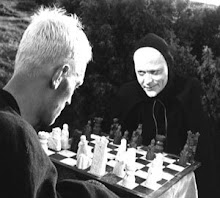
El libro de arena
Utopía de un hombre que está cansado (un cuento escrito de JL Borges , en El libro de arena)
""En el cuento, Eudoro Acevedo, de la ciudad de Buenos Aires y nacido en 1897, visita una finca en medio de una llanura desierta, en el futuro. Su anfitrión, que habla en latín, le cuenta la vida del futuro, en la que los hombres viven el tiempo que desean, prefieren la soledad y el arte. Acevedo retorna al presente con una pintura de su anfitrión."""
Tuesday, January 06, 2009

Saturday, January 03, 2009
Mike Whitney re Obama and Gaza
Uno momento de la Izquierda autentica:
"""""....[Obama's] nothing more than an ambitious and well-spoken young man who's being used to conceal the genocidal operation of the imperial machine; a fact that is particularly poignant on a day like December 29, the 118th anniversary of Wounded Knee, when more than 200 Lakota Sioux were mowed down by the 7th Cavalry on the Pine Ridge Reservation marking the end of the Indian Wars. Like the Palestinians, the Indians were guilty of nothing more than having been born in the wrong place at the wrong time. Needless to say, if Obama had been around then, he would have looked askance and bit his tongue just as he has today. The truth is Obama is a "cool guy" who doesn't really feel that strongly about anything. That's why Obama's moral authority has been gravely eroded before he's even been sworn in. The bloody streets of Gaza are an indictment of Obama not Hamas.
When people see the photos of the Palestinian children being extracted from the debris of bombed-out buildings in Gaza; they should ask themselves whether Obama could have saved a few lives by just speaking out. The fact is, he had a chance to defend the people who can't defend themselves, but chose silence and complicity instead...."""""
Viva Malatesta! Recuerde, La Señora Feinstein - La Porcina del CA--es el primer orador en el fiesta de Obama. No, nos se no puedan....
Thursday, January 01, 2009
AC Grayling blogs the UDHR
Hear, hear. 'Mericans could do worse than to sublimate their instinct for British-bashing and study a bit of GraylingSpeak. Multicultural leftists generally dismiss the secular-progressivism and rights-talk of a Grayling, regarding about any British academic--whether a Keynes, Bertrand Russell, or even Dawkins--as imperialist anathema, whereas the US yokel is probably reminded of Hannibal Lector, or Winnie Churchill, assuming they read Guardian-level English at all (--tho of course Grayling not exactly competing with like Paturkno State vs TrojanCo, or ...Bill n Hillary Iguana tripping the light phantastic to Sinatra drones.... Hymn to La Cosa Nostra).
Regardless, Grayling does correctly note the importance of free speech/expression rights. However bor-reeng, trite, or liberal rights-speak seems to some gauchistes (or boring to Coulteresque vichy wannabes, or neo-confederates, etc.), intelligent humans have a fundamental right to express their viewpoints, their objections, their dissent--whether that's via local metro-newspaper (hardly a vehicle for democracy), blogs, magazines, academic journals. Those rights also apply, arguably, to academia, which often controls or purges discussion of various issues (such as the academic bureaucracy itself).
Professor Grayling has a bit of the old Fabian sensibility: that tends to offend romantics, whether marxist, or mafiosi. He's dissed the royals and even that supposed saint Rowan Williams. He's rather well-read in many of the current scientific/evolutionary debates. To people who consider a Bertrand Russell a manifestation of Apollyon, he probably seems demonic; to those of us who would rather sink with the ship--the USS Fabian--with the likes of Bertrand Russell, Keynes, Dewey, Orwell, even Chomsky, than side with stalinists, or jihadists, he's the voice of reason.
"""""The importance of freedom of speech – which includes, as the jurisprudence of the US's first amendment shows, all forms of expression – is so great that it cannot be overstated. First, though, one must accept that it is not absolute: the hoary old example, no less compelling for being so, is that one cannot shout "fire!" in a crowded theatre where there is no fire. But the circumstances in
which some greater benefit is served by limiting freedom of expression have to
be such that, on a strictly individual and one-off basis, an overwhelming case
can be made for doing it on that occasion alone. There should, in short, never
be a blanket proscription of expression. When such expression is libelous or
damaging, there can be remedy after the fact, as when someone sues for
defamation. Prior restraint on expression, by contrast, should be a rare and
exceptional event, as just suggested. And emphatically, the fact that someone
"feels offended" by someone else's utterances – or cartoons or theatre
performances – ought never to be grounds for quelling free speech.
Why all these shoulds and should nots regarding free speech? Why is article 19 so
important? Because our other rights depend on it. Without free speech you cannot
claim, assert or protect your other rights. You cannot defend yourself in court
or accuse those who harm you. You cannot have democracy, which turns upon the
statement and discussion of policies and challenge to those who propose them.
There cannot be education worth the name when some things cannot be said, when
some information is suppressed, and when enquiry and debate is stifled. There
cannot be fully flourishing literature or theatre or broadcasting services if
there are gags over mouths and blindfolds over eyes.""""""
Hear, hear. 'Mericans could do worse than to sublimate their instinct for British-bashing and study a bit of GraylingSpeak. Multicultural leftists generally dismiss the secular-progressivism and rights-talk of a Grayling, regarding about any British academic--whether a Keynes, Bertrand Russell, or even Dawkins--as imperialist anathema, whereas the US yokel is probably reminded of Hannibal Lector, or Winnie Churchill, assuming they read Guardian-level English at all (--tho of course Grayling not exactly competing with like Paturkno State vs TrojanCo, or ...Bill n Hillary Iguana tripping the light phantastic to Sinatra drones.... Hymn to La Cosa Nostra).
Regardless, Grayling does correctly note the importance of free speech/expression rights. However bor-reeng, trite, or liberal rights-speak seems to some gauchistes (or boring to Coulteresque vichy wannabes, or neo-confederates, etc.), intelligent humans have a fundamental right to express their viewpoints, their objections, their dissent--whether that's via local metro-newspaper (hardly a vehicle for democracy), blogs, magazines, academic journals. Those rights also apply, arguably, to academia, which often controls or purges discussion of various issues (such as the academic bureaucracy itself).
Professor Grayling has a bit of the old Fabian sensibility: that tends to offend romantics, whether marxist, or mafiosi. He's dissed the royals and even that supposed saint Rowan Williams. He's rather well-read in many of the current scientific/evolutionary debates. To people who consider a Bertrand Russell a manifestation of Apollyon, he probably seems demonic; to those of us who would rather sink with the ship--the USS Fabian--with the likes of Bertrand Russell, Keynes, Dewey, Orwell, even Chomsky, than side with stalinists, or jihadists, he's the voice of reason.
Wednesday, December 24, 2008
Kossacks tackle the existence of G*d and other matters
from terry2wa :
Rather eloquent for a Kossack.
from terry2wa :
""I find Dawkins' works to be solidly scientific and logical, but
like so many of his intellectual mentors from the Post-War era, there is a
profound sense of existential despair lying just below the surface. He is excellent with explanations of process and hypotheses of causality, but he is simply mute on the wonder of it all. His work is intellectually compelling, but spiritually sterile and flat. He's like Camus in a lab coat.
Hitchens is, in my opinion, simply a contrarian who, if he does not actually actively
despise any human interaction which could be deemed altruistic or noble or self-abnegating, is so skeptical of motive as to be little more than a misanthrope. If his aim is to win converts to atheism, then I am fairly certain eventually Evangelicals like Rick Warren will pass out copies of God Is Not Great along with their religious tracts, because after reading Hitchens the usual reaction is, after taking one long and very hot shower and scrubbing off most one's epidermis, to pray devoutly for the existence of a God who can lock Hitchens safely away for eternity in Hell with the other demons who roam the world seeking the ruin of souls.
That said, I find Daniel Dennett's upbeat and almost lyrical atheist credo, as outlined in Breaking The Spell, to be the most compelling and accessible. His personal philosophy has accomplished the almost miraculous feat of combining a rigorous scientifically-grounded agnosticism with the best elements of Humanist thought. Like EO Wilson, his science flows from his curiosity, awe and wonder at the natural world, and he is able to acknowledge that Beauty, Truth and Goodness are the cornerstones of a fulfilling human existence, the foundation of human ethics, and the lynchpins of civilization. One comes away from Dennett's books with the impression that he has enjoyed life, in spite of being godless, and that you are the better for
having made his acquaintance.
Of course, all I've said here should be tempered by the admission that I remain, in spite of everything, a believer. The Apostle's Creed has long since fallen into disuse and disrepair in this jaded soul, but I continue to judge the affairs of Mankind by the standards of the rebel Jesus. And while I no longer cling to the conviction that anything awaits me after death except recycling, my soul refuses to accept the proposition that life, even individual life, is without purpose or meaning. It may be Freud's "illusion", but I'm too damned old now to care.
That said, I have a great deal of respect for an honest disbeliever. Like Paul Tillich, I believe that no faith exists without doubt, and I join many of you in stating my firm conviction that organized religion is the fountainhead of a large portion of this world's temporal suffering.
Still, as I get older and closer to whatever eternity is, I am absolutely certain that the hunger and thirst for justice which those old Dominican nuns drilled into my dense and feral little head all those years back was a good thing, and I am grateful for the part of me which yearns to see every human given his due and holds all people accountable for the gifts received, in the measure they have received them."""
Rather eloquent for a Kossack.
Tuesday, December 23, 2008
Hegel-mass
(from GWFH's Phil of History)
""""“Eh bien,” said Napoleon, “we shall go to mass again, and my good fellows will say: ‘That is the word of command!’” This is the leading feature in the character of these nations – the separation of the religious from the secular interest, i.e., from the special interest of individuality; and the ground of this separation lies in their inmost soul, which has lost its independent entireness of being, its profoundest unity. Catholicism does not claim the essential direction of the Secular; religion remains an indifferent matter on the one side, while the other side of life is dissociated from it, and occupies a sphere exclusively its own. Cultivated Frenchmen therefore feel an antipathy to Protestantism because it seems to them something pedantic, dull, minutely captious in its morality; since it requires that Spirit and Thought should be directly engaged in religion: in attending mass and other ceremonies, on the contrary, no exertion of thought is required, but an imposing sensuous spectacle is presented to the eye, which does not make such a demand on one’s attention as entirely to exclude a little chat, while yet the duties of the occasion are not neglected.""""
O Schweigen KristallNacht. Yo BubbaBot: that's sort of like you, blasting bombastically away on a trumpet. GWFH tho' plays Beethoven (or maybe Wagner), and you, alas, play like "Lil Light of Mine." And GWF knows 4 or 5 languages fluently (Deutsch, Latin, greek, romance tongues, probably a bit of sanskrit, chinese, even arabic--and you can barely manage Anglo-preacher speak), has mastered most of the sciences of the time (quite adept with derivatives and integrals), and knows world history, greek and roman thinkers (Caesar one of his faves) up and down. BubbaRon x 10.
http://www.marxists.org/reference/archive/hegel/index.htm
Saturday, December 20, 2008
LPOE
4:17 Shall mortal man be more just than God? shall a man be more pure than his maker? 4:18 Behold, he put no trust in his servants; and his angels he charged with folly: 4:19 How much less in them that dwell in houses of clay, whose foundation is in the dust, which are crushed before the moth? 4:20 They are destroyed from morning to evening: they perish for ever without any regarding it. (from the Book of Job)
The LPOE has been known for centuries. The Book of Job presents the issue in some form; greek and roman scribes alluded to it. Voltaire, pal of Franklin and Hume had some awareness of the issue , as that great surreal graphic novel Candide reveals. (Jefferson kept a bust of Voltaire, Marquis de Arouet in his Monticello study his entire life). Dr. Pangloss, V's parody of that brilliant mystic-windbag Leibniz, insists this is the best of all possible worlds, even in the face of wars, earthquakes and tidal waves killing untold thousands.
Most modern theologians--Dr. Panglosses are still around--would probably uphold Leibniz's rather optimistic view, and claim that, even apres-Stalin, Hitler, Pol Pot, and the Bush Administration, their God chose the best of possible worlds (how do they know, without knowing of other worlds??), and at the same time grant that God does allow evil (another problematic normative concept). He does not intervene to stop the suffering of the innocent, say, when by definition He could; and obviously history affords a monumental amount of evidence showing the suffering of innocent (or mostly innocent), via pain, poverty, natural disasters, disease, collateral damage in wars, etc. ("Free will" does not offer the theologian an escape in the above cases).
In short, God's putative Justice, Perfection and Omnipotence are not consistent, or evident or provable in any normal sense of proof, i.e. via axiom, or observation (here is a brief synopsis of the logical problem of evil). The inconsistency of the premises suggests that JHVH (assuming He exists for sake of irritating the pious) is either Omnipotent, but not Just (or "perfect" really), OR he is not Omnipotent (and then not really God), or simply does not exist.
So, God either won't prevent undue suffering, though He could--which seems to suggest an amoral KingGod, sort of a Tamerlane on high---or He can't (which denies his omnipotence, or perhaps suggest a manicheanism, or polydeism, or other oddities), OR since that all seems rather preposterous, we can safely claim He does not exist. However ancient and obscure manicheanism seems, a battle between opposing forces seems a rather more plausible religious model (even somewhat evolutionary) when considering the absurd implications of a monotheist Being. Given a century of brutal wars, genocide, political oppression of all sorts, the conclusion of the LPOE seems rather a fortiori (as do Voltaire's points).
There are other anti-theological tactics of course--such as the Darwinian tactic. Darwin and Lyell did not merely advance biological science: they established the fallibility of the dogma of Old Testament (and all theological texts purporting to account for natural history). Radiocarbon dating disproved the rabbinical and xtian accounts of creation (ie 4000 bc, etc.), and confirmed Darwinian accounts of a very old world, and of common descent with modifications (problems there are with naive Darwinism--McDarwinism--as evidenced by TH Huxley's simplifications. For that matter Darwin himself waffled on the religious question, and at times appears to have agreed with the 'teleological' argument).
The LPOE does something quite different than Darwinism does: the LPOE shows the inconsistencies of the theologians' own assumptions via a fairly obvious set of premises. The correct conclusions drawn from LPOE will not likely phase many biblethumpers, or koranthumpers, most of whom have no problem upholding the code of Credo que Absurdum:theists are generally great romantics. That our elected officials also uphold the Credo q.A. (ie asking fundies to offer invocations and benedictions), however, should concern all Non-Churchians.
Monday, December 15, 2008
Dr. Chu
Dolores May, commenting on Obama's appointment of Dr. Chu to Sec. of Energy(HuffPo):
Meet the new Energy Czar, same as the old Energy czar. Chu also supports nuclear energy. That said, Chu's scientific credentials appear impressive, and Contingencies does not automatically dismiss the potential viability of nuclear power. (Emo-crats usually do, however--except when Chairman BO assures them it's ok). Obama also has selected former Clintonite EPA boss Carol Browner (Miss Browner's the actual E-Czar--Czarina?) for an eco-bureaucrat position, along with Nancy Sutley, an assistant to Browner: all Clintonites. Hope and Change.
The nerdier DailyKOS sorts approve of Chu for the most part, believing that a real "geek" has taken over the reins of Energy. Chu, however, like most high-powered laboratory scientists, has ties to oil corporations such as BP, as did his predecessors in Bush admin. (BP has in fact greatly profited from the Iraqi war--). The implication seems to be that a pro-nuclear Asian scientist with ties to Big Oil is to be preferred to the pro-nuclear American scientist with ties to Big Oil.
One Counterpuncher, Karl Grossman doesn't seem overly thrilled with the appointment of Dr. Chu: “He’s really big on efficiency and renewables,” says Michael Mariotte, executive director of the Nuclear Information and Resource Service, of Chu. But he is “looking at nuclear as well. He and President-elect Obama are not anti-nuclear, and not perhaps as versed on it as they should be.” Mariotte has a major concern that “they will accede to demands to fund nuclear power made by Congress”—awash in contributions from the nuclear power industry and with many members loyal to the national nuclear laboratories in their districts.""
One of the Dept. of Energy's founding members, Admiral Rickover--hardly some tofu-munching, birkenstock'd Greenpeacer--ultimately took a stance against nuclear power, and suggested banning nuclear reactors.
....................................
Cockburn on Politix, Chicago-style. When he keeps his VI Lenin fetish under control, Alex Cockburn actually can scribble a bit. Blogging Blago:
""""Top storyline has been the impact of Blagojevich’s indictment on Obama. At the very moment the president-elect proclaims an era of uplift and constitutional propriety, the slimy tentacles of old-style Chicago corruption snake towards his ankles. The chortles of outgoing President George Bush Jr., himself harassed by US Attorney Patrick Fitzgerald in the Scooter Libby affair, must be rich and prolonged.
Blagojevich did Obama the enormous favor of denouncing him on the government’s tapes. “F--- him,” bellowed the governor during a call with top aides and Patti, covertly recorded by the FBI on November 10th, “For nothing? F--- him.” The governor was peeved that Obama’s representatives weren’t offering him any material incentives to nominate Obama’s political associate and Chicago powerhouse, Valerie Jarrett, for the senate seat vacated by Obama. The president elect can thank his stars for the expletive, but potential embarrassments still loom.....""
We suspect Kid Obama's closer--much closer--to this than most of the Emo-crats realize. So BO goes with Emanuel--and thus ratted out his one-time ally Blago. Blago then puts BO's Senatorial position on the block. F--- him, indeed. Alas, facts, historical facts interfere with that gleaming Progressive futurity.
Darwin. Marx. Darwin and/or Marx.
Dolores May, commenting on Obama's appointment of Dr. Chu to Sec. of Energy(HuffPo):
Progressives should be aware that Dr. Chu's energy research is entirely funded by British Petroleum, through a controversial $500 million dollar contract with UC Berkeley and Lawrence Berkeley Labs (as well as the University of Illinois at Urbana-Champaign). The emphasis at the BP-created initiative is mainly on biofuels. The deal has come under heavy criticism for potentially ensuring that a major oil company will be setting much of the agenda for energy research in the coming century (not to mention setting the agenda for the public universities involved). Not an entirely evil enterprise, perhaps, but hardly free of distortion by economic interests. And Dr. Chu was a major force creating the deal. So not to rain on anyone's parade, but just to add a little perspective. This appointment is very much in the mold of other Obama appointments: Super-smart, super-qualified guy - but no progressive.
Meet the new Energy Czar, same as the old Energy czar. Chu also supports nuclear energy. That said, Chu's scientific credentials appear impressive, and Contingencies does not automatically dismiss the potential viability of nuclear power. (Emo-crats usually do, however--except when Chairman BO assures them it's ok). Obama also has selected former Clintonite EPA boss Carol Browner (Miss Browner's the actual E-Czar--Czarina?) for an eco-bureaucrat position, along with Nancy Sutley, an assistant to Browner: all Clintonites. Hope and Change.
The nerdier DailyKOS sorts approve of Chu for the most part, believing that a real "geek" has taken over the reins of Energy. Chu, however, like most high-powered laboratory scientists, has ties to oil corporations such as BP, as did his predecessors in Bush admin. (BP has in fact greatly profited from the Iraqi war--). The implication seems to be that a pro-nuclear Asian scientist with ties to Big Oil is to be preferred to the pro-nuclear American scientist with ties to Big Oil.
One Counterpuncher, Karl Grossman doesn't seem overly thrilled with the appointment of Dr. Chu: “He’s really big on efficiency and renewables,” says Michael Mariotte, executive director of the Nuclear Information and Resource Service, of Chu. But he is “looking at nuclear as well. He and President-elect Obama are not anti-nuclear, and not perhaps as versed on it as they should be.” Mariotte has a major concern that “they will accede to demands to fund nuclear power made by Congress”—awash in contributions from the nuclear power industry and with many members loyal to the national nuclear laboratories in their districts.""
One of the Dept. of Energy's founding members, Admiral Rickover--hardly some tofu-munching, birkenstock'd Greenpeacer--ultimately took a stance against nuclear power, and suggested banning nuclear reactors.
....................................
Cockburn on Politix, Chicago-style. When he keeps his VI Lenin fetish under control, Alex Cockburn actually can scribble a bit. Blogging Blago:
""""Top storyline has been the impact of Blagojevich’s indictment on Obama. At the very moment the president-elect proclaims an era of uplift and constitutional propriety, the slimy tentacles of old-style Chicago corruption snake towards his ankles. The chortles of outgoing President George Bush Jr., himself harassed by US Attorney Patrick Fitzgerald in the Scooter Libby affair, must be rich and prolonged.
Blagojevich did Obama the enormous favor of denouncing him on the government’s tapes. “F--- him,” bellowed the governor during a call with top aides and Patti, covertly recorded by the FBI on November 10th, “For nothing? F--- him.” The governor was peeved that Obama’s representatives weren’t offering him any material incentives to nominate Obama’s political associate and Chicago powerhouse, Valerie Jarrett, for the senate seat vacated by Obama. The president elect can thank his stars for the expletive, but potential embarrassments still loom.....""
We suspect Kid Obama's closer--much closer--to this than most of the Emo-crats realize. So BO goes with Emanuel--and thus ratted out his one-time ally Blago. Blago then puts BO's Senatorial position on the block. F--- him, indeed. Alas, facts, historical facts interfere with that gleaming Progressive futurity.
Just as Darwin discovered the law of development of organic nature, so Marx discovered the law of development of human history: the simple fact, hitherto concealed by an overgrowth of ideology, that mankind must first of all eat, drink, have shelter and clothing, before it can pursue politics, science, art, religion, etc.; that therefore the production of the immediate material means, and consequently the degree of economic development attained by a given people or during a given epoch, form the foundation upon which the state institutions, the legal conceptions, art, and even the ideas on religion, of the people concerned have been evolved, and in the light of which they must, therefore, be explained, instead of vice versa, as had hitherto been the case.
Engels, Speech at the Grave of Karl Marx
Darwin. Marx. Darwin and/or Marx.
Tuesday, December 09, 2008
One Susan Jacoby on American Unreason:
Contingencies-approved.
"""The debasement of the nation's speech is evident in virtually everything, on every subject, broadcast and podcast on radio, television, and the Internet. In this true, all-encompassing public square, homogenized language and homogenized thought reinforce each other in circular fashion. As George Orwell noted in 1946, “A man may take to drink because he feels himself a failure, and then fail all the more completely because he drinks. It is rather the same thing that is happening to the English language. It becomes ugly and inaccurate because our thoughts are foolish, but the slovenliness of our language makes it easier for us to have foolish thoughts” In this continuous blurring of clarity and intellectual discrimination, political speech is always ahead of the curve—especially because today’s media possess the power to amplify and spread error with an efficiency that might have astonished even Orwell. Consider the near-universal substitution, by the media and politicians, of “troop” and “troops” for “soldier” and “soldiers.” As every dictionary makes plain, the word “troop” is always a collective noun; the “s” is added when referring to a particularly large military force. Yet each night on the television news, correspondents report that “X troops were killed in Iraq today.” This is more than a grammatical error; turning a soldier—an individual with whom one may identify—into an anonymous-sounding troop encourages the public to think about war and its casualties in a more abstract way. Who lays a wreath at the Tomb of the Unknown Troop? It is difficult to determine exactly how, why, or when this locution began to enter the common language. Soldiers were almost never described as troops during the Second World War, except when a large military operation (like the Allied landing on D-Day) was being discussed, and the term remained extremely uncommon throughout the Vietnam era. My guess is that some dimwits in the military and the media (perhaps the military media) decided, at some point in the 1980s, that the word “soldier” implied the masculine gender and that all soldiers, out of respect for the growing presence of women in the military, must henceforth be called troops. Like unremitting appeals to folks, the victory of troops over soldiers offers an impressive illustration of the relationship between fuzzy thinking and the debasement of everyday speech."""
Contingencies-approved.
Friday, December 05, 2008
Meet the new Madame Hillary; same as the old Madame Hillary
Josh Frank on Madame Hillary:
Those nasty Demopublicans. The choice of Miss Clinton for the rather crucial position ofReceptionistSecretary of State should not shock. That the "liberal" blogging horde did not raise their voice at Obama's selection of Hillary does not shock either (and GOPers already have said they will confirm): that's how the contemporary political process works at this stage, with American politicians shifting from a phony puritanical pacifism (i.e. Obama a year ago), to hard-boiled RealPolitik in a matter of weeks.
One year ago, Obamaites portrayed Hillary as a neo-con, ally of Lieberman, if not the equivalent of Dick Cheney in terms of foreign policy. The hack satirists of DailyKOS and similar DINO.com sites had Hillary outfitted in the She-Wolf of the SS gear. Team Obama removed her jackboots, and she's now an experienced asset, carrying on the noble tradition of Condi Rice. That said, Miss Hillary, does possess some spine, and really more of a Truman-style Dem. than most of Obama's cronies. Perhaps she'll send a message of Love across the earth, like along with the aircraft carriers: the USS Jeee-zuss
Josh Frank on Madame Hillary:
"""It’s official.
Barack Obama has chosen Hillary Clinton to be Secretary of State; a choice that confirms US foreign policy is not about to change significantly under the forthcoming Democratic administration. The US will continue to pander to Israel and the War on Terror will still be the rallying cry for our foreign interventions.
In a letter to her constituents in November 2005, Clinton expressed her belief that the war in Iraq shouldn’t be “open-ended,” but was clear that she would never “pull out of Iraq immediately.” She wrote that she wouldn’t accept any timetable for withdrawal and won’t even embrace a “redeployment” of US troops along the lines of Rep. John Murtha (D-Pa.).""""
Those nasty Demopublicans. The choice of Miss Clinton for the rather crucial position of
One year ago, Obamaites portrayed Hillary as a neo-con, ally of Lieberman, if not the equivalent of Dick Cheney in terms of foreign policy. The hack satirists of DailyKOS and similar DINO.com sites had Hillary outfitted in the She-Wolf of the SS gear. Team Obama removed her jackboots, and she's now an experienced asset, carrying on the noble tradition of Condi Rice. That said, Miss Hillary, does possess some spine, and really more of a Truman-style Dem. than most of Obama's cronies. Perhaps she'll send a message of Love across the earth, like along with the aircraft carriers: the USS Jeee-zuss
Thursday, December 04, 2008
Congressman Kevin "Kern Guy" McCarthy,
brought to you by
Chevron, Exxon, JP Morgan-Chase, New York Life, Occidental, RJ Reynolds, Walmart, & Wine and Spirits Wholesalers of America Inc.
FEC/Disclosure
brought to you by
Chevron, Exxon, JP Morgan-Chase, New York Life, Occidental, RJ Reynolds, Walmart, & Wine and Spirits Wholesalers of America Inc.
FEC/Disclosure
Monday, November 24, 2008
De Toke-ville on De-mocracy
Tocqueville understands the faulty premise of Jeffersonian democracy (as did TJ, in his gloomier moments). Democracy presupposes that any person is as competent, intelligent and "virtuous" as any other. That is demonstrably false: people vary widely in intelligence and virtue, as a comparison of education scores, or incarceration ratios would show. So "democracy rests on a lie" (Colin McGinn's phrase). D-T also seems to suggest as much: x is "considered" as enlightened as any, but not proven to be. That does not imply, however, the superiority of Pax Regina, except to dolts (a large and controlling tribe, paraphrasing Bierce).
In more formal terms, D-T questions the presumption of agency. That citizens all have the right to vote at 18 does not mean they possess the knowledge to make informed vote-choices; being a citizen in a Democratic society does not mean one is Thomas Jefferson. Criteria does exist for various social roles, employment, for establishing "competent agency," in effect--say driving a car or obtaining an MD--but not for others, such as voting, or running for political office (nor for blogging). It does not seem prima facie unreasonable to require a voting license program similar to a driver's license (or requiring a hs diploma, etc). That might not appeal to the romantic leftist (usually a crypto-rightist anyway) representin' for the Peoples, but would most likely lend a bit more intelligence to the political process.

Miss Rand, America's Phirst Lady of Philosophy
Academics rarely offer some cogent definition of agency for that matter-- anymore than they establish the "Rational Man" standard of Smithian economics (20th century history reads more like the work of Irrational man--). Granting that humans do make choices (even if they are coerced by physiological factors of various sorts--voluntary determinism, aka compatibilism of a sort), some choices are measurably better than others, and in many situations one person is a more competent "chooser" than another. There is a definite tendency among many people, rather Nietzschean and elitist (also seen in Aynnie Rand's pop-Nietzschean ideas) to think that the smarter, competent, more virtuous person has more of a entitlement claim, and greater "rights" of some type than an uneducated or mentally ill, homeless person does (Nietzsche's "chandala"). That's not necessarily mistaken: obviously some people are smarter and more competent than others, and that can be established via various methods, by standardized tests, degrees, credentials, etc. Mistaken however is the usual protestant assumption (or monotheistic, really) that being a good Churchie and believing in Jee-zuss confers some special right..
Indeed, meritocracy (as opposed to naive democracy), given our technological age, would seem to require specified agency criteria. That needn't imply elitism of the Nietzschean sort: rational-agent Meritocracy could be to the advantage of intelligent progressive politics, and a means to dismantling oligarchies of various sorts (say "natural fortune" in Rawlsian terms). Meritocracy based on carefully defined agency-criteria could create a more even, and fairer playing field. Rawls also requires that humans who make disinterested decisions regarding society via his "veil of ignorance" be rational, though he does not hash that out too much (what would be sufficient to establish rationality, and a sort of political-participation right? a HS diploma, or an MD). Meritocracy could in principle avoid the problems of populism, of economic disparity--like that between rich pimps n ho's and starving Einsteins and Jeffersons--and ameliorate mob rule in general (whether that's a mob of biblethumpers for Sarah Palin, or a mob of sans cullottes bent on smashing the state)---don't hold your breath.
Tocqueville: "I have previously stated that the principle of the sovereignty of the people hovers over the whole political system of the Anglo-Americans. Every page of this book will reflect certain fresh instances of this doctrine. In nations where it exists, every individual takes an equal share in sovereign power and participates equally in the government of the state. Thus he is considered as enlightened, virtuous, strong as any of his fellow men."
Tocqueville understands the faulty premise of Jeffersonian democracy (as did TJ, in his gloomier moments). Democracy presupposes that any person is as competent, intelligent and "virtuous" as any other. That is demonstrably false: people vary widely in intelligence and virtue, as a comparison of education scores, or incarceration ratios would show. So "democracy rests on a lie" (Colin McGinn's phrase). D-T also seems to suggest as much: x is "considered" as enlightened as any, but not proven to be. That does not imply, however, the superiority of Pax Regina, except to dolts (a large and controlling tribe, paraphrasing Bierce).
In more formal terms, D-T questions the presumption of agency. That citizens all have the right to vote at 18 does not mean they possess the knowledge to make informed vote-choices; being a citizen in a Democratic society does not mean one is Thomas Jefferson. Criteria does exist for various social roles, employment, for establishing "competent agency," in effect--say driving a car or obtaining an MD--but not for others, such as voting, or running for political office (nor for blogging). It does not seem prima facie unreasonable to require a voting license program similar to a driver's license (or requiring a hs diploma, etc). That might not appeal to the romantic leftist (usually a crypto-rightist anyway) representin' for the Peoples, but would most likely lend a bit more intelligence to the political process.

Miss Rand, America's Phirst Lady of Philosophy
Academics rarely offer some cogent definition of agency for that matter-- anymore than they establish the "Rational Man" standard of Smithian economics (20th century history reads more like the work of Irrational man--). Granting that humans do make choices (even if they are coerced by physiological factors of various sorts--voluntary determinism, aka compatibilism of a sort), some choices are measurably better than others, and in many situations one person is a more competent "chooser" than another. There is a definite tendency among many people, rather Nietzschean and elitist (also seen in Aynnie Rand's pop-Nietzschean ideas) to think that the smarter, competent, more virtuous person has more of a entitlement claim, and greater "rights" of some type than an uneducated or mentally ill, homeless person does (Nietzsche's "chandala"). That's not necessarily mistaken: obviously some people are smarter and more competent than others, and that can be established via various methods, by standardized tests, degrees, credentials, etc. Mistaken however is the usual protestant assumption (or monotheistic, really) that being a good Churchie and believing in Jee-zuss confers some special right..
Indeed, meritocracy (as opposed to naive democracy), given our technological age, would seem to require specified agency criteria. That needn't imply elitism of the Nietzschean sort: rational-agent Meritocracy could be to the advantage of intelligent progressive politics, and a means to dismantling oligarchies of various sorts (say "natural fortune" in Rawlsian terms). Meritocracy based on carefully defined agency-criteria could create a more even, and fairer playing field. Rawls also requires that humans who make disinterested decisions regarding society via his "veil of ignorance" be rational, though he does not hash that out too much (what would be sufficient to establish rationality, and a sort of political-participation right? a HS diploma, or an MD). Meritocracy could in principle avoid the problems of populism, of economic disparity--like that between rich pimps n ho's and starving Einsteins and Jeffersons--and ameliorate mob rule in general (whether that's a mob of biblethumpers for Sarah Palin, or a mob of sans cullottes bent on smashing the state)---don't hold your breath.
Monday, November 17, 2008
Bricmont, representin'
A point worth re-iterating: "since then, modern science has turned the tables decisively in favor of materialism." Many in Consumerland (even in the universities of Consumerland) can't quite realize that point, and instead insist that quantum mechanics and the latest findings of physics (or what they take to be physics) provides support for their own brand of mysticism (be it monotheistic, or otherwise). Bricmont reminds us that materialism has not been overthrown, but updated and revised (as Einstein, not a mystic or immaterialist, asserted as well). Or in the words of one Professor Beiser--not quite a Bricmont, but not lacking a materialist sensibility, when you're dead, you're dead.
Bricmont, however, like many scientific materialists, does not quite realize all the entailments of his ontology (at least in this essay, and others I have read): assuming his physicalism (and no transcendent soul/ego), AND, at the same time assuming that thinking exists/occurs (like Bricmont thinking through the ideas for this essay) , bio-chemical matter then itself must think (a rather odd point that some material minded idealists, like Schopenhauer, understood--and perhaps Hegel and Marx in some sense). The Idea realizes itself in the human brain...........

"...Here is where modern science and British empiricism (which can be characterized as the working philosophy of most scientists) enter. Science explains the visible world, let’s say the structure of matter, by appealing to the invisible one, the properties of atoms. So, why can’t science postulate an invisible Intelligent Design to account for the origin of the Universe or its unexplained properties? The difference is that we do not use merely the word "atom" in our explanations, but also their many quantitative and testable properties. On the other hand, the Design of the ID movement is just a word -- nobody has ever proposed that it possesses any given properties, nor how, if such properties were proposed, one could test them. The postulated Design has just whichever properties were needed to make the world as it is and not otherwise. But then why was the ID not intelligent enough to create a world without birth defects, tsunamis or American imperialism ? The only thing that the defenders of ID are able to establish is that there are certain things we don’t know -- and with that, of course, all scientists agree.
Because of the specificity and testability of its explanations, modern science has introduced a new factor into the spiritualism/materialism debate that was absent among the classical materialist philosophers. The latter had their hearts in the right place but, because of lack of experiments, their physics was fanciful and open to the objection that it was not any more credible than religious stories. Since then, modern science has turned the tables decisively in favor of materialism.
More to the point, this postulated Design has nothing whatsoever to do with the Gods of the traditional religions. Theologians constantly try to present such "arguments" as ID in favor of a deity as if they supported their favorite belief systems. But those belief systems are all based on some kind of revelations and "sacred" scriptures. Even if the ID arguments were valid, they would tell us nothing about particular revelations. The God of ID is a philosopher’s God, like the one whose existence St Thomas Aquinas or Descartes thought to have proven. But the God of the traditional religions is entirely different. It is a being that defines what is good and evil, answers our prayers, and punishes us in the afterlife. Those belief systems are even more radically undermined by modern science than ID. Indeed, whenever one looks at the facts in an undogmatic way, the sacred books turn out to be essentially wrong. Not only about evolution but about almost everything. There is no independent evidence for the story told in the Gospels, the Bible is mythological, and even the Jewish people is, as Shlomo Sand puts it, "an invention" .
Given that, there are two routes open to the believer. There is that of Sarah Palin, clinging literally to the belief system, in spite of all evidence to the contrary. That school of Christians enter into direct conflict with science. Or one can choose the metaphorical route, which most liberal and European Christians (including even the Pope, at times) follow -- declare that, whenever the Scriptures conflict with science, they have to be "interpreted" in a non-literal way. That leads to total defeat for religious belief, because, if the parts of the Scriptures that can be checked with the facts are not to be taken seriously, why pay any attention to the parts that cannot be checked (notably concerning Heaven and Hell or God himself )? The whole of liberal Christianity is the result of a double standard: follow the Scriptures whenever they are "metaphysical" or ethical and cannot be checked independently, and discard them when they can. Since God is not good enough to tell us what he really meant in his "revelations", and which parts have to be taken seriously and which parts not, we are left with total arbitrariness.
People who call themselves agnostics are often confused about these two notions of God. What they claim to be agnostic about is the philosopher’s god not, say, the Gods of Homer. With respect to the latter, they are atheist, just as all religious people are atheist with respect to all gods except their own.
It is also a pity that some secular leftists, like Stephen Jay Gould, support liberal Christianity with the idea of non-overlapping magisteria (NOMA): science deals with facts, religion deals with values. But if you really remove all statements of facts from religion, including those about the existence of God or of Heaven and Hell, then why should one care about what religion says about values ? (That is why the NOMA argument adds to the confusion on the secular side, but is rarely accepted by the religious one).""""
A point worth re-iterating: "since then, modern science has turned the tables decisively in favor of materialism." Many in Consumerland (even in the universities of Consumerland) can't quite realize that point, and instead insist that quantum mechanics and the latest findings of physics (or what they take to be physics) provides support for their own brand of mysticism (be it monotheistic, or otherwise). Bricmont reminds us that materialism has not been overthrown, but updated and revised (as Einstein, not a mystic or immaterialist, asserted as well). Or in the words of one Professor Beiser--not quite a Bricmont, but not lacking a materialist sensibility, when you're dead, you're dead.
Bricmont, however, like many scientific materialists, does not quite realize all the entailments of his ontology (at least in this essay, and others I have read): assuming his physicalism (and no transcendent soul/ego), AND, at the same time assuming that thinking exists/occurs (like Bricmont thinking through the ideas for this essay) , bio-chemical matter then itself must think (a rather odd point that some material minded idealists, like Schopenhauer, understood--and perhaps Hegel and Marx in some sense). The Idea realizes itself in the human brain...........

(continued). Bricmont thus might be classified (by those who specialize in such things, like Dennett) as a greedy reductionist. While scientific materialism may be the most plausible ontological account of "reality" for lack of a better term, that doesn't mean that much. Humans still think and make decisions, even if a Bricmont (or Searle, or Skinner, etc.) insists all decisions are determined by biological- genetic, and/or environmental factors (tracing those causal determining factors still out of reach as well); and they are to be held accountable for those decisions, just as someone making a wrong answer on a test, or a bad move in chess is held accountable--not only by say losing the game, but by subsequent analysis showing what went wrong.
It seems quite evident (considering a game of skill like chess, or Dreyfus' example of learning to drive, or a person deciding to commit a crime) that in many situations, a person does have a definite decision which results in different outcomes, and that one choice (or move) was better or more successful than another--he could have done differently (chess opening analysis seems to suggest this as well---had Karpov moved this way instead of that, he would have beaten Kasparov, etc). The beginner who brings out his queen early will probably lose: with more skill, he no longer does that. The ability to plan, and envision future scenario also poses a problem for deterministic views--how does bio-chemical matter (ala a brain) envision future events, even a few moves ahead on a chess board? Rather difficult to explain via the Bricmontian clock-physics.
However quaint or macabre Marx might seem to some, he addressed some of the implications of a Bricmontian materialism (ie psychological implications) over 100 years ago: humans may be determined to some degree (in Hegelian terms, that determinism, or conditioning is mediated--), but they are not merely animals responding to stimuli, or following some primitive algorithms. Marx's criticism of the older materialism of Feuerbach thus still seems pertinent, given the prevalence of Feuerbach-like Bricmonts (though Jean's a rather high-powered Feuerbach): “The chief defect of all previous materialism — including Feuerbach’s—is that the object, reality, sensibility, is conceived only in the form of the object or as conception, but not as human sensory activity..." .
It's difficult to think of a Beethoven symphony--or the invention of integrals for that matter-- as causally determined in the Bricmontian, mechanistic sense; there does seem to be a human sensory activity implied (or dare we say conceptualization of some sort, without affirming any metaphysical ghosts). Brains aren't machines, or CPU's; brains may have some CPU-like characteristics (or, rather CPUs have brain-like characteristics), but there's more to it, a lot more to it; at the same time, objecting to strict determinism ala Bricmont does not thereby necessitate belief in a soul-ghost.
Sunday, November 16, 2008
A linguistic heretic takes on Pope Chomsky
DanEverett:
Maestro Chomsky's a formidable intellectual force: at the same time, he's arguably become a sort of guru for many (both in terms of his linguistic theory and political views). More than a few psychologists, linguists, and philosophers have criticized Chomsky's theory of Universal Grammar as somewhat idealist and "Cartesian", though doing so requires some skill in terms of empirical psychology, and philosophical debate (skills generally absent in many hysteria cases of left and right). One recent criticism of UG relates to Chomsky's insistence on infinite recursion as an aspect of UG (Recursiveness is the ability--presumed to be universal by Chomskyites-- to embed endless phrases in any syntax).
Dan Everett has for years studied a native language, Piraha, which apparently falsifies the UG claim of recursiveness. A Piraha native might say "Moe's house" (in his language of course), and he can say "Moe's brother", but if he wants to say "Moe's brother's house", he must say "Moe has a brother. This brother has a house". The Piraha don't embed, but say that in separate sentences. (We suspect that recursion's characteristic of most languages, but not all, especially those without writing (while realizing the political-ethical problems implied by saying one language or culture is more advanced than another)). Recursion as used in programming involves a bit more complexity than the linguist's, but related: in both programming and linguistics recursion involves an equation that relates later terms in the sequence to earlier terms (iterations, and loops also make use of recursion in various ways).
Everett has in effect offered an empirical rebuttal of the recursion claims of UG. Old empirical savages like Skinner (and his logician pal WVO Quine) had of course brought up similar points a few decades ago, before Pope Noam's excommunication of behaviorism. Finiteness, empiricism, human language use as conditioned by environment, dare we say synthetic a posteriori: all of that was more or less proclaimed anathema by the Chomsky-Cartesian school, which demanded, instead of Watson/Skinner's experimental methods, an a priori account of language acquisition (indeed, the Noamster has no problem citing Platonic metaphysics as support for UG). Everett's research suggests that the experimentalists were not completely mistaken (or Sapir-Whorf, perhaps?), though Everett's not the first scholar to point out key differences in primitive languages compared to modern and/or indo-european languages. This might not be a refutation of Chomsky's UG, yet an interesting development, and of course Dr. Everett's already been dismissed as a fascist, hick, imperialist lackey, etc.
-----------------
Searle approves of Dan Everett's work: "Dan Everett has written an excellent book. .....his data and his conclusions about the language of the Piraha run dead counter to the prevailing orthodoxy in linguistics. If he is right, he will permanently change our conception of human language.' That in itself could be anathema.
Speaking of Searle, he's written a somewhat interesting book on "free will" and determinism (not unrelated to the Everett/Chomsky debate). He recently paid a visit to Google:
(that was Zeno's paradox, Doc--actually a rather more challenging problem than the language specialist Searle realizes)
DanEverett:
"""When I first started working with the Pirahã, I realized that I needed more linguistics if I was going to understand their language. When I began to tell them the stories from the Bible, they didn't have much of an impact. I wondered, was I telling the story incorrectly? Finally one Pirahã asked me one day, well, what color is Jesus? How tall is he? When did he tell you these things? And I said, well, you know, I've never seen him, I don't know what color he was, I don't know how tall he was. Well, if you have never seen him, why are you telling us this?
I started thinking about what I had been doing all along, which was, give myself a social environment in which I could say things that I really didn't have any evidence for—assertions about religion and beliefs that I had in the Bible. And because I had this social environment that supported my being able to say these things, I never really got around to asking whether I knew what I was talking about. Whether there was any real empirical evidence for these claims.
The Pirahã, who in some ways are the ultimate empiricists—they need evidence for every claim you make—helped me realize that I hadn't been thinking very scientifically about my own beliefs. At the same time, I had started a Ph.D. program in linguistics at the University of Campinas in southern Brazil, and I was now in the middle of a group of very intelligent Brazilian intellectuals, who were always astounded that someone at a university doing a Ph.D. in linguistics could believe in the things I claimed to believe in at the time. So it was a big mixture of things involving the Pirahã, and at some point I realized that not only do I not have any evidence for these beliefs, but they have absolutely no applicability to these people, and my explanation of the universe.
I sat with a Pirahã once and he said, what does your god do? What does he do? And I said, well, he made the stars, and he made the Earth. And I asked, what do you say? He said, well, you know, nobody made these things, they just always were here. They have no concept of God. They have individual spirits, but they believe that they have seen these spirits, and they believe they see them regularly. In fact, when you look into it, these aren't sort of half-invisible spirits that they're seeing, they just take on the shape of things in the environment. They'll call a jaguar a spirit, or a tree a spirit, depending on the kinds of properties that it has. "Spirit" doesn't really mean for them what it means for us, and everything they say they have to evaluate empirically. This is what I hadn't been doing, and this challenged the faith that I thought I had, to the extent that I realized that it wasn't honest for me to continue to claim to believe these things when I realized how little investigation I had done into the nature of the things I claimed to believe.""""
Maestro Chomsky's a formidable intellectual force: at the same time, he's arguably become a sort of guru for many (both in terms of his linguistic theory and political views). More than a few psychologists, linguists, and philosophers have criticized Chomsky's theory of Universal Grammar as somewhat idealist and "Cartesian", though doing so requires some skill in terms of empirical psychology, and philosophical debate (skills generally absent in many hysteria cases of left and right). One recent criticism of UG relates to Chomsky's insistence on infinite recursion as an aspect of UG (Recursiveness is the ability--presumed to be universal by Chomskyites-- to embed endless phrases in any syntax).
Dan Everett has for years studied a native language, Piraha, which apparently falsifies the UG claim of recursiveness. A Piraha native might say "Moe's house" (in his language of course), and he can say "Moe's brother", but if he wants to say "Moe's brother's house", he must say "Moe has a brother. This brother has a house". The Piraha don't embed, but say that in separate sentences. (We suspect that recursion's characteristic of most languages, but not all, especially those without writing (while realizing the political-ethical problems implied by saying one language or culture is more advanced than another)). Recursion as used in programming involves a bit more complexity than the linguist's, but related: in both programming and linguistics recursion involves an equation that relates later terms in the sequence to earlier terms (iterations, and loops also make use of recursion in various ways).
Everett has in effect offered an empirical rebuttal of the recursion claims of UG. Old empirical savages like Skinner (and his logician pal WVO Quine) had of course brought up similar points a few decades ago, before Pope Noam's excommunication of behaviorism. Finiteness, empiricism, human language use as conditioned by environment, dare we say synthetic a posteriori: all of that was more or less proclaimed anathema by the Chomsky-Cartesian school, which demanded, instead of Watson/Skinner's experimental methods, an a priori account of language acquisition (indeed, the Noamster has no problem citing Platonic metaphysics as support for UG). Everett's research suggests that the experimentalists were not completely mistaken (or Sapir-Whorf, perhaps?), though Everett's not the first scholar to point out key differences in primitive languages compared to modern and/or indo-european languages. This might not be a refutation of Chomsky's UG, yet an interesting development, and of course Dr. Everett's already been dismissed as a fascist, hick, imperialist lackey, etc.
-----------------
Searle approves of Dan Everett's work: "Dan Everett has written an excellent book. .....his data and his conclusions about the language of the Piraha run dead counter to the prevailing orthodoxy in linguistics. If he is right, he will permanently change our conception of human language.' That in itself could be anathema.
Speaking of Searle, he's written a somewhat interesting book on "free will" and determinism (not unrelated to the Everett/Chomsky debate). He recently paid a visit to Google:
(that was Zeno's paradox, Doc--actually a rather more challenging problem than the language specialist Searle realizes)
Friday, November 14, 2008
Wednesday, November 12, 2008
Jimmy Carl Black RIP
""Jimmy Carl Black, the original drummer in Frank Zappa's Mothers of Invention, a band that helped define the sub-genre of art rock, died of cancer Saturday. He was 70.
He died in Siegsdorf, Germany, according to Roddie Gilliard, who performed with Black in recent years as part of the Muffin Men, a British group that specialized in performing Zappa's music live."""

UPDATE: another great rock drummer, Mitch Mitchell, found dead. Mitch. was the equivalent of a Elvin Jones or Buddy Rich of rock. RIP.
International Con Man Barack Obama Leaves U.S. With $85 Million
"To my tender little pawns, the all-too-trusting people of America," said FBI lead investigator Ray Hilland, quoting the letter at a press conference Wednesday. "If you are reading this, then I have already left your silly country in my private jet, and am right now sipping fine champagne with my lovely associate, a woman you have come to know as 'Michelle.'"
"I assure you, this was the most pleasurable and fulfilling con I have ever pulled off," the note continued. "Not since the Moroccan elections in 1984 have I taken so much joy in raising, and then crushing, the hopes and dreams of so many pathetic, disenfranchised, and downtrodden people."
"It's been an absolute delight doing business with you. Rest assured, your generous contributions will be well spent," the note concluded. "Fondly yours, Ψ."
Heh heh. The Onion posse understands dissent to some degree, unlike most of the soy-milk swilling PC vermin who make up the suburban DNCocrats.
Saturday, November 08, 2008
The Myth of the Great Leader
Carlos Fierro:
One could quibble with a few points here (MLK for one drew from Thoreau as much as he did from a Douglass), but Fierro hits fairly close to the mark. Politicians rarely advance the cause of authentic progressive politics: that's the responsibility of informed citizens (that doesn't necessarily mean proletarian heroes). Also to be noted are Fierro's rips of the three branches of the USA political system. Those siding with the winning party of an election typically praise Democracy and the popular vote--the People have spoken!--at least as long as the party remains in power; those with the losing party usually object, until gaining power again (unless they are outlawed, as the nazis or communists outlawed opposition parties).
At the same time, however cold, ugly, and oppressive Prospero seems (the Kingdom of Prospero), Caliban (the Peoples Republic of Caliban!) does not offer much of an alternative. Eugene Debs, or MLK are not exactly Calibans, perhaps--tho' the knave's counted in their ranks. Which is to say, Menschliches, Allzumenschliches. FN cared little for King Prospero or his outlaw subordinate Caliban, really; and for that matter NietzscheSpeak provides an effective antidote to anarchist dreams (so may Shakespeare, or whoever penned that interesting dystopia, The Tempest).
Carlos Fierro:
"""""We don’t need another Lincoln, or an Obama; what we need is more Fredrick Douglasses and Harriet Beecher Stowes. We need more Martin Luther Kings, Big Bill Haywoods, and Helen Kellers. We don’t need more FDRs, we need more Eugene Debs. We don’t need more JFKs, we need more Philip Berrigans. We don’t need to look to great men to lead us to the promised land, we need to recognize the power that we, the nameless and “the powerless,” possess when we assert our power rather than make assertions of faith directed at the great leader myths.
There are two reasons why these myths are particularly dangerous. First, they are simply false. The legislature, the executive, and the judiciary have not pushed this nation forward. They have gone along with popular movements kicking and screaming. It was not any of the three branches of government that led to the advances in voting rights, labor rights, or the end of slavery, it was mass popular movements. It was not Cleveland, Harrison, McKinley, Teddy Roosevelt, Taft, Wilson, or even FDR that had anything to do with advances in labor rights or suffrage. It wasn't Brandeis, Berger, Brennan, Holmes or Marshall that led to the advancement of this nation as a more equitable state. It wasn't JFK, Robert Kennedy or Johnson in the White House, or Mansfield and Dirksen in the Senate that lead to the Civil Rights Act of 1964. It was people on the street marching and fighting for a more equitable nation. It was many of those same people that brought about the end to the Vietnam War, not the mainstream media or any of those mentioned above. It is this very misperception, the creation of dubious hero leaders that leads to the second danger: disempowerment. We are left to petition our overseers and vote for leaders and wish a wish based on the most unfounded faith that they will make things better."""""
One could quibble with a few points here (MLK for one drew from Thoreau as much as he did from a Douglass), but Fierro hits fairly close to the mark. Politicians rarely advance the cause of authentic progressive politics: that's the responsibility of informed citizens (that doesn't necessarily mean proletarian heroes). Also to be noted are Fierro's rips of the three branches of the USA political system. Those siding with the winning party of an election typically praise Democracy and the popular vote--the People have spoken!--at least as long as the party remains in power; those with the losing party usually object, until gaining power again (unless they are outlawed, as the nazis or communists outlawed opposition parties).
At the same time, however cold, ugly, and oppressive Prospero seems (the Kingdom of Prospero), Caliban (the Peoples Republic of Caliban!) does not offer much of an alternative. Eugene Debs, or MLK are not exactly Calibans, perhaps--tho' the knave's counted in their ranks. Which is to say, Menschliches, Allzumenschliches. FN cared little for King Prospero or his outlaw subordinate Caliban, really; and for that matter NietzscheSpeak provides an effective antidote to anarchist dreams (so may Shakespeare, or whoever penned that interesting dystopia, The Tempest).
Wednesday, November 05, 2008
The General Fantasia
Dennis Perrin:
Word. Now, time for some Hope, Change, and enforcing FISA...
Dennis Perrin:
""...I'll give Obama this much -- his campaign has been one of the most brilliantly conceived and cynically executed appeals I've ever seen. His propaganda team has ably exploited people's desire for HOPE and CHANGE, offering them empty platitudes which they can fill with any fantasy they choose. Even when Obama baldly states whose interests he actually serves, his followers either don't care or pretend not to hear. Besides, they bleat when pushed, Obama will be pressured to do the right thing should he stray too far from liberal concerns. The fact that he already has done this shows that claim to be as empty as Obama's speeches. The idea that libs are going to shift from genuflection to lighting fires under Obama's feet is preposterous, but fully in line with the general fantasia.
President Obama will be vigorously defended by liberals, who'll devote more energy to attacking and mocking right wingers than clogging the machine until Obama moves "left," or wherever he's supposed to go. I've repeatedly asked those few libs who bother to debate the issues what they will do when Obama sells them out, further strengthening the authoritarian legacy of Bush/Cheney. Will they demonstrate? Commit civil disobedience? Call for impeachment and criminal indictments? I've yet to get any firm answers to these questions, but the answers are already known. Besides, we gotta get Obama re-elected in '12, or it's President Palin/Romney/Monster Yet To Emerge. But once he snags that second term . . ."""
Word. Now, time for some Hope, Change, and enforcing FISA...
Monday, November 03, 2008
When Actors Attempt Economics...
John Cusack, master thespian, with some deep thoughts on the lending crisis:
An interesting rant, but Signore Cusack does not recall that JM Keynes claimed that he wanted to save capitalism, not bury it. Many GOP econ. and finance people are Keynesians; for that matter, Bill Clinton and his staff (including Robert "NAFTA" Rubin, now working with Obama) promoted Keynesian ideas, including privatization. The status of Keynesian macroeconomics itself remains an issue as well. While Keynes had an interest in poverty and unemployment, he was mostly unaware of other contemporary problems (related to poverty, really), such as depleted energy sources, Big Oil (a commodity), monopolies, mobs, strife of various sorts (including religious).

Econ. guys--whether micro or macro--talk a good game; they're usually the wits and wags around the kegger at the frat boy FAC. In reality economists (whether pro or not-so-pro) should be considered more like sociologists than physicists. They do not offer reliable predictions of, say, how changes in interest rates affect demand (i.e. consumer purchases): economic theories, claims, and "laws"--even as basic as supply-demand--are a type of inductive reasoning-- i.e contingent and probabilistic, not "necessary" as a logic wank might say.
The macro indicators like GDP are grand abstractions; not completely meaningless--at least to economists--but anecdotal. Keynes did rightly emphasize the non-rational elements in economic behavior; and he's against the moralizing aspects of most liberal politics. Like most real economists, he's more interested in describing, not prescribing; it's the accuracy of his descriptions that are in question. Keynesian ideas influenced Galbraith, yet Galbraith understood the limitations of the macro. model, especially aggregation. Galbraith also took issue with the businessmen and managers, who, greatly influenced by macroeconomics, placed "aggregate growth at the heart of modern economic organization and economic theory."
Cusack also made mention of James Madison (Dr. Johnson comes to mind--"patriotism, the last refuge of a scoundrel....."). Madison did modify his views, as Cusack pointed out, from federalism to a slightly more Jeffersonian view. Both JM and TJ opposed monarchy, and were more mercantilist than capitalist. Was JM Keynes opposed to monarchy? I am not completely sure, but his statist-capitalism does seem amenable to Tories, whether they be of royal lineage, or perhaps hollywood or silicon valley lineage. We are not avid fans of Marx, but Cusack does argue for his own "class interests," more or less; compared to the authentic leftists of say Counterpunch, not to say someone like Zizek, the reformer liberalism of Cusack (and Klein) seems fairly tame--Democracy ala Chair-Dame Pelosi and DiDi Feinstein.
Bill Clinton himself ENDED the most critical New Deal regs (google Glass-Steagal act, Signore Cusack), when he signed off on Gramm/Gingrich's de reg plans. Obama, the Change candidate, sided with Paulson, Bush and Pelosi on thecorporate welfare planbailout. That doesn't stop liberals, especially the celebrity sorts (not to be mistaken for real progressives) from routinely overlooking the bipartisan nature of the USA dystopia, or the bipartisan-supported Iraqi war. (That said, Cusack in The Grifters: bravissimo).
John Cusack, master thespian, with some deep thoughts on the lending crisis:
Many believe economies must serve humanity and not the other way around. Economies must make a moral connection to the republic. Brace yourselves free marketers: the quality of economic and human transactions will have to take priority over money. Faith and hope have to manifest in the social transactions we make.
A new social contract could be coming based on a real currency my friend Kevin McCabe calls the currency of grace. It is a currency of economic fairness and institutionalizing concepts of shared responsibility; a currency based on the gold standard that every human has value and should be awarded respect and opportunity, the dignity that comes from human beings protecting each other from the values and ideals of a Darwinist world. Its spirit is in Keynesian economics, a mixed economy with regulated markets and social spending. In the new era, we must remove fundamentalist right wing economists as the high priests and kings. Their ideology will stay dead only if we remain vigilant and call things what they are. It's a battle for the idea of America and it's just beginning if Senator Obama becomes president.
An interesting rant, but Signore Cusack does not recall that JM Keynes claimed that he wanted to save capitalism, not bury it. Many GOP econ. and finance people are Keynesians; for that matter, Bill Clinton and his staff (including Robert "NAFTA" Rubin, now working with Obama) promoted Keynesian ideas, including privatization. The status of Keynesian macroeconomics itself remains an issue as well. While Keynes had an interest in poverty and unemployment, he was mostly unaware of other contemporary problems (related to poverty, really), such as depleted energy sources, Big Oil (a commodity), monopolies, mobs, strife of various sorts (including religious).

Econ. guys--whether micro or macro--talk a good game; they're usually the wits and wags around the kegger at the frat boy FAC. In reality economists (whether pro or not-so-pro) should be considered more like sociologists than physicists. They do not offer reliable predictions of, say, how changes in interest rates affect demand (i.e. consumer purchases): economic theories, claims, and "laws"--even as basic as supply-demand--are a type of inductive reasoning-- i.e contingent and probabilistic, not "necessary" as a logic wank might say.
The macro indicators like GDP are grand abstractions; not completely meaningless--at least to economists--but anecdotal. Keynes did rightly emphasize the non-rational elements in economic behavior; and he's against the moralizing aspects of most liberal politics. Like most real economists, he's more interested in describing, not prescribing; it's the accuracy of his descriptions that are in question. Keynesian ideas influenced Galbraith, yet Galbraith understood the limitations of the macro. model, especially aggregation. Galbraith also took issue with the businessmen and managers, who, greatly influenced by macroeconomics, placed "aggregate growth at the heart of modern economic organization and economic theory."
Cusack also made mention of James Madison (Dr. Johnson comes to mind--"patriotism, the last refuge of a scoundrel....."). Madison did modify his views, as Cusack pointed out, from federalism to a slightly more Jeffersonian view. Both JM and TJ opposed monarchy, and were more mercantilist than capitalist. Was JM Keynes opposed to monarchy? I am not completely sure, but his statist-capitalism does seem amenable to Tories, whether they be of royal lineage, or perhaps hollywood or silicon valley lineage. We are not avid fans of Marx, but Cusack does argue for his own "class interests," more or less; compared to the authentic leftists of say Counterpunch, not to say someone like Zizek, the reformer liberalism of Cusack (and Klein) seems fairly tame--Democracy ala Chair-Dame Pelosi and DiDi Feinstein.
Bill Clinton himself ENDED the most critical New Deal regs (google Glass-Steagal act, Signore Cusack), when he signed off on Gramm/Gingrich's de reg plans. Obama, the Change candidate, sided with Paulson, Bush and Pelosi on the
Sunday, November 02, 2008
Apostasy club
AC Grayling representin,' contra-Prophet:
To reiterate: "The personal cost in family and community terms of rejecting the doctrines of any of these religions is very similar; only in Islam does the danger of being murdered for doing so remain." Americans may choose to be secularists, or atheists, by law (that doesn't mean they aren't discriminated against). Humans living in muslim countries under sharia, however, often receive a death sentence for doing so. Apostasy: it's a right, not a privilege (let's hope Chairman BO keeps that in mind, assuming the Demos out vote-tamper the GOPers).
AC Grayling representin,' contra-Prophet:
""""The conference was supported by the National Secular Society and the British Humanist Association, so that the dozens of ex-Muslims present had the support of over 200 others who believe in the right of individuals to think for themselves and who treat people as human individuals, not merely as bearers of overriding identity labels stuck to their foreheads by tradition and religion. A friend who is a crown court judge once told me that he is always pleased when a member of a jury affirms rather than swears the oath on the Bible, because it indicates independence and maturity of mind. Indeed: that was what was on display last Friday at Conway Hall.
One of those speaking at the conference, my friend Ibn Warraq, recently edited a book on apostasy in Islam, which combines a scholarly overview of doctrines on apostasy in the various schools of Islamic law, with a collection of powerful personal testimonies by those who came to leave Islam either for another faith or none. It was interesting to compare the accounts there given with those in Louise Anthony's book Philosophers Without Gods, which collects similar accounts by ex-Christians and ex-Jews. The personal cost in family and community terms of rejecting the doctrines of any of these religions is very similar; only in Islam does the danger of being murdered for doing so remain.
But, horribly, it is a genuine danger. That is why some of the speeches made during this conference, and some of the remarks from the floor, were filled with a passion and concern that were as real as they were moving. Not least among the matters that surfaced several times in different contexts was the question of the position of women in Islam. To take just one issue: in sharia law a woman is worth half a man, and thus among many other things receives half the inheritance that a man does. Like other provisions of sharia law, this is a stark example of contrast with the laws of England and Wales and with Scottish law, in both of which principles of justice do not countenance systematic discrimination on the basis of sex. By the oppressive requirements of conformity with community practices, many women in Muslim communities in Britain are obliged to observe the practices that the community prefers, across the whole range from whom they marry to what they wear.""""
To reiterate: "The personal cost in family and community terms of rejecting the doctrines of any of these religions is very similar; only in Islam does the danger of being murdered for doing so remain." Americans may choose to be secularists, or atheists, by law (that doesn't mean they aren't discriminated against). Humans living in muslim countries under sharia, however, often receive a death sentence for doing so. Apostasy: it's a right, not a privilege (let's hope Chairman BO keeps that in mind, assuming the Demos out vote-tamper the GOPers).
Subscribe to:
Posts (Atom)

Custom Search