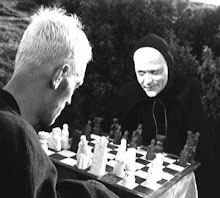
Der Luegen-Geist
"Buddy Holly": """"The US before WWII was 95% anti-Semitic, and just barely beginning to reject the KKK.""""
Du bist voll von scheisse. Sie habe für FDR und "New Deal", und FDR war Freunde mit den Juden.
Verachte nur Vernunft und Wissenschaft,
des Menschen allerhöchste Kraft,
laß nur in Blend- und Zauberwerken
dich von dem Lügengeist bestärken,
so hab' ich dich schon unbedingt.
(from Faust)
Thursday, May 21, 2009

Sunday, May 17, 2009
Beware the Hate Crimes Bill.
Paul Craig Roberts/Counterpunch:
The type of PC-language-paranoia embodied by the GASRA has been on the increase. Reasonable humans should object to racial epithets of all types--including subtle regional ones--ah to be expected--he's from Texas..etc--yet words, even ugly insulting and obscene words, do not bring about bodily harm, and are not literally weapons. In some circumstances, such as the shouting fire in a theatre cliche, trash talkers in bars, or outright threats, speech might be dangerous, may even incite hatred, though establishing the specifics of that hatred-inciting process seems about as subjective as any decision made by the geniuses of the Black Robe posse.
Mere epithets, however, do not equate to a pistol pointed to the head, much less the pistol fired. Making a joke about a Kissinger or Elliot Abrams or DiDi Feinstein does not imply that one has put Mein Kampf to memory. Zappa singing Jewish Princess-- with titanic titz and sand-blasted zits--did not mean to deny the reality of Dachau, I don't think. The big liberal sites--DailyKOS, Salon, DU, Fray--also engage in the PC-speech enforcement, and those who step out of line are troll-rated, banned, given the roadkill recipe.
Paul Craig Roberts/Counterpunch:
""""Since the passage of the Global Anti-Semitism Review Act in 2004, the US Department of State is required to monitor anti-semitism world wide. The State Department is not required to monitor anti-Americanism or sentiments against Christians, Muslims or Arabs. Thus, the act created a specially protected class worthy of careful monitoring by the US Department of State of negative sentiments expressed against Jews.
In order to monitor anti-semitism, the term must be defined. The definition is subjective and will be widely, rather than narrowly, interpreted. The State Department has come up with its attempt. The State Department’s approach could include any truthful statements about Israel and its behavior toward the Palestinians that the Israeli government or AIPAC or the Anti-Defamation League would deny or contest.
Anti-semitic speech can be interpreted as inciting hatred. Inciting hatred can be interpreted to be a violent act. “Excessive” criticism of Israel is a subjective, undefinable concept that can be used to determine anti-semitic speech. It is easy to conflate “excessive” with “strong.” Thus, demands that Israel be held accountable for war crimes committed in Gaza, the West Bank, Lebanon, or elsewhere become acts of the hate crime of anti-semitism."""""
The type of PC-language-paranoia embodied by the GASRA has been on the increase. Reasonable humans should object to racial epithets of all types--including subtle regional ones--ah to be expected--he's from Texas..etc--yet words, even ugly insulting and obscene words, do not bring about bodily harm, and are not literally weapons. In some circumstances, such as the shouting fire in a theatre cliche, trash talkers in bars, or outright threats, speech might be dangerous, may even incite hatred, though establishing the specifics of that hatred-inciting process seems about as subjective as any decision made by the geniuses of the Black Robe posse.
Mere epithets, however, do not equate to a pistol pointed to the head, much less the pistol fired. Making a joke about a Kissinger or Elliot Abrams or DiDi Feinstein does not imply that one has put Mein Kampf to memory. Zappa singing Jewish Princess-- with titanic titz and sand-blasted zits--did not mean to deny the reality of Dachau, I don't think. The big liberal sites--DailyKOS, Salon, DU, Fray--also engage in the PC-speech enforcement, and those who step out of line are troll-rated, banned, given the roadkill recipe.
Thursday, May 14, 2009
Revisionism
VILenin
We have no love for VI Lenin and bolsheviki, but VIL described the philosophical situation of his time fairly accurately (and dare we say Kultur situation); and indeed his remarks still seem applicable to the postmodernists (including Zizek, who praises idealisms of various sorts, including the psychoanalytical sort, ad nauseum), to the rise of religious fundamentalism, and even to a certain type of liberal mysticism which follows the latest pronouncements of the "professiorial class", say the Swineford Physics Department, regarding "possible/alternative worlds". In his contempt for the professoriat, VIL's quite close to Marx's own thinking. At the same time marxist dialectical materialism should not be mistaken for Darwinism as a political model; however ugly, nauseating, or terrifying the average 'Merican might find marxism, humans are still human --not merely the Darwinian primate*--and allowed to think, plan, create as they obtain their economic and biological necessaries. It's make friends with your inner Bolshevik day here on Contingencies!
(*though evolution does hold, and Darwinists performed a service to humanity in terms of revising the dogma of monotheism. Marx himself in fact praised Darwin, at least initially (and for that matter, quoted Hume once in a while, generally not in agreement, but acknowledging his influence). As a psychological model for humans, however, Darwinian determinism has shortcomings, and has been put to nefarious uses by "social darwinists." ).
""""In the sphere of philosophy revisionism followed in the wake of bourgeois professorial “science”. The professors went “back to Kant"—and revisionism dragged along after the neo-Kantians. The professors repeated the platitudes that priests have uttered a thousand times against philosophical materialism—and the revisionists, smiling indulgently, mumbled (word for word after the latest Handbuch) that materialism had been “refuted” long ago. The professors treated Hegel as a “dead dog”,[2] and while themselves preaching idealism, only an idealism a thousand times more petty and banal than Hegel’s, contemptuously shrugged their shoulders at dialectics—and the revisionists floundered after them into the swamp of philosophical vulgarisation of science, replacing “artful” (and revolutionary) dialectics by “simple" (and tranquil) “evolution”. The professors earned their official salaries by adjusting both their idealist and their “critical” systems to the dominant medieval “philosophy” (i.e., to theology)—and the revisionists drew close to them, trying to make religion a “private affair”, not in relation to the modern state, but in relation to the party of the advanced class."""
VILenin
We have no love for VI Lenin and bolsheviki, but VIL described the philosophical situation of his time fairly accurately (and dare we say Kultur situation); and indeed his remarks still seem applicable to the postmodernists (including Zizek, who praises idealisms of various sorts, including the psychoanalytical sort, ad nauseum), to the rise of religious fundamentalism, and even to a certain type of liberal mysticism which follows the latest pronouncements of the "professiorial class", say the Swineford Physics Department, regarding "possible/alternative worlds". In his contempt for the professoriat, VIL's quite close to Marx's own thinking. At the same time marxist dialectical materialism should not be mistaken for Darwinism as a political model; however ugly, nauseating, or terrifying the average 'Merican might find marxism, humans are still human --not merely the Darwinian primate*--and allowed to think, plan, create as they obtain their economic and biological necessaries. It's make friends with your inner Bolshevik day here on Contingencies!
(*though evolution does hold, and Darwinists performed a service to humanity in terms of revising the dogma of monotheism. Marx himself in fact praised Darwin, at least initially (and for that matter, quoted Hume once in a while, generally not in agreement, but acknowledging his influence). As a psychological model for humans, however, Darwinian determinism has shortcomings, and has been put to nefarious uses by "social darwinists." ).
Wednesday, May 13, 2009
PrisonCo
Counterpunch/Cockburn
Better than another episode of Star Trek, Police academy-in-space (Sarge Roddenberry, ex LAPD, founder)
Counterpunch/Cockburn
""""It’s expensive running an ever-expanding gulag. State after state is finding that herding the dangerous classes into prison with tools such as the Rockefeller drug laws and throwing away the key for decades or forever by nonnegotiable mandatory minimum sentencing costs too much. But then there’s a problem: what to do about the prison unions and the towns (like many in New York) that survive economically only because of prison jobs, where the prison population is greater than the population of free people, and the free people love it because, apart from the jobs keeping their kids from fleeing the post-industrial or post-ag wasteland, the prisoners count in the census, giving these towns and regions more representation in statehouses, hence more political power, than they deserve.
Shades of Gogol, who was born 200 years ago this year. The motor of his great novel is the economic use of “dead souls”—deceased serfs listed by the state as assets of the landlords. The novel’s central character, Chichikov, goes around buying them up. New York State could take Gogol’s hint and start auctioning its “living dead” as income generators to other states in need. Looking at our criminal justice system here, Gogol would surely use the line carved on his gravestone: “And I shall laugh my bitter laugh.”"""
Better than another episode of Star Trek, Police academy-in-space (Sarge Roddenberry, ex LAPD, founder)
Sunday, May 10, 2009
Hume, cont.
Fred Wilson:
(the naive sunday schooler reads a few sentences about Hume and skepticism, and thinks the old reprobate denied knowledge via experience, induction, probability, if not science itself. Nyet. As Wilson notes, Hume is not a ultra-skeptic, except in the sense that he points out that causal "laws" are matters of habit and observation, not necessary or axiomatic (that said, I might agree with mechanists that Hume overstated the case for subjectivity, as did the early Popper). Newtonian mechanics were thought absolute, until Einstein arrived. That said, Hume does provide fairly convincing arguments why miracles should not be accepted as legitimate--the uniformity of experience precludes people rising from the dead, or jezebels riding on the back of 10 headed beasts--and a fortiori, why scripture has no authority...While perhaps not quite a Newton, Hume served human liberty.
Even somecheese-eating surrender monkeys french postmodernists, like Deleuze, have expressed an admiration for Hume:
""Deleuze insists that one of Hume's greatest contributions to modern philosophy is his insistence that all relations are external to their terms: this is the essence of Hume's anti-transcendental stance. Human nature cannot unite itself, there is no 'I' which stands before experience, but only moments of experience themselves, unattached and meaningless without any necessary relation to each other. A flash of red, a movement, a gust of wind, these elements must be externally related to each other to create the sensation of a tree in autumn. In the social world, this externality attests to the always-already interested nature of life: no relation is necessary, or governed by neutral laws, so every relation has a localised and passional motive. The ways in which habits are formed attests to the desires at the heart of our social milieu."""""
Contingencies also notes a rather unsettling, anti-essentialist aspect to Hume-- psychological, perhaps, rather than logical. Deleuze's writing also should be considered a type of conceptual psychology, and not philosophy per se--a point overlooked by the PoMo bashers (CS Peirce had claimed Hume as an early pragmatist). Reality is ostensive; knowledge is ostensive. Wittgenstein himself had read Hume, and understands Ostension (Deleuze however referred to Wittgenstein as an assassin of philosophy, or something).
There is a fourth planet-object. Westerners call it "Mars," after Ares.. Egyptians referred to it as eye of Horus. Hindus called it something else. The Mars-object could be named, Sram, or anything, really. Like other planets, Mars follows an elliptical orbit. That's not likely to change, at least until the sun explodes (you think I jest? read the guesstimates of "experts"regarding solaric activity). Hume, however, would remind us that the supposed "laws" of elliptical orbits--or solar physics--while for all intensive purposes permanent (at least they appear so to mere mortals), are themselves not necessary.
There are no comforting, stable eternal truths, whether in terms of human experience, religion, science, or politics, yet the "process" for Hume--or Deleuze, presumably--lacks the mystical or heroic aspects ala Hegel. In that sense, Hume does seem akin to the ancient stoics, who also concerned themselves with chance, fortune, the fates, and hardening themselves against ....Contingencies.
Fred Wilson:
""""Given Hume’s general argument against objective necessary connections, there is no logical necessity attaching to any causal judgement; it is always possible that events will be contrary to any causal law. The human mind can therefore never achieve the level of absolute certainty that Cartesians and Aristotelians demand; all causal judgments are fallible. This amounts to scepticism provided that one thinks that such standards as those of the Cartesian are reasonable. However, given the argument against objective necessities, and therefore against the possibility of absolute certainty, it is not reasonable, Hume holds, to
adopt the Cartesian standard. Hence, given the Humean argument his position
cannot reasonably be characterized as sceptical.
This means in particular that Hume’s pragmatic justification or vindication of the norms of empirical science as the defining standards of human reason is itself empirical and fallible. This does not imply, however, that Hume is a sceptic about science or about causal inferen- ces. For, if a sceptic is one who holds that no causal judgement is ever reasonable or that all are equally reasonable, then Hume is no sceptic. Now, the basic evidence for a causal judgement that all A’s are B’s is
the fact that all observed A’s are Bs. Often enough, however, we observe a
certain contrariety in effects; that is, A’s are sometimes followed by B s and
sometimes by C’s.2’ We do not in such cases, at least we do not if we are
philosophers, simply conclude that there is no causality here, that here it is
chance and not causation that is opera-tive. Rather, we infer that there is a
hitherto unknown factor, call it D*, such that an A is B just in case that it is
D* and is C just in case that it is not D*. We make this inference on the basis
of our past successes in discovering previously unknown causal factors which can explain the contrariety of events. The vulgar, of curse, often do explain by appeal to chance the observed contrariety of effects; to use Hume's example, that my watch sometimes does not work properly is due to chance. But to the artisan such an explanation will not do: he knows better. What stops the watch is not chance but a hidden - unknown but not unknowable cause -for example, a speck of dust?' Science, or what is the same for Hume, philosophy, has systematically extended the watchmaker's experience to many other cases, and has been systematically successful in discovering causes for contrary ef-fects. It is just this fact of experience,
that science has been successful in discovering causes, that leads us to affirm
the proposition, the law about laws to use Mill's phrase:' that for every event
there is a cause, that is, the proposition that for every event there is a
causal law under which it can be subsumed..."
(the naive sunday schooler reads a few sentences about Hume and skepticism, and thinks the old reprobate denied knowledge via experience, induction, probability, if not science itself. Nyet. As Wilson notes, Hume is not a ultra-skeptic, except in the sense that he points out that causal "laws" are matters of habit and observation, not necessary or axiomatic (that said, I might agree with mechanists that Hume overstated the case for subjectivity, as did the early Popper). Newtonian mechanics were thought absolute, until Einstein arrived. That said, Hume does provide fairly convincing arguments why miracles should not be accepted as legitimate--the uniformity of experience precludes people rising from the dead, or jezebels riding on the back of 10 headed beasts--and a fortiori, why scripture has no authority...While perhaps not quite a Newton, Hume served human liberty.
Even some
""Deleuze insists that one of Hume's greatest contributions to modern philosophy is his insistence that all relations are external to their terms: this is the essence of Hume's anti-transcendental stance. Human nature cannot unite itself, there is no 'I' which stands before experience, but only moments of experience themselves, unattached and meaningless without any necessary relation to each other. A flash of red, a movement, a gust of wind, these elements must be externally related to each other to create the sensation of a tree in autumn. In the social world, this externality attests to the always-already interested nature of life: no relation is necessary, or governed by neutral laws, so every relation has a localised and passional motive. The ways in which habits are formed attests to the desires at the heart of our social milieu."""""
Contingencies also notes a rather unsettling, anti-essentialist aspect to Hume-- psychological, perhaps, rather than logical. Deleuze's writing also should be considered a type of conceptual psychology, and not philosophy per se--a point overlooked by the PoMo bashers (CS Peirce had claimed Hume as an early pragmatist). Reality is ostensive; knowledge is ostensive. Wittgenstein himself had read Hume, and understands Ostension (Deleuze however referred to Wittgenstein as an assassin of philosophy, or something).
There is a fourth planet-object. Westerners call it "Mars," after Ares.. Egyptians referred to it as eye of Horus. Hindus called it something else. The Mars-object could be named, Sram, or anything, really. Like other planets, Mars follows an elliptical orbit. That's not likely to change, at least until the sun explodes (you think I jest? read the guesstimates of "experts"regarding solaric activity). Hume, however, would remind us that the supposed "laws" of elliptical orbits--or solar physics--while for all intensive purposes permanent (at least they appear so to mere mortals), are themselves not necessary.
There are no comforting, stable eternal truths, whether in terms of human experience, religion, science, or politics, yet the "process" for Hume--or Deleuze, presumably--lacks the mystical or heroic aspects ala Hegel. In that sense, Hume does seem akin to the ancient stoics, who also concerned themselves with chance, fortune, the fates, and hardening themselves against ....Contingencies.
Thursday, May 07, 2009
From Boswell's The Life of Johnson
Which is to say, the real test of faith--or ~(faith)--starts on one's deathbed.
"""""I mentioned to Dr. Johnson, that David Hume's persisting in his infidelity, when he was dying, shocked me much. JOHNSON. "Why should it shock you, Sir? Hume owned he had never read the New Testament with attention. Here then was a man who had been at no pains to enquire into the truth of religion, and had continually turned his mind the other way. It was not to be expected that the prospect of death would alter his way of thinking, unless GOD should send an angel to set him right." I said, I had reason to believe that the thought of annihilation gave Hume no pain. JOHNSON. "It was not so, Sir. He had a vanity in being thought easy. It is more probable that he should assume an appearance of ease, than so very improbable a thing should be, as a man not afraid of going (as, in spite of his delusive theory, he cannot be sure but he may go), into an unknown state, and not being uneasy at leaving all he knew. And you are to consider, that upon his own principle of annihilation he had no motive to speak the truth." The horrour of death, which I had always observed in Dr. Johnson, appeared strong to-night. I ventured to tell him, that I had been, for moments in my life, not afraid of death; therefore I could suppose another man in that state of mind for a considerable space of time. He said, "he never had a moment in which death was not terrible to him." He added, that it had been observed, that scarce any man dies in publick, but with apparent resolution from that desire of praise which never quits us. I said, Dr. Dodd seemed to be willing to die, and full of hopes of happiness. "Sir, (said he,) Dr. Dodd would have given both his hands and both his legs to have lived. The better a man is, the more afraid is he of death, having a clearer view of infinite purity." He owned, that our being in an unhappy uncertainty as to our salvation, was mysterious; and said, "Ah! we must wait till we are in another state of being, to have many things explained to us." Even the powerful mind of Johnson seemed foiled by futurity. But I thought, that the gloom of uncertainty in solemn religious speculation, being mingled with hope, was yet more consolatory than the emptiness of infidelity. A man can live in thick air, but perishes in an exhausted receiver.""""""
Which is to say, the real test of faith--or ~(faith)--starts on one's deathbed.
Monday, May 04, 2009
Swine-flu Hysteria 101
Well-stated. Also note comment by one "horatiox" regarding vichy-liberal hispanic-bashing, a typical trait of the KOS/DU/Salon crowd generally, now brought out in living color by the flu alarmism. The Demo McMinutemen appear to be as excited as MittRomneyoids are at the prospect of shutting down the border and invading mexico, and/or banning pork products across the US.
"""Clearly the 2009 Swine Flu pandemic is nothing to sneeze at but I think it’s also clear that the 24 hour news and even the CDC - perhaps practicing for a real threat -have hyped this event out of proportion to the real threat. If that’s because the threat really, really cannot be known I supposed it’s fine, but if it’s because this type of thing keeps people focused in ways that are profitable to TV News or grant and funding producing for CDC I hope we take a close look at all this when it’s over. Although epidemiologists are probably going to say “better safe than sorry” with Pandemic alerts it’s also true that overhyped events can lead to a lax future response from a public that becomes too used to “crying wolf” when the threat is actually quite low."""
Well-stated. Also note comment by one "horatiox" regarding vichy-liberal hispanic-bashing, a typical trait of the KOS/DU/Salon crowd generally, now brought out in living color by the flu alarmism. The Demo McMinutemen appear to be as excited as MittRomneyoids are at the prospect of shutting down the border and invading mexico, and/or banning pork products across the US.
Saturday, May 02, 2009

Wednesday, April 29, 2009
"""Putting the Bush years on trial""
Cockburn/Counterpunch:
Cockburn/Counterpunch:
"""'The notion of putting the Bush years on trial has never held allure for President Obama; even less so that of putting Wall Street in the dock. From his lips has always dropped the catechism of uplift and forgiveness, of “moving forward”. He and his advisors had supposed that closing down Guantanamo and issuing a stern denunciation of torture would be sufficient advertisement of the new era; that a few terse reprimands for excessive bonuses for executives would slake the public appetite for retribution on the bankers and tycoons.Cockburnspeak: peligroso pero divertido.. Given that senior Democrats in Congress were, as Cockburn points out, "complicit in sanctioning torture," a bipartisan investigation would probably not amount to much. A non-partisan, special prosecutor--or tribunal, even non-American--would likely carry a bit more weight. Take it to Barry Spinoza's alma mater, the Hague.
On torture, as he approaches the 100-day benchmark, Obama has been forced to change step, in response to public outrage at the chilling stream of memoranda documenting the savageries, and legal justifications for same, ordered and subsequently monitored in minute detail by the Bush high command. Obama's continuing aversion to any serious calling to account of the sponsors of torture has been evident in his almost daily shifts in position. At the start of this last week he indicated that yes, those okaying the tortures might be legally answerable, that a “Truth Commission” might be the way forward. By Thursday he was backing into that, saying that a commission would “open the door to a protracted, backward-looking discussion” and in the language of his press secretary, "the president determined the concept didn't seem altogether workable in this case" because of the intense partisan atmosphere built around the issue.
So it’s still not clear whether Bush, Cheney, Rumsfeld and their subordinates will have to endure the soft option of a bipartisan commission of enquiry, or face a special prosecutor, or sit back and watch political momentum flag as the issue devolves into lengthy and possibly closed hearings by the Senate Intelligence Committee. As Republicans have not been slow in pointing out, senior Democrats in Congress were certainly complicit in sanctioning torture as early as 2002. They say House Speaker Nancy Pelosi endorsed waterboarding. She says she did not.
As always, former vice president Cheney has usefully raised the stakes. Did the various tortures, the hundreds of waterboarding sessions, the exposure of naked captives to weeks of intense cold in small concrete boxes, actually make America safer? Cheney snarls on television that they did, thus inviting documented ripostes that this is far from clear, and indeed they contributed nothing of advantage to the national interest.""""
Monday, April 27, 2009
DiFi the Enhancer
The vengeance craze also raises another problem: that some politician (of whatever party) approves of enhanced interrogation techniques does not therefore exculpate (google 'er Bubba) the officers and soldiers who have chosen to use such techniques, though many sentimental liberals seem to think otherwise. We might call this the My Lai meme. The grunt agrees to shoot enemy soldiers. He does not agree to My Lai-like devastation, and when he does follow a Lt. Calley's sinister commands to rape pillage and murder he has himself become party to the crime (and atrocity). Similarly, when soldiers agree to use torture they have themselves become party to the crimes of their COs (whether that's a colonel, or commander in chief). To think otherwise--to insist the underlings had to follow orders, and are therefore innocent--seems, like, tantamount to seriously sick mierda.
""""Sen. Dianne Feinstein of California pointedly noted that her Intelligence Committee already is investigating the Bush administration's legal underpinnings for the interrogation program and the value of information gained from it. And several Democratic leaders appeared to favor using that panel for any hearings.That's not to bless the powerline hick--Contingencies favors an investigation into possible war crimes on the part of BushCo--but Powerline at least understands something like Due Process. The BO-bots have been stalling on the "Truth Commission" (paging Eric Blair) probably because the smarter Dems realize that any serious investigation will implicate most if not all leading Donkeycrats, including DiFi, Pelosi (who apparently approved of "enhanced" interrogation techniques as well), Hillarity, Kerry, Emanuel, Biden and the rest. The Torture party, say some in Bubbaland--that would be the Demopublican par-tay aka US Govt., though consistency rarely bothers a D-pub. Of course, prosecutors, whether real or wannabe, generally approve of torture as a tactic. As Nietzsche realized--not to say the ancient greeks-- most plebes crave retributive justice; the Erinyes brawl and byatch for a few dozen centuries until Apollo arrives with the Reason-light .
I think that's a great idea. Sen. Feinstein can call herself as the first witness and explain why she enthusiastically endorsed waterboarding and other "enhanced" interrogation techniques back in the days before the Bush administration devastated al Qaeda, and we were all worried about being blown up.""""
The vengeance craze also raises another problem: that some politician (of whatever party) approves of enhanced interrogation techniques does not therefore exculpate (google 'er Bubba) the officers and soldiers who have chosen to use such techniques, though many sentimental liberals seem to think otherwise. We might call this the My Lai meme. The grunt agrees to shoot enemy soldiers. He does not agree to My Lai-like devastation, and when he does follow a Lt. Calley's sinister commands to rape pillage and murder he has himself become party to the crime (and atrocity). Similarly, when soldiers agree to use torture they have themselves become party to the crimes of their COs (whether that's a colonel, or commander in chief). To think otherwise--to insist the underlings had to follow orders, and are therefore innocent--seems, like, tantamount to seriously sick mierda.
Sunday, April 26, 2009
Down on Rue Morgue Avenue
Music fans have for years offered their assessment of the Bob Dylan phenomena: brooding, Rimbaud-like genius of rock, OR overrated, vain opportunist and wheezing musical primitive? As with the knuckles-dichotomy of Love and Hate, there doesn't seem to be a middle ground with Dylan/Zimmerman. I tend to side with the skeptics, like Jack Marx, who claims that Dylan invented "the arrogant, faux-cerebral posturing" typical of many rock stars and celebrities (tho' BD might have taken lessons from Brando). Some Dylan musick--from say late 60s, the Highway 61 Revisited/Blonde on Blonde stuff (the tasty organ riffs, from Al Kooper I believe, and Bloomsfield licks made the sound)-- still packs a bit of a punch, yet I find his voice wearisome, his music simplistic and the faux-cerebral schtick tiresome (then most 60s muzak produces that effect at this stage, including those psycho-delic musical hall jingles of the Beatless).
At some point in the 70s, after he recuperated from his mysterious motorcycle crash (he never entered a hospital), Dylan morphed into a businessman and "celebrity", though the folky 70s sound verges on nauseating really, especially compared to some of the creative music of the time--say Hendrix, Corea, early Steely Dan, the ECM crowd, Bill Evans or Getz's final works, minimalism, Zappa. Peaches in Regalia may sound a bit trite or phreaky now, but the freaks got to have some chops to play it, and other FZ works. Then compared to an interesting Chopin etude played competently, most rock, like Brown shoes, doesn't make it ...
Dylan's a competent tunesmith, a poet of sorts, and he rocks at times, though his best vamps, once he got over the boring Guthrie imitations, were blues variations for most part (From a Buick 6, etc.). His recent music sounds rather traditional as well: country-blues sounds, with a few rock like numbers, biblical hints, a certain social-realist aspect to the writing, with highways, trains, rivers, the lonesome belle, and so forth (more Steinbeck than surrealist, really). Some of his recent musick at times leans towards jazz--like "Bye and Bye," a few others on Love and Theft--- but not much different than the average bar band blasting out Muddy Waters (the jam on High Water not bad--what was up with Chas. Darwin reference?). It's a free country and all---no one forces you to buy a Dylan or Dead CD, or tickets to their hootenanny---yet the infatuation shown by some for Dylanianna seems on the whole misplaced and irrational.
Not approving of Dylan does not mean one thereby sides with the hawks or the squares, and so forth: I imagine Theodore Adorno (not a guru, but had interesting insight on pop muzak) felt the same about Zimmerman's music as he did about Joanie Baez; which is to say, Dylan's hymns uphold conservatism really, regardless of the radical chic, and PC politics. Americans are better off reading Chomsky's thoughts on 'Nam (not necessarily always agreeing) than unravelling Dylan lyrics (or joining the rock bacchanalia as a whole, really). Dylan's move towards Christianity (and recently Judaism, supposedly) should not have surprised us overly much, either (John Lennon was not completely down with Dylan's conversion, and wrote "Serve Yourself" a few months before being murdered).
Other Dylan skeptics, such as the aforementioned Jack Marx,have pointed out a certain shallowness to Dylan's persona and sound:
"....Dylan pulled off the most prestigious magic trick in modern music's history: he created a persona full of charisma and intelligence both real and affected, then repeatedly disowned it, disappearing into a notional bunker of vagueness before the questions got too tricky, the silence leaving fans gasping for explanations that, beyond some very engaging show-business chutzpah, probably were never there. "Anybody can be specific and obvious," Dylan told Playboy in 1966. "That's always been the easy way. It's not that it's so difficult to be unspecific and less obvious; it's just that there's nothing, absolutely nothing, to be specific and obvious about." How phoney, and yet how true."""
No, Dylan's not completely phony--Positively 4th street rings fairly true, even now. The situation seems more akin to that of the washed-up bullfighter Belmonte in Hemingway's The Sun Also Rises, who competes against the young gallant Pedro Romero. Senor Belmonte, El Viejo Torero, was great once, as far as bullfighters go, though way past his prime, he appears like an old clown when in the ring. El Viejo Dylan may have been great, as far as troubadours go (and Zimmy hisself said he wrote "just songs"). Now, past his prime, he's entered the Belmonte zone.
Music fans have for years offered their assessment of the Bob Dylan phenomena: brooding, Rimbaud-like genius of rock, OR overrated, vain opportunist and wheezing musical primitive? As with the knuckles-dichotomy of Love and Hate, there doesn't seem to be a middle ground with Dylan/Zimmerman. I tend to side with the skeptics, like Jack Marx, who claims that Dylan invented "the arrogant, faux-cerebral posturing" typical of many rock stars and celebrities (tho' BD might have taken lessons from Brando). Some Dylan musick--from say late 60s, the Highway 61 Revisited/Blonde on Blonde stuff (the tasty organ riffs, from Al Kooper I believe, and Bloomsfield licks made the sound)-- still packs a bit of a punch, yet I find his voice wearisome, his music simplistic and the faux-cerebral schtick tiresome (then most 60s muzak produces that effect at this stage, including those psycho-delic musical hall jingles of the Beatless).
At some point in the 70s, after he recuperated from his mysterious motorcycle crash (he never entered a hospital), Dylan morphed into a businessman and "celebrity", though the folky 70s sound verges on nauseating really, especially compared to some of the creative music of the time--say Hendrix, Corea, early Steely Dan, the ECM crowd, Bill Evans or Getz's final works, minimalism, Zappa. Peaches in Regalia may sound a bit trite or phreaky now, but the freaks got to have some chops to play it, and other FZ works. Then compared to an interesting Chopin etude played competently, most rock, like Brown shoes, doesn't make it ...
Dylan's a competent tunesmith, a poet of sorts, and he rocks at times, though his best vamps, once he got over the boring Guthrie imitations, were blues variations for most part (From a Buick 6, etc.). His recent music sounds rather traditional as well: country-blues sounds, with a few rock like numbers, biblical hints, a certain social-realist aspect to the writing, with highways, trains, rivers, the lonesome belle, and so forth (more Steinbeck than surrealist, really). Some of his recent musick at times leans towards jazz--like "Bye and Bye," a few others on Love and Theft--- but not much different than the average bar band blasting out Muddy Waters (the jam on High Water not bad--what was up with Chas. Darwin reference?). It's a free country and all---no one forces you to buy a Dylan or Dead CD, or tickets to their hootenanny---yet the infatuation shown by some for Dylanianna seems on the whole misplaced and irrational.
Not approving of Dylan does not mean one thereby sides with the hawks or the squares, and so forth: I imagine Theodore Adorno (not a guru, but had interesting insight on pop muzak) felt the same about Zimmerman's music as he did about Joanie Baez; which is to say, Dylan's hymns uphold conservatism really, regardless of the radical chic, and PC politics. Americans are better off reading Chomsky's thoughts on 'Nam (not necessarily always agreeing) than unravelling Dylan lyrics (or joining the rock bacchanalia as a whole, really). Dylan's move towards Christianity (and recently Judaism, supposedly) should not have surprised us overly much, either (John Lennon was not completely down with Dylan's conversion, and wrote "Serve Yourself" a few months before being murdered).
Other Dylan skeptics, such as the aforementioned Jack Marx,have pointed out a certain shallowness to Dylan's persona and sound:
"....Dylan pulled off the most prestigious magic trick in modern music's history: he created a persona full of charisma and intelligence both real and affected, then repeatedly disowned it, disappearing into a notional bunker of vagueness before the questions got too tricky, the silence leaving fans gasping for explanations that, beyond some very engaging show-business chutzpah, probably were never there. "Anybody can be specific and obvious," Dylan told Playboy in 1966. "That's always been the easy way. It's not that it's so difficult to be unspecific and less obvious; it's just that there's nothing, absolutely nothing, to be specific and obvious about." How phoney, and yet how true."""
No, Dylan's not completely phony--Positively 4th street rings fairly true, even now. The situation seems more akin to that of the washed-up bullfighter Belmonte in Hemingway's The Sun Also Rises, who competes against the young gallant Pedro Romero. Senor Belmonte, El Viejo Torero, was great once, as far as bullfighters go, though way past his prime, he appears like an old clown when in the ring. El Viejo Dylan may have been great, as far as troubadours go (and Zimmy hisself said he wrote "just songs"). Now, past his prime, he's entered the Belmonte zone.
Thursday, April 23, 2009
Casino Feinstein
From Harper's:
Dame DiFi's now expanded her bunko operation from war profiteering to mortgage scams. As many DiFi-watchers probably realize, this isn't the first time that DiDi has awarded sweet deals to her Bay-area sugar-daddy Blum--just the first time some VIP has seemed to mind (DiFi's now spinning the "we didn't know" meme, which seems to work fine for politicians--not for homies in cellblock B). It's probably Buh-bye to gubernational dreams, and back to Bayberg for DF--though with Blum/CB Ellis' deep pockets funding her, she could conceivably hire some Ueber-Attorney to cook the books, and soon return to mishandling assault rifles in front of Demopublicans.
From Harper's:
"""On the day the new Congress convened this year, Sen. Dianne Feinstein introduced legislation to route $25 billion in taxpayer money to a government agency that had just awarded her husband’s real estate firm a lucrative contract to sell foreclosed properties at compensation rates higher than the industry norms.
Mrs. Feinstein’s intervention on behalf of the Federal
Deposit Insurance Corp. was unusual: the California Democrat isn’t a member of the Senate Committee on Banking, Housing and Urban Affairs with jurisdiction over FDIC; and the agency is supposed to operate from money it raises from bank-paid insurance payments—not direct federal dollars.
Documents reviewed by The Washington Times show Mrs. Feinstein first offered on Oct. 30 to help the FDIC secure money for its effort to stem the rise of home foreclosures. Her letter was sent just days before the agency determined that CB Richard Ellis Group (CBRE)—the commercial real estate firm that her husband Richard Blum heads as board chairman—had won the competitive
bidding for a contract to sell foreclosed properties that FDIC had inherited
from failed banks.""""
Dame DiFi's now expanded her bunko operation from war profiteering to mortgage scams. As many DiFi-watchers probably realize, this isn't the first time that DiDi has awarded sweet deals to her Bay-area sugar-daddy Blum--just the first time some VIP has seemed to mind (DiFi's now spinning the "we didn't know" meme, which seems to work fine for politicians--not for homies in cellblock B). It's probably Buh-bye to gubernational dreams, and back to Bayberg for DF--though with Blum/CB Ellis' deep pockets funding her, she could conceivably hire some Ueber-Attorney to cook the books, and soon return to mishandling assault rifles in front of Demopublicans.
Monday, April 20, 2009
J.G. Ballard, RIP
From the JGB-Death-Tribute-show:
"JG Ballard is gone, wheels-up from the abandoned airstrip of our imaginations, but his coiled brilliance will lie in waiting for just the right unsuspecting teenager — and there’s always one, in every suburb — who opens Crash to read the unforgettable lines, “Vaughan died yesterday in his last car crash. During our friendship, he had rehearsed his death in many car crashes, but this was his only true accident.” She will read those lines, and 224 pages later, close the book dazedly, firm in the knowledge that her worldview has been shattered and wired back together, and for the darker better.
The sci-fi novelist William Gibson was one such teenager.
“I was so young when I first discovered Ballard’s work,” he told me, in an interview for my L.A. Weekly review of Ballard’s memoir, Miracles of Life. (The interview ended up on the cutting-room floor.) “Thirteen, fourteen. I probably read him before I read Burroughs, but only by a few months. I seem to remember Burroughs baffling me at first, too many moving parts, but Ballard seemed to have the keys to the kingdom. In retrospect it was like a lot of great foreign cinema that I hadn’t seen yet. Long pans without actors. I remember finding it all enormously welcoming, and calming somehow. He became a literary hero of mine without my ever having to think about it.
[...] Most ‘influence’ questions just cause me to shrug, but Ballard? Huge. And durable. More than anyone else, really.
My first work of fiction, ever, consisted of a single faux-Ballardian sentence: ‘Seated each afternoon in the darkened screening room, [ ] came to perceive the targeted numerals of the academy leader as hypnagogic sigils preceding the dream state of film.’ I worked on that for so long, months, that I’ve never forgotten it.”
Gibson’s unindicted co-conspirator in the cyberpunk insurgency, Bruce Sterling, offered his thoughts.
“He’s truly a great science fiction writer,” he told me, by e-mail. “One of the few. Lovecraft is also a great science fiction writer, and creates the same intensely visionary world, the same kind of lasting, all-devouring, even bewildering appeal. But Ballard certainly writes much better than Lovecraft. He’s a better artist.” Even so, noted Sterling, he remains a cult figure — ”globally notorious,” a “persistent critics’ darling” with a swelling following, but a cult figure nonetheless. “Ballard’s intelligence and surreal worldview simply intimidate readers,” said Sterling. “Most people who might read Ballard pick up one of his books, forge 30 pages in, become baffled and obscurely terrified, and never dare to open another one. Of course he’s a good writer, but he’s the strong stuff; nobody picks up six-packs of Laphroaig.”
(Mark Dery)
.........
"""It is also a drily funny score-settling with Little England, whose rattletrap cars he described as “coal scuttles,” on first seeing them after moving back to Britain from China, and whose morose, “putty-faced” people had won the war but acted, he thought, as if they’d lost it. Ballard was perversely fond of America in the way that, say, Kafka or Baudrillard were; he regarded the U.S.A. with a kind of horrified delight, and loved best all that is worst about our theme-parked nightmare, which he reimagined in Hello America as a post-apocalyptic disaster zone, presided over by a President Charles Manson. And he cordially detested the class-conscious, parochial England of Prince Charles’s Poundbury and the Boy’s Own Paper, refusing Commander of the British Empire honors in 1993 with the withering quip that such “Ruritanian charade[s]” help “prop up our top-heavy monarchy.”
----------------------------------
Bruce Sterling described BallardSpeak fairly effectively. To reiterate: “Ballard’s intelligence and surreal worldview simply intimidate readers,” said Sterling. “Most people who might read Ballard pick up one of his books, forge 30 pages in, become baffled and obscurely terrified, and never dare to open another one. Of course he’s a good writer, but he’s the strong stuff; nobody picks up six-packs of Laphroaig.”
Ballard's Vermillion Sands presented an odd, organic sort of sci-fi, quite different than the space operas and heroics of a Heinlein or Asimov. With Ballard, we did not need to be transported to Mars, or galaxy Andromeda, but could contemplate futuristic colonies in the Sonoran desert, with aria-singing orchids, and holographic gardens....His later books grew darker, yet remained eloquent and "British"--perhaps too eloquent, though Brit writers, sci-fi, or trad., generally creep out 'Mericans. Really, the nightmare of Hello America with President Manson, or the auto-dystopia of Crash do not seem that "surreal" in this day of Cho's, supercarriers, and LAPD GPS-guided paramilitary ops.
PK Dick--not to say Orwell--understood dystopia, yet at times PK Dick lacked what film dweebs call verisimilitude (though PKD's police state hallucinations ala A Scanner Darkly were generally entertaining). Ballard had more of an objective vision, similar to Orwell in ways--though as Sterling hinted at, with a Lovecraftian vibe. JGB understood dystopia, or maybe it's psychopathology (though not necessarily the Parisian marxist sort), and depicts it authentically--scaring the phuck out of those in Consumerland who manage to crawl through his labyrinthes.
From the JGB-Death-Tribute-show:
"JG Ballard is gone, wheels-up from the abandoned airstrip of our imaginations, but his coiled brilliance will lie in waiting for just the right unsuspecting teenager — and there’s always one, in every suburb — who opens Crash to read the unforgettable lines, “Vaughan died yesterday in his last car crash. During our friendship, he had rehearsed his death in many car crashes, but this was his only true accident.” She will read those lines, and 224 pages later, close the book dazedly, firm in the knowledge that her worldview has been shattered and wired back together, and for the darker better.
The sci-fi novelist William Gibson was one such teenager.
“I was so young when I first discovered Ballard’s work,” he told me, in an interview for my L.A. Weekly review of Ballard’s memoir, Miracles of Life. (The interview ended up on the cutting-room floor.) “Thirteen, fourteen. I probably read him before I read Burroughs, but only by a few months. I seem to remember Burroughs baffling me at first, too many moving parts, but Ballard seemed to have the keys to the kingdom. In retrospect it was like a lot of great foreign cinema that I hadn’t seen yet. Long pans without actors. I remember finding it all enormously welcoming, and calming somehow. He became a literary hero of mine without my ever having to think about it.
[...] Most ‘influence’ questions just cause me to shrug, but Ballard? Huge. And durable. More than anyone else, really.
My first work of fiction, ever, consisted of a single faux-Ballardian sentence: ‘Seated each afternoon in the darkened screening room, [ ] came to perceive the targeted numerals of the academy leader as hypnagogic sigils preceding the dream state of film.’ I worked on that for so long, months, that I’ve never forgotten it.”
Gibson’s unindicted co-conspirator in the cyberpunk insurgency, Bruce Sterling, offered his thoughts.
“He’s truly a great science fiction writer,” he told me, by e-mail. “One of the few. Lovecraft is also a great science fiction writer, and creates the same intensely visionary world, the same kind of lasting, all-devouring, even bewildering appeal. But Ballard certainly writes much better than Lovecraft. He’s a better artist.” Even so, noted Sterling, he remains a cult figure — ”globally notorious,” a “persistent critics’ darling” with a swelling following, but a cult figure nonetheless. “Ballard’s intelligence and surreal worldview simply intimidate readers,” said Sterling. “Most people who might read Ballard pick up one of his books, forge 30 pages in, become baffled and obscurely terrified, and never dare to open another one. Of course he’s a good writer, but he’s the strong stuff; nobody picks up six-packs of Laphroaig.”
(Mark Dery)
.........
"""It is also a drily funny score-settling with Little England, whose rattletrap cars he described as “coal scuttles,” on first seeing them after moving back to Britain from China, and whose morose, “putty-faced” people had won the war but acted, he thought, as if they’d lost it. Ballard was perversely fond of America in the way that, say, Kafka or Baudrillard were; he regarded the U.S.A. with a kind of horrified delight, and loved best all that is worst about our theme-parked nightmare, which he reimagined in Hello America as a post-apocalyptic disaster zone, presided over by a President Charles Manson. And he cordially detested the class-conscious, parochial England of Prince Charles’s Poundbury and the Boy’s Own Paper, refusing Commander of the British Empire honors in 1993 with the withering quip that such “Ruritanian charade[s]” help “prop up our top-heavy monarchy.”
----------------------------------
Bruce Sterling described BallardSpeak fairly effectively. To reiterate: “Ballard’s intelligence and surreal worldview simply intimidate readers,” said Sterling. “Most people who might read Ballard pick up one of his books, forge 30 pages in, become baffled and obscurely terrified, and never dare to open another one. Of course he’s a good writer, but he’s the strong stuff; nobody picks up six-packs of Laphroaig.”
Ballard's Vermillion Sands presented an odd, organic sort of sci-fi, quite different than the space operas and heroics of a Heinlein or Asimov. With Ballard, we did not need to be transported to Mars, or galaxy Andromeda, but could contemplate futuristic colonies in the Sonoran desert, with aria-singing orchids, and holographic gardens....His later books grew darker, yet remained eloquent and "British"--perhaps too eloquent, though Brit writers, sci-fi, or trad., generally creep out 'Mericans. Really, the nightmare of Hello America with President Manson, or the auto-dystopia of Crash do not seem that "surreal" in this day of Cho's, supercarriers, and LAPD GPS-guided paramilitary ops.
PK Dick--not to say Orwell--understood dystopia, yet at times PK Dick lacked what film dweebs call verisimilitude (though PKD's police state hallucinations ala A Scanner Darkly were generally entertaining). Ballard had more of an objective vision, similar to Orwell in ways--though as Sterling hinted at, with a Lovecraftian vibe. JGB understood dystopia, or maybe it's psychopathology (though not necessarily the Parisian marxist sort), and depicts it authentically--scaring the phuck out of those in Consumerland who manage to crawl through his labyrinthes.
Saturday, April 18, 2009
The Power that Made the Body Heals the Body, Brruthrr (Chiro-quacks, cont.)
"""Exemption clauses instead of chiro laws by all means, and LET THAT EXEMPTION BE THE RIGHT TO PRACTICE OUR RELIGION. But we must have a religious head, one who is the founder, as did Christ, Mohamed, Jo. Smith, Mrs. Eddy, Martin Luther and others who have founded religions. I am the fountain head. I am the founder of chiropractic in its science, in its art, in its philosophy and in its religious phase. Now, if chiropractors desire to claim me as their head, their leader, the way is clear. My writings have been gradually steering in that direction until now it is time to assume that we have the same right to as have Christian Scientists."""" (DD Palmer, founder of "Chiropractics")
Palmer's "subluxation" was a quack idea and hustle from the start and motivated by religious, if not racial factors. The early chiros played on fears of vaccination--vaccines devised by foreigners, frenchmen, "zionists," and so forth. Keep the American Christian blood of your children untainted by the pollution of modern medicine, pilgrim, and instead use the natural chiropractic cure! (Note "Jo. Smith"--the founder of Mormonism, who supposedly saw the Golden Plates--listed among the Visionaries in Palmer's rant). Palmer, a "magnetic healer", and grocer or something--and not qualified in medicine whatsoever--insisted that vaccines and modern medicine were superfluous; instead, the Spine held the secrets to Health: "A subluxated vertebra, a vertebral bone, is the cause of 95 percent of all diseases."
Physicians opposed Palmer's Chiropractic from its commencement. As one skeptic of chiropractic,Dr. Jarvis states, "Palmer contrived the notion that "subluxations" of the spine impinge nerves, interfering with nerve flow, which he dubbed the Innate Life Force, and that all a practitioner had to do was to adjust the spine -- the healing powers of nature would do the rest. Neither Palmer nor any other chiropractor has ever been able to reliably demonstrate the existence of "subluxations," much less validate their importance to health and disease." The AMA rightfully listed Chiropractic as quack medicine starting in the 20s, and that lasted until 70s, when they re-classified it as "alternative medicine", along with like herbal remedies and acupuncture--Chiropractic still in the class of Bogus for most reasonable humans.

Doc Palmer, founder of Chiropractic
Chiropractors have attempted to reconcile their quasi-metaphysical "subluxation" concept with modern medical science, but experiments have consistently revealed no empirical support for subluxation (not surprising, since Palmer claimed the spinal column was more or less the meeting place between the immortal soul and the human body) . A few chiros may be skilled enough to offer a type of physical therapy for spinal injuries (that is, when they read the X-rays correctly), yet any competent physician--if not RN--possesses that skill. The treatments of back injuries are better left to the physician.
The chiro. biz also depends upon misleading and fraudulent advertising and marketing and that involves not only the DCs (not MDs or Dr.s), but the businesses which cater to DCs and the offices. Bunko artists market supposedly "ergonomic" pens and keyboards which will sooth and alleviate back injuries (if not anything which ails ye) because of some mysterious "subluxational" realignment (as one Sacramento chiro-bunko artist claims of his gimcracker pens, "Drop off a bundle at your community’s welcome wagon, and automatically introduce yourself to every new family in the area!""). Often the advertising goes beyond mere misrepresentation and verges on a type of medical malpractice: some gullible elderly persons with back injuries could conceivably see these bent pens or "ergonomic" keypads and think they will eliminate their back pains or spinal injuries merely by using the bentpen or asymmetrical keypad. The false claims and misleading advertising of the Chiro-quacks have, in fact, been subjected to litigation, and the chiropractor business has declined by over 25% in the last decade. Hopefully that will be 100% in the next few years: and the hucksters and bunko artists will return to flipping 'cakes at the IHOP, methodist-mormon preaching, tire-busting.
Buh Bye, Bubba the Subluxanator.
"""Exemption clauses instead of chiro laws by all means, and LET THAT EXEMPTION BE THE RIGHT TO PRACTICE OUR RELIGION. But we must have a religious head, one who is the founder, as did Christ, Mohamed, Jo. Smith, Mrs. Eddy, Martin Luther and others who have founded religions. I am the fountain head. I am the founder of chiropractic in its science, in its art, in its philosophy and in its religious phase. Now, if chiropractors desire to claim me as their head, their leader, the way is clear. My writings have been gradually steering in that direction until now it is time to assume that we have the same right to as have Christian Scientists."""" (DD Palmer, founder of "Chiropractics")
Palmer's "subluxation" was a quack idea and hustle from the start and motivated by religious, if not racial factors. The early chiros played on fears of vaccination--vaccines devised by foreigners, frenchmen, "zionists," and so forth. Keep the American Christian blood of your children untainted by the pollution of modern medicine, pilgrim, and instead use the natural chiropractic cure! (Note "Jo. Smith"--the founder of Mormonism, who supposedly saw the Golden Plates--listed among the Visionaries in Palmer's rant). Palmer, a "magnetic healer", and grocer or something--and not qualified in medicine whatsoever--insisted that vaccines and modern medicine were superfluous; instead, the Spine held the secrets to Health: "A subluxated vertebra, a vertebral bone, is the cause of 95 percent of all diseases."
Physicians opposed Palmer's Chiropractic from its commencement. As one skeptic of chiropractic,Dr. Jarvis states, "Palmer contrived the notion that "subluxations" of the spine impinge nerves, interfering with nerve flow, which he dubbed the Innate Life Force, and that all a practitioner had to do was to adjust the spine -- the healing powers of nature would do the rest. Neither Palmer nor any other chiropractor has ever been able to reliably demonstrate the existence of "subluxations," much less validate their importance to health and disease." The AMA rightfully listed Chiropractic as quack medicine starting in the 20s, and that lasted until 70s, when they re-classified it as "alternative medicine", along with like herbal remedies and acupuncture--Chiropractic still in the class of Bogus for most reasonable humans.

Doc Palmer, founder of Chiropractic
Chiropractors have attempted to reconcile their quasi-metaphysical "subluxation" concept with modern medical science, but experiments have consistently revealed no empirical support for subluxation (not surprising, since Palmer claimed the spinal column was more or less the meeting place between the immortal soul and the human body) . A few chiros may be skilled enough to offer a type of physical therapy for spinal injuries (that is, when they read the X-rays correctly), yet any competent physician--if not RN--possesses that skill. The treatments of back injuries are better left to the physician.
The chiro. biz also depends upon misleading and fraudulent advertising and marketing and that involves not only the DCs (not MDs or Dr.s), but the businesses which cater to DCs and the offices. Bunko artists market supposedly "ergonomic" pens and keyboards which will sooth and alleviate back injuries (if not anything which ails ye) because of some mysterious "subluxational" realignment (as one Sacramento chiro-bunko artist claims of his gimcracker pens, "Drop off a bundle at your community’s welcome wagon, and automatically introduce yourself to every new family in the area!""). Often the advertising goes beyond mere misrepresentation and verges on a type of medical malpractice: some gullible elderly persons with back injuries could conceivably see these bent pens or "ergonomic" keypads and think they will eliminate their back pains or spinal injuries merely by using the bentpen or asymmetrical keypad. The false claims and misleading advertising of the Chiro-quacks have, in fact, been subjected to litigation, and the chiropractor business has declined by over 25% in the last decade. Hopefully that will be 100% in the next few years: and the hucksters and bunko artists will return to flipping 'cakes at the IHOP, methodist-mormon preaching, tire-busting.
Buh Bye, Bubba the Subluxanator.
Friday, April 17, 2009
How not to Read a Wiki (Chiro-quacktics, cont.)
One McDyslexic writes ""A reader- just a tad off topic- writes:
“subluxation”–his selling point for his gimcrackery ballpoints– has been debunked as pseudo-science (the spiritual substance of yr spine!)"""
I was curious so I consulted wikipedia, which says nothing of the kind. Presumably that’s why there was no link."""
In fact, McDyslexic didn't even bother to read the entire Wiki (or can't): check the link again, Einstein. From the last paragraph:
Hmmm, to Reiterate: ""rejected by medical science."" Sort of like debunked? In fact, mo' better. Let's say it again, Subluxation....rejected by medical science. Bada bing, bada boom. Back to Houston, Reverend Fraudonius (now, let's hear Fraud-Ron's usual Ad Hominems, lies, verbal belches, character attacks. Mansonite, nnnneo-con queer nazis!).
More info. (from McDyslexic's own LINK via Wiki):
Can ah, ah get a witness?
One McDyslexic writes ""A reader- just a tad off topic- writes:
“subluxation”–his selling point for his gimcrackery ballpoints– has been debunked as pseudo-science (the spiritual substance of yr spine!)"""
I was curious so I consulted wikipedia, which says nothing of the kind. Presumably that’s why there was no link."""
In fact, McDyslexic didn't even bother to read the entire Wiki (or can't): check the link again, Einstein. From the last paragraph:
"""Although research into the significance of the chiropracticand from the cited article:
vertebral subluxation is ongoing in chiropractic circles, the concept is rejected by mainstream medicine and progressive chiropractors.""""
"""""Campbell JB, Busse JW, Injeyan HS (2000). "Chiropractors and vaccination: a historical perspective". Pediatrics 105 (4): e43. doi:10.1542/peds.105.4.e43. PMID 10742364. http://pediatrics.aappublications.org/cgi/content/full/105/4/e43.
"... considered disease the result of spinal nerve dysfunction caused by misplaced (subluxated) vertebrae. Although rejected by medical
science, this concept is still accepted by a minority of chiropractors....
Indeed, many progressive chiropractors have rejected the historical concept of the chiropractic subluxation in favor of ones that more accurately describe the nature of the complex joint disfunctions they treat.""""""""
Hmmm, to Reiterate: ""rejected by medical science."" Sort of like debunked? In fact, mo' better. Let's say it again, Subluxation....rejected by medical science. Bada bing, bada boom. Back to Houston, Reverend Fraudonius (now, let's hear Fraud-Ron's usual Ad Hominems, lies, verbal belches, character attacks. Mansonite, nnnneo-con queer nazis!).
More info. (from McDyslexic's own LINK via Wiki):
""""By using spinal manipulation therapy for the removal of subluxations,
[Palmer] believed he was influencing a life force within the body which he named
"innate intelligence," the unimpeded presence of which was essential for good
health. When he later equated innate intelligence with a personified part of
universal intelligence (God), the religious overtones of chiropractic became
manifest.""""
Holy Subluxational Intelligence Batman!
More on Chiro-quacktics:
Ah those poisonous, evil.......Vaccinations, from the Zionist Lamanites: Into the fiery flames!""""Building on the concepts of his father, B. J. promulgated a form of health care incompatible with that provided by practitioners of orthodox medicine. He emphasized that chiropractic did not cure or heal, but instead removed interference with the normal functioning of the innate intelligence, thereby allowing the body to heal itself. This concept resulted in a conflict with the germ theory of disease, which was gaining acceptance at the time. Although B. J. did not dispute the existence of germs, he rejected the proposition that they were the causes of infectious disease.
"""" Morris Fishbein, secretary of the American Medical Association (AMA) and editor of its journal from 1924 to 1949, was 1 of the most influential of the antichiropractic forces, grouping chiropractic along with antivivisectionism and osteopathy as "nonmedical cults," and referring to the profession as "chiroquactic.""""""
Can ah, ah get a witness?
Tuesday, April 14, 2009
Pascal's wager, redux
Cat-eyes:
As the Wiki puts it, ""Pascal's Wager (or Pascal's Gambit) is a suggestion posed by the French philosopher Blaise Pascal that even though the existence of God cannot be determined through reason, a person should "wager" as though God exists, because so living has everything to gain, and nothing to lose." Sort of like a Win-win situation, but a bit more subtle; french subtleties tend to scare WASPs, of course (or WASPettes).
One X describes Pascal's Wager:
Menschliches, Allzumenschliches.
...... ...... ...... ........... .........
Pascal's wager does not lack a certain pragmatic force. Regardless, thinkers have criticized it for the last few centuries--Richard Dawkins' points contra-Pascal some of the most recent criticism. Dawkins may have a point that the scenario of belief and no-God may not result only in "nothing lost": all the time and energy spent going to church, participating, taking mass or communion, praying (especially if one prays to Nada) could be a loss, assuming there is ~God. That hints at another issue--the status of other faiths---which Cat-eyes may have hinted at (as did Dawkins, I believe), though did not really flesh it out. Yes, the choice of faiths would also be part of the Wager, or expanded Wager (Osiris forbid the faithful xtian/jew/muslim--or atheist---reaches the gates of Nirvana, and well, connect the dots).
At the same time, Dawkins seems to overlook the somewhat ethical point: Pascal was not just asserting that faith might be prudent, but that the best bet, spiritually speaking, was to act as if God existed (and he meant the God of Christianity, Roman Catholicism, in particular). That seems a bit different than merely making appearances, coughing up some shekels onto the plate, having faith, shaking the preacher or Padre's hands; though defining what those acts would consist of--catholicism, or calvin? etc.--presents another problem--perhaps slightly Kantian. A witness might believe "do not bear false witness" to be correct action, until her refusal to lie (say during testimony) means the mob kills the people she ratted out, or her family, and so forth.
* * *
Evidentialists present another defense to Pascal's gambit: shouldn't humans base their decisions--whether in terms of ordinary life, scientific research, legal matters, or religion--on evidence, and withhold assent (not to say actions based on belief) when the evidence does not support a particular belief?? An obscure British mathematician and philosopher William Clifford suggested as much. We cannot really determine how God might or might not reward our decisions, first off. Bertrand Russell (aware of Clifford both in terms of his skepticism and work in mathematics)also suggested as much: a rational Being would seemingly prefer reasonable inquiry into religion, perhaps even doubt, rather than blind faith, even of the Pascalian pragmatist sort. Thus, asked whether he feared meeting a living God, Russell claimed he would answer the Almighty by saying He had not provided sufficient evidence of His existence, and thus should be admitted into Heaven for relying on reason (evidentiary, and logical) instead of the blind faith of zealots.
Evidentialists thus suggest that it's "absolutely wicked" for humans to base any belief on decision-theoretic self-interests. Pascalians have various answers to this, but I believe this criticism also shows that a pragmatic, utilitarian belief may be missing the point: one doesn't calculate the odds of the Almighty vis a vis a theological cost-benefit analysis and then decide to believe, or "do the right thing"; one believes and acts virtuously, because it is the right thing to do (whatever that is--even Kant hisself could not prove obligations).
Pascal did, of course, grant the lack of evidence of God, and arguably anticipated the evidentialist's tactics. Pascal himself belonged to the experimentalist school--he not only worked in mathematics and probability, but in physics and engineering (his work in hydraulics quite important--he demonstrated a substance-less vacuum, startling all the old aristotelian mechanists and the rationalist, Cartesian sorts. He also devised early adding machines, and........the roulette table). While taken to be a catholic, Pascal actually opposed church dogma in many instances (and catholics still have not quite blessed him). The Wager does not merely relate to belief, to evidence, and faith, but to actions. A skeptic who, after deciding that no compelling evidence supports the religious hypothesis, engages in a murder spree would not likely be rewarded in the afterlife were he to LOSE the wager, and discover that God exists---whether he possessed a Russell-like mind or not; in some cases taking an atheist viewpoint could conceivably result in immoral or criminal actions (or totalitarian). Indeed, Contingencies suggests that Pascal's Wager really concerns objective ethics, and moral realism as much as it does decision theory, the problems of evidentialism, or theological wrangling. Pascal wants to suggest that a chance exists that a theological moral realm holds: he does not, however, assign probabilities.
Cat-eyes:
"""Actually it is better known as Pascal’s Wager. However, the argument is not really sound. For example, substitute some other entity that cannot be shown to exist for God. Moreover, if it is only the placebo effect of belief in God that affects one’s actions, isn’t it a little reminiscent of a coercive act (or at the least a deceptive act but it is a moot point) because in either case it lacks the free-will autonomous basis for moral action."""Actually, Miss Cat doesn't quite understand Pascal's Wager, which is, as the name indicates, a wager--not a deductive argument at all; really PW's an early example of a decision matrix. Pascal admits God's existence cannot be proven (or disproven) by Reason alone, yet Pascal asserts that the safe bet, spiritually speaking, involves living as if a God existed, since the chance--however slight--of an afterlife means not living as if God existed could result in, like, eternal damnation (supposedly). Moreover, Cat eyes begs the question on the "the placebo effect of belief in God": assuming He exists, it's not a placebo effect, is it; if He doesn't, we won't know, presumably. The "coercive act" bit a bit vague: though if God does exist, He knows all, commands all, so in a sense we would be His subjects (one of the absurdities of calvinist variety of determinism).
As the Wiki puts it, ""Pascal's Wager (or Pascal's Gambit) is a suggestion posed by the French philosopher Blaise Pascal that even though the existence of God cannot be determined through reason, a person should "wager" as though God exists, because so living has everything to gain, and nothing to lose." Sort of like a Win-win situation, but a bit more subtle; french subtleties tend to scare WASPs, of course (or WASPettes).
One X describes Pascal's Wager:
""It’s a wager: i.e. sort of like decision matrix–not an argument. Pascal’s wager doesn’t prove anything, Cat Lies. It sets up a scenario with various outcomes: something like “If G*d of the Bible does not exist, a mafioso doesn’t lose anything by being a mafiosi. If G*d of the Bible does exist, mafioso roasts in the malebolgia.”Then, Cat-eyes wrote,
Free will’s a separate matter, but obviously religious tradition holds that humans are free, and have “moral autonomy,” at least from their own perspective.""""
Weak and generally fallacious attempt at a rebuttal as characterized by the need to resort to an ad hominem."""Wrong. Not only does she not understand Pascal's wager or X's point (like, Malebolgia, Dante? etc? Fuggetabout it), she doesn't know what Ad Hominem or fallacious reasoning consists of. There's NO Ad Hom (except in her mind): If one were to say "we don't have to pay attention to Cat Lies' points because she has a silly name, or because she's musically incompetent, a friend of biblethumping chiropractors and frauds," etc. THAT would be Ad Hominem. That has not occurred, whatsoever. A slight attempt at humor (Cat Lies) in the midst of serious writing does not suffice for Ad Hom, and really to object to that trivial level of parody is itself paranoia, nearly J-Edgar like. And since Pascal's Wager is NOT a deductive argument, her point on rebuttal was mistaken and silly. X describes Pascal's Wager quite adequately.
Menschliches, Allzumenschliches.
...... ...... ...... ........... .........
Pascal's wager does not lack a certain pragmatic force. Regardless, thinkers have criticized it for the last few centuries--Richard Dawkins' points contra-Pascal some of the most recent criticism. Dawkins may have a point that the scenario of belief and no-God may not result only in "nothing lost": all the time and energy spent going to church, participating, taking mass or communion, praying (especially if one prays to Nada) could be a loss, assuming there is ~God. That hints at another issue--the status of other faiths---which Cat-eyes may have hinted at (as did Dawkins, I believe), though did not really flesh it out. Yes, the choice of faiths would also be part of the Wager, or expanded Wager (Osiris forbid the faithful xtian/jew/muslim--or atheist---reaches the gates of Nirvana, and well, connect the dots).
At the same time, Dawkins seems to overlook the somewhat ethical point: Pascal was not just asserting that faith might be prudent, but that the best bet, spiritually speaking, was to act as if God existed (and he meant the God of Christianity, Roman Catholicism, in particular). That seems a bit different than merely making appearances, coughing up some shekels onto the plate, having faith, shaking the preacher or Padre's hands; though defining what those acts would consist of--catholicism, or calvin? etc.--presents another problem--perhaps slightly Kantian. A witness might believe "do not bear false witness" to be correct action, until her refusal to lie (say during testimony) means the mob kills the people she ratted out, or her family, and so forth.
* * *
Evidentialists present another defense to Pascal's gambit: shouldn't humans base their decisions--whether in terms of ordinary life, scientific research, legal matters, or religion--on evidence, and withhold assent (not to say actions based on belief) when the evidence does not support a particular belief?? An obscure British mathematician and philosopher William Clifford suggested as much. We cannot really determine how God might or might not reward our decisions, first off. Bertrand Russell (aware of Clifford both in terms of his skepticism and work in mathematics)also suggested as much: a rational Being would seemingly prefer reasonable inquiry into religion, perhaps even doubt, rather than blind faith, even of the Pascalian pragmatist sort. Thus, asked whether he feared meeting a living God, Russell claimed he would answer the Almighty by saying He had not provided sufficient evidence of His existence, and thus should be admitted into Heaven for relying on reason (evidentiary, and logical) instead of the blind faith of zealots.
Evidentialists thus suggest that it's "absolutely wicked" for humans to base any belief on decision-theoretic self-interests. Pascalians have various answers to this, but I believe this criticism also shows that a pragmatic, utilitarian belief may be missing the point: one doesn't calculate the odds of the Almighty vis a vis a theological cost-benefit analysis and then decide to believe, or "do the right thing"; one believes and acts virtuously, because it is the right thing to do (whatever that is--even Kant hisself could not prove obligations).
Pascal did, of course, grant the lack of evidence of God, and arguably anticipated the evidentialist's tactics. Pascal himself belonged to the experimentalist school--he not only worked in mathematics and probability, but in physics and engineering (his work in hydraulics quite important--he demonstrated a substance-less vacuum, startling all the old aristotelian mechanists and the rationalist, Cartesian sorts. He also devised early adding machines, and........the roulette table). While taken to be a catholic, Pascal actually opposed church dogma in many instances (and catholics still have not quite blessed him). The Wager does not merely relate to belief, to evidence, and faith, but to actions. A skeptic who, after deciding that no compelling evidence supports the religious hypothesis, engages in a murder spree would not likely be rewarded in the afterlife were he to LOSE the wager, and discover that God exists---whether he possessed a Russell-like mind or not; in some cases taking an atheist viewpoint could conceivably result in immoral or criminal actions (or totalitarian). Indeed, Contingencies suggests that Pascal's Wager really concerns objective ethics, and moral realism as much as it does decision theory, the problems of evidentialism, or theological wrangling. Pascal wants to suggest that a chance exists that a theological moral realm holds: he does not, however, assign probabilities.
Baseball, Inc
"""Our country, as you may have heard, is tits-deep in a pretty frightening recession. It’s so bad that some have compared it to the Big D—you know, the Great Depression. Our current president, God bless him, has already demonstrated shades of F.D.R., promising to lead us through dark times with nothing more than an unwavering confidence and belief in our potential. But who’s going to buoy our national spirit when we get down in the recession dumps? Well, if the Great Depression is our best barometer, it’s probably going to be baseball.
""""Back in the 1930s, when the U.S. economy was fodder for John Steinbeck novels, baseball was experiencing a golden age. Players like Babe Ruth and Joe DiMaggio became icons, even among people who wouldn’t go to a ball game on a dare. The sport essentially became our national panacea. The world may have seemed hopeless and scary, but baseball offered the huddled masses a chance to escape and lose themselves in the exploits of larger-than-life sports heroes. So I have to wonder, will our national pastime once again become the diversion a rattled and recession-weary country needs? Will modern baseball shed its controversial reputation, ruined by years of steroids, scandals, and bloated salaries, and resume its rightful place as a proud American tradition, right up there with mom and apple pie?
There are plenty of fans in Clearwater willing to explain why the answer is a resounding “no.” Their reasons aren’t surprising: the players, even the good ones, are overpaid, egomaniacal babies who are probably all lying about steroids. Yankee slugger Alex Rodriguez, baseball’s latest black sheep, is a favorite target of derision among fans looking for proof that baseball is a corrupt institution, somewhere on the ethical scale between A.I.G. and the Mafia.""""
Closer to mafia, probably, says Contingencies--though pro-ball and organized crime go way back, before Pete Rose gambling scams, or DiMaggio parties at Frank Costello's night-clubs, to like Ring Lardner- days and the Black sox scandal (games are still fixed, with the outcome known in advance for the right homies at the right casinos, but the baseball racket's far more professional, smooth, inpenetrable than it was in Ring's day).
Manny Ramirez may swat as well as Ruth or McGuire, but nada mas que Mobster-in- dreadlocks (check out stats for a few of Ramirez's HRs during playoffs: that one HR in Chavez Ravine--itself Mob-built, and Brooklyn-Mob-owned--400+ ft. still rising when it smacked into upper decks). Natural talent? 'Roids? Crack? Hottie ho in Dodgerios clubhouse? Or combination, thereof.
"""Our country, as you may have heard, is tits-deep in a pretty frightening recession. It’s so bad that some have compared it to the Big D—you know, the Great Depression. Our current president, God bless him, has already demonstrated shades of F.D.R., promising to lead us through dark times with nothing more than an unwavering confidence and belief in our potential. But who’s going to buoy our national spirit when we get down in the recession dumps? Well, if the Great Depression is our best barometer, it’s probably going to be baseball.
""""Back in the 1930s, when the U.S. economy was fodder for John Steinbeck novels, baseball was experiencing a golden age. Players like Babe Ruth and Joe DiMaggio became icons, even among people who wouldn’t go to a ball game on a dare. The sport essentially became our national panacea. The world may have seemed hopeless and scary, but baseball offered the huddled masses a chance to escape and lose themselves in the exploits of larger-than-life sports heroes. So I have to wonder, will our national pastime once again become the diversion a rattled and recession-weary country needs? Will modern baseball shed its controversial reputation, ruined by years of steroids, scandals, and bloated salaries, and resume its rightful place as a proud American tradition, right up there with mom and apple pie?
There are plenty of fans in Clearwater willing to explain why the answer is a resounding “no.” Their reasons aren’t surprising: the players, even the good ones, are overpaid, egomaniacal babies who are probably all lying about steroids. Yankee slugger Alex Rodriguez, baseball’s latest black sheep, is a favorite target of derision among fans looking for proof that baseball is a corrupt institution, somewhere on the ethical scale between A.I.G. and the Mafia.""""
Closer to mafia, probably, says Contingencies--though pro-ball and organized crime go way back, before Pete Rose gambling scams, or DiMaggio parties at Frank Costello's night-clubs, to like Ring Lardner- days and the Black sox scandal (games are still fixed, with the outcome known in advance for the right homies at the right casinos, but the baseball racket's far more professional, smooth, inpenetrable than it was in Ring's day).
Manny Ramirez may swat as well as Ruth or McGuire, but nada mas que Mobster-in- dreadlocks (check out stats for a few of Ramirez's HRs during playoffs: that one HR in Chavez Ravine--itself Mob-built, and Brooklyn-Mob-owned--400+ ft. still rising when it smacked into upper decks). Natural talent? 'Roids? Crack? Hottie ho in Dodgerios clubhouse? Or combination, thereof.
Saturday, April 11, 2009
Pharisäer
"Also aber rathe ich euch, meine Freunde: misstraut Allen, in welchen der Trieb, zu strafen, mächtig ist! Das ist Volk schlechter Art und Abkunft; aus ihren Gesichtern blickt der Henker und der Spürhund. Misstraut allen Denen, die viel von ihrer Gerechtigkeit reden! Wahrlich, ihren Seelen fehlt es nicht nur an Honig. Und wenn sie sich selber 'die Guten und Gerechten' nennen, so vergesst nicht, dass ihnen zum Pharisäer Nichts fehlt als — Macht!"
(The Tarantulas, from Nietzsche's Zarathustra)
"Also aber rathe ich euch, meine Freunde: misstraut Allen, in welchen der Trieb, zu strafen, mächtig ist! Das ist Volk schlechter Art und Abkunft; aus ihren Gesichtern blickt der Henker und der Spürhund. Misstraut allen Denen, die viel von ihrer Gerechtigkeit reden! Wahrlich, ihren Seelen fehlt es nicht nur an Honig. Und wenn sie sich selber 'die Guten und Gerechten' nennen, so vergesst nicht, dass ihnen zum Pharisäer Nichts fehlt als — Macht!"
(The Tarantulas, from Nietzsche's Zarathustra)
Monday, April 06, 2009
Adorno on Joan Baez (with anglo subtitles for AdornoSprach)
My Deutsch not so wunderbar, but "Eine wie Adorno hatte das sofort durchschaut" something like, "a dude such as Adorno saw through all that bullshit immediately." Teddy A, love-man...and schweeet lovahs luv the Schpring.*
"""There is nothing left for the consumer to classify. Producers have done it for him. Art for the masses has destroyed the dream but still conforms to the tenets of that dreaming idealism which critical idealism baulked at. Everything derives from consciousness: for Malebranche and Berkeley, from the consciousness of God; in mass art, from the consciousness of the production team. Not only are the hit songs, stars, and soap operas cyclically recurrent and rigidly invariable types, but the specific content of the entertainment itself is derived from them and only appears to change. The details are interchangeable. The short interval sequence which was effective in a hit song, the hero’s momentary fall from grace (which he accepts as good sport), the rough treatment which the beloved gets from the male star, the latter’s rugged defiance of the spoilt heiress, are, like all the other details, ready-made clichés to be slotted in anywhere; they never do anything more than fulfil the purpose allotted them in the overall plan. Their whole raison d’être is to confirm it by being its constituent parts. As soon as the film begins, it is quite clear how it will end, and who will be rewarded, punished, or forgotten. In light music, once the trained ear has heard the first notes of the hit song, it can guess what is coming and feel flattered when it does come. The average length of the short story has to be rigidly adhered to. Even gags, effects, and jokes are calculated like the setting in which they are placed. They are the responsibility of special experts and their narrow range makes it easy for them to be apportioned in the office."""""
To reiterate: "The details are interchangeable. The short interval sequence which was effective in a hit song, the hero’s momentary fall from grace (which he accepts as good sport), the rough treatment which the beloved gets from the male star, the latter’s rugged defiance of the spoilt heiress, are, like all the other details, ready-made clichés to be slotted in anywhere; they never do anything more than fulfil the purpose allotted them in the overall plan.""
Sehr gut. One-size-Fits-All-ocracy.
(*: from one of Jacques' Songs from S-speare's As You Like it. In medias res of a 5 act comedy, Bard tossed off a few of the most copacetic lines of anglo poesy ever tossed. A few centuries ante-mass deception).
culture-industry
My Deutsch not so wunderbar, but "Eine wie Adorno hatte das sofort durchschaut" something like, "a dude such as Adorno saw through all that bullshit immediately." Teddy A, love-man...and schweeet lovahs luv the Schpring.*
"""There is nothing left for the consumer to classify. Producers have done it for him. Art for the masses has destroyed the dream but still conforms to the tenets of that dreaming idealism which critical idealism baulked at. Everything derives from consciousness: for Malebranche and Berkeley, from the consciousness of God; in mass art, from the consciousness of the production team. Not only are the hit songs, stars, and soap operas cyclically recurrent and rigidly invariable types, but the specific content of the entertainment itself is derived from them and only appears to change. The details are interchangeable. The short interval sequence which was effective in a hit song, the hero’s momentary fall from grace (which he accepts as good sport), the rough treatment which the beloved gets from the male star, the latter’s rugged defiance of the spoilt heiress, are, like all the other details, ready-made clichés to be slotted in anywhere; they never do anything more than fulfil the purpose allotted them in the overall plan. Their whole raison d’être is to confirm it by being its constituent parts. As soon as the film begins, it is quite clear how it will end, and who will be rewarded, punished, or forgotten. In light music, once the trained ear has heard the first notes of the hit song, it can guess what is coming and feel flattered when it does come. The average length of the short story has to be rigidly adhered to. Even gags, effects, and jokes are calculated like the setting in which they are placed. They are the responsibility of special experts and their narrow range makes it easy for them to be apportioned in the office."""""
To reiterate: "The details are interchangeable. The short interval sequence which was effective in a hit song, the hero’s momentary fall from grace (which he accepts as good sport), the rough treatment which the beloved gets from the male star, the latter’s rugged defiance of the spoilt heiress, are, like all the other details, ready-made clichés to be slotted in anywhere; they never do anything more than fulfil the purpose allotted them in the overall plan.""
Sehr gut. One-size-Fits-All-ocracy.
(*: from one of Jacques' Songs from S-speare's As You Like it. In medias res of a 5 act comedy, Bard tossed off a few of the most copacetic lines of anglo poesy ever tossed. A few centuries ante-mass deception).
culture-industry
Thursday, April 02, 2009
"The deification of stupidity"
AC Grayling
"""""At the United Nations Council on Human Rights in Geneva, the OIC is trying again to have "defamation of religion" banned. The aim is a universal gag on free speech, blocking the right of anyone to criticise the too frequently negative effects of religion on individuals and society. The OIC has yet to appreciate that if it succeeds in its effort to protect Islam from legitimate challenges to its less attractive doctrines and practices – to say nothing of Islamism with its murderous extreme – the relentless antisemitism from its own side of the street will have to stop too.
If it succeeds in turning criticism of religion and its main beneficiaries into "defamation", we might not be free to express our condemnation of a sentence just handed down in Saudi Arabia against a 74-year-old woman, condemned to 45 lashes, three months in prison, and deportation to her native Jordan, for having two male visitors in her home who were not relatives.
And here is another thing we might not be able to discuss. The Pope's iteration of his church's doctrine on contraception, while on his way to visit Africa where 21 million people in sub-Saharan countries are infected with HIV, millions have died of Aids, and millions of Aids orphans live in frightful conditions of semi-slavery and destitution, has been rightly condemned by many around the world.
But the HIV/Aids tragedy of Africa is only the tip of an iceberg. Opposition to control of family size in the poorest part of the world condemns women to endless pregnancies if they are not – as many are – killed or incapacitated by childbearing in difficult circumstances. The difficulty of looking after numerous children in abject poverty is, on its own, a grinding oppression, to say nothing of the immense barriers to the opportunity for decent lives later on for the children. These brutal facts are as nothing to the Pope: in his view the blight of too many pregnancies, too many children, infant mortality, starvation, disease, poverty and immiseration is all part of the deity's plan. For anyone who goes by evidence, if there is a deity, this suggests that it devotes its spare time to pulling wings off flies.
The Pope's attitude to sex is mainly informed by having to deal with child-abusing priests (latest reports say that in the US complaints against abusive priests rose to 800 in 2008: that's more than a dozen a week), which is why his advice to them – abstinence – seems to be the only thing he can think to suggest to everyone else, and most of all as a guard against HIV infection. Plenty of people lack insight into the deep imperatives of human nature, so let us not blame the Pope for adding this particular deficit to his already rich repertoire of them: but let us ask whether a marrying clergy might not be part of the solution to sexually abusing priests, if there has to be a clergy at all. Best of all as a policy for the Pope and his church on matters of sex might be silence. To adapt Wittgenstein, "Wherof you know nothing, shut up."
The chief point is that Vatican policy on contraception is in every sense a hideous crime against humanity and ought to be treated as such.
And that takes us back to the OIC. The OIC dislikes the Universal Declaration of Human Rights for the very good reason that religion, not excluding their version of it, is a systematic violator of human rights, not least the rights of women – who are one half of the world, a fact the OIC does not notice, or if it does it applies religious arithmetic to solve the problem: one woman is worth half a man. The OIC is trying to change the Universal Declaration of Human Rights accordingly."""""
To reiterate: ""For anyone who goes by evidence, if there is a deity, this suggests that it devotes its spare time to pulling wings off flies."" An important point, however obvious to many non-believers (technically, the evidentiary problem of evil). Granting, for a few nano-seconds, the possibility of a monotheistic Deity (JHVH, JC, or Allah), He would by definition allow disease, plagues, natural disasters, the deaths of countless civilians during wartime, etc. That does not square with His supposed just nature, so doubts about a deity's presumed existence are more than justified. The faithful in effect pay homage to a Tamerlane- like fictive being (that is, Tamerlane, cubed). That the presumed King-God on occasion seems to afford some Good or justice (say, the allies winning WWII, or the beauty of nature, etc) to humanity does not at all compensate or out-weigh the substantial evidence of the injustice--unmerited suffering really--anymore than a Judge's previously clean record compensates for him taking a bribe, or wrongly convicting someone for a crime they did not commit. Justice doesn't even out in some quasi-utilitarian fashion (though even some high-ranking theologians such as Plantinga seem to think otherwise).
That said, there are possible defenses for the theist, though they depend on accepting supernatural premises. Were post-mortem existence to hold, then perhaps the victims of plagues or tidal waves or collateral damage could be redeemed or offered some spiritual compensation; or, as the "eschatological" sorts claim, in some future state, apparent evil will be compensated for. Until a Believer produces a snapshot of the Hereafter that hypothesis may be ignored, though, yes, some might believe in those mystic dreams, just as many believe in ethical objectivity (ethics a problem for the skeptic who affirms secular Justice, yet has no theological guarantee).
Ala Hume we can of course refuse to play chess (amateur chess, usually), with the theologian, and not grant his existence claim, which is hardly capable of confirmation. The events of Old and New Testaments themselves are not capable of confirmation. Hume takes the issue a bit further: an ancient narrative with writing suggesting the dead come back to life, or virgin births, or seas parting, of demons battling in the skies, or angels speaking to prophets shall not be considered reliable; it's hearsay at best, and also conflicts with the claims of other religions. Per Judge Hume, supernatural testimony shall be considered inadmissable as evidence.
Hume's great essay contra-miracles does not lack a Newtonian aspect: the uniformity of experience precludes the Resurrection, and Reanimated Jee-zuss (and all other supposed supernatural events), except as metaphor or myth (albeit somewhat grand, though probably related more to the arrival of La Primavera--or perhaps, a variation on Osiris).
AC Grayling
"""""At the United Nations Council on Human Rights in Geneva, the OIC is trying again to have "defamation of religion" banned. The aim is a universal gag on free speech, blocking the right of anyone to criticise the too frequently negative effects of religion on individuals and society. The OIC has yet to appreciate that if it succeeds in its effort to protect Islam from legitimate challenges to its less attractive doctrines and practices – to say nothing of Islamism with its murderous extreme – the relentless antisemitism from its own side of the street will have to stop too.
If it succeeds in turning criticism of religion and its main beneficiaries into "defamation", we might not be free to express our condemnation of a sentence just handed down in Saudi Arabia against a 74-year-old woman, condemned to 45 lashes, three months in prison, and deportation to her native Jordan, for having two male visitors in her home who were not relatives.
And here is another thing we might not be able to discuss. The Pope's iteration of his church's doctrine on contraception, while on his way to visit Africa where 21 million people in sub-Saharan countries are infected with HIV, millions have died of Aids, and millions of Aids orphans live in frightful conditions of semi-slavery and destitution, has been rightly condemned by many around the world.
But the HIV/Aids tragedy of Africa is only the tip of an iceberg. Opposition to control of family size in the poorest part of the world condemns women to endless pregnancies if they are not – as many are – killed or incapacitated by childbearing in difficult circumstances. The difficulty of looking after numerous children in abject poverty is, on its own, a grinding oppression, to say nothing of the immense barriers to the opportunity for decent lives later on for the children. These brutal facts are as nothing to the Pope: in his view the blight of too many pregnancies, too many children, infant mortality, starvation, disease, poverty and immiseration is all part of the deity's plan. For anyone who goes by evidence, if there is a deity, this suggests that it devotes its spare time to pulling wings off flies.
The Pope's attitude to sex is mainly informed by having to deal with child-abusing priests (latest reports say that in the US complaints against abusive priests rose to 800 in 2008: that's more than a dozen a week), which is why his advice to them – abstinence – seems to be the only thing he can think to suggest to everyone else, and most of all as a guard against HIV infection. Plenty of people lack insight into the deep imperatives of human nature, so let us not blame the Pope for adding this particular deficit to his already rich repertoire of them: but let us ask whether a marrying clergy might not be part of the solution to sexually abusing priests, if there has to be a clergy at all. Best of all as a policy for the Pope and his church on matters of sex might be silence. To adapt Wittgenstein, "Wherof you know nothing, shut up."
The chief point is that Vatican policy on contraception is in every sense a hideous crime against humanity and ought to be treated as such.
And that takes us back to the OIC. The OIC dislikes the Universal Declaration of Human Rights for the very good reason that religion, not excluding their version of it, is a systematic violator of human rights, not least the rights of women – who are one half of the world, a fact the OIC does not notice, or if it does it applies religious arithmetic to solve the problem: one woman is worth half a man. The OIC is trying to change the Universal Declaration of Human Rights accordingly."""""
To reiterate: ""For anyone who goes by evidence, if there is a deity, this suggests that it devotes its spare time to pulling wings off flies."" An important point, however obvious to many non-believers (technically, the evidentiary problem of evil). Granting, for a few nano-seconds, the possibility of a monotheistic Deity (JHVH, JC, or Allah), He would by definition allow disease, plagues, natural disasters, the deaths of countless civilians during wartime, etc. That does not square with His supposed just nature, so doubts about a deity's presumed existence are more than justified. The faithful in effect pay homage to a Tamerlane- like fictive being (that is, Tamerlane, cubed). That the presumed King-God on occasion seems to afford some Good or justice (say, the allies winning WWII, or the beauty of nature, etc) to humanity does not at all compensate or out-weigh the substantial evidence of the injustice--unmerited suffering really--anymore than a Judge's previously clean record compensates for him taking a bribe, or wrongly convicting someone for a crime they did not commit. Justice doesn't even out in some quasi-utilitarian fashion (though even some high-ranking theologians such as Plantinga seem to think otherwise).
That said, there are possible defenses for the theist, though they depend on accepting supernatural premises. Were post-mortem existence to hold, then perhaps the victims of plagues or tidal waves or collateral damage could be redeemed or offered some spiritual compensation; or, as the "eschatological" sorts claim, in some future state, apparent evil will be compensated for. Until a Believer produces a snapshot of the Hereafter that hypothesis may be ignored, though, yes, some might believe in those mystic dreams, just as many believe in ethical objectivity (ethics a problem for the skeptic who affirms secular Justice, yet has no theological guarantee).
Ala Hume we can of course refuse to play chess (amateur chess, usually), with the theologian, and not grant his existence claim, which is hardly capable of confirmation. The events of Old and New Testaments themselves are not capable of confirmation. Hume takes the issue a bit further: an ancient narrative with writing suggesting the dead come back to life, or virgin births, or seas parting, of demons battling in the skies, or angels speaking to prophets shall not be considered reliable; it's hearsay at best, and also conflicts with the claims of other religions. Per Judge Hume, supernatural testimony shall be considered inadmissable as evidence.
Hume's great essay contra-miracles does not lack a Newtonian aspect: the uniformity of experience precludes the Resurrection, and Reanimated Jee-zuss (and all other supposed supernatural events), except as metaphor or myth (albeit somewhat grand, though probably related more to the arrival of La Primavera--or perhaps, a variation on Osiris).
Subscribe to:
Posts (Atom)

Custom Search