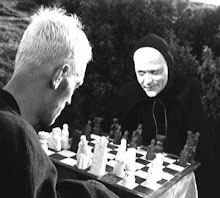
Rome vs Israel (Nietzsche, continued)
Following the current PC fashion, cafe-Nietzscheans insist that Nietzsche was not anti-semitic. This is not entirely accurate. Nietzsche may have balked at the extreme right of Bismarck's era (unlike Wagner, who did sign on---one hopes both FN and RW would have objected to a Himmler sort of final solution, but that is not entirely clear), yet anti-semitic passages can be found a plenty in Nietzsche's writing. This section from "The Genealogy of Morals" indicates quite clearly that Nietzsche was not only attacking Christianity but the Jews as well, "the priestly nation of ressentiment par excellence":
"""How, on the other hand, did the Jews feel about Rome? A thousand signs tell us; but it suffices to recall the Apocalypse of John, the most wanton of all literary outbursts that vengefulness has on its conscience. (One should not underestimate the profound consistency of the Christian instinct when it signed this book of hate with the name of the disciple of love, the same disciple to whom it attributed that amorous-enthusiastic Gospel: there is a piece of truth in this, however much literary counterfeiting might have been required to provide it.) For the Romans were the strong and noble, and nobody stronger and nobler has yet existed on earth or even been dreamed of: every remnant of them, every inscription gives delight, if only one divines what it was that was there at work. The Jews, on the contrary, were the priestly nation of ressentiment par excellence, in whom there dwelt an unequalled popular-moral genius: one only has to compare similarly gifted nations—the Chinese or the Germans, for instance—with the Jews, to sense which is of the first and which of the fifth rank. [4]
Which of them has won for the present, Rome or Judea? There can be no doubt: consider to whom one bows down in Rome itself today, as if they were the epitome of all the highest values [5]—and not only in Rome but over almost half the earth, everywhere that man has become tame or desires to become tame: three Jews, as is known, and one Jewess (Jesus of Nazareth, the fisherman Peter, the rug weaver Paul, and the mother of the aforementioned Jesus, named Mary). This is very remarkable: Rome has been defeated beyond all doubt. [6]
There was, to be sure, in the Renaissance an uncanny and glittering reawakening of the classical ideal, of the noble mode of evaluating all things; Rome itself, oppressed by the new superimposed Judaized Rome that presented the aspect of an ecumenical synagogue and was called the "church," stirred like one awakened from seeming death: but Judea immediately triumphed again, thanks to that thoroughly plebeian (German and English) ressentiment movement called the Reformation, and to that which was bound to arise from it, the restoration of the church—the restoration too of the ancient sepulchral repose of classical Rome.[7]. . ."""
Really one tires of the grand generalizations. Notwithstanding the typical bombast, we should note the attack on the Book of Revelation. That's the somewhat rational side of Nietzsche creeping out (a rarity). Jefferson, hardly the machiavellian that Nietzsche was, considered the Book of Rev. "merely the ravings of a maniac." (both were most likely fond of Voltaire's writings)
One might question whether identifying the Book of Rev. with jewish tradition is correct: for one, some biblical scholars suggest that the Revelator was a Roman, or at least converted gentile of some sort. Who cares, really. AS both Nietzsche and Jefferson realized, the Book of Rev. reveals the madness of Scripture as a whole (though that's not to yawp, Hitchens style, that it's all BS. The Beatitudes will do for beat poesy--so will the book of Psalms. FN might have agreed). For Nietzsche the madness speaks of Judea, and the ressentiment of the jewish and then jew-Christian scribes. One can hardly fail to term that a type of anti-semitism, and anti-zionism--not quite Himmler, but a profound dislike for judeo-christian tradition and culture (and we might also recall that roman historians such as Tacitus took Xtians to be a jewish sect). That hardly implies that one should toss TGOM or Nietzsche as a whole. That is the raw honest power, the wolf-sublimity of Nietzsche that must be acknowledged, however much it offends the regs at Cafe-Gauche.
And there's another somewhat rational point (one that TJ himself might respect). Nietzsche indicates the essential paradox (even dangerous paradox) of Scripture, and of the New Testament, that supposed Gospel of Luv: as Nietzsche says, "one should not underestimate the profound consistency of the Christian instinct when it signed this book of hate with the name of the disciple of love, the same disciple to whom it attributed that amorous-enthusiastic Gospel." Das stimmt! That same hysteria and irrational faith characteristic of the Revelator (that both Nietzsche and Jefferson attack) exists today, mainly in the protestant churches, whether that of a Hagee (McCain's pastor-general) or Wright (Obama's pastor-panderer (at least until a few weeks ago).
Sunday, June 01, 2008

Friday, May 30, 2008
Holy Hohenstaufen Batman! Frederick II (Nietzsche, cont).
Some dweebs in blogland still catch Nietzsche-fever on occasion. Usually they are failed engineer types, wannabe Jack Parsons, OR, just as pernicious, they are lapsed marxists--suburban Che Guevaras who have lost their faith in La Gente, and turn to Nietzsche for some type of anti-democratic guidance, or something. The Genealogy of Morals is one of the favorite texts (though other texts, even "Thus Spake Zarathustra" however bizarre (Kahil Gibran meets Himmler??) offer a rawer Nietzsche--by the time of his "Antichrist," Nietzsche has his howitzers blazing (and it's sort of sublime--as sublime as like a gyrfalcon attacking a dove).
Nietzsche admired the Holy Roman Emperor Frederick II, and called him "the FIRST of Europeans according to my taste, the Hohenstaufen, Frederick the Second". Who the F izz that, inquiring minds want to know--at least a few might. (Here's the Wiki.). There are, we suggest, various curious reasons for Nietzsche's fondness for Fred II. One, he was a Northerner who had moved south. He also battled against the Pope and papal states. AS the Wiki makes clear, Fred. II also had allies among the Muslims--a rather radical (and heretical) policy at the time. Fred. II. supposedly was a bit of a freethinker, skilled in numerous languages, ladies' man, a patron of scientists of the time, and artists--though also a Crusader. He was, circa 1200, a very powerful man. Dante put him in a rather nasty section of the Inferno--near Dis-- with other heretics (though not nearly as nasty as Mohammed's abode). He then represents a type of aggressive Renaissance man for Nietzsche, it would seem--one not bound to ecclesiastical tradition. Politically, Fred. II probably represented a German ruler who could (and did) conquer southern Europe and establish a German, or at least teutonic presence in the Mediterranean.

Die Will Zur Macht!!!
Nietzsche's fondness for Fred. II also indicates his relationship to, shall we say "military totalitarianism". Some might term it fascism, though Nietzsche seems more akin in his political strategies to prussian Junkers, who were monarchist, and mostly evangelical (starting at least with the Hohenzollern, a later development from the Hohenstaufen. The Hohenzollern of course often ruled over brutal, militaristic regimes, as was that of the crusader and proto-prussian Fred II, who had muslim mercenaries in his army). Regardless if Hohenzollern or outright fascist, Nietzsche's certainly supportive of the prussian militarism (and those who read the Antichrist might have note his near-Ode to the prussian army).
Nietzsche's praise of Alcibiades in TGOM--a despotic greek general, whose reckless campaigns destroyed Athens--- also provides evidence of Nietzsche's political thinking, as Bertrand Russell well knew (and Plato had criticized military oligarchies, so, like maybe McX can connect the dots). Of course Russell was British, and a lil' guy--Untermensch-- so probably suspect according to Nietzschean macho-men, regardless of his mastery of mathematical logic, metaphysics, modern science, history, etc.
Some dweebs in blogland still catch Nietzsche-fever on occasion. Usually they are failed engineer types, wannabe Jack Parsons, OR, just as pernicious, they are lapsed marxists--suburban Che Guevaras who have lost their faith in La Gente, and turn to Nietzsche for some type of anti-democratic guidance, or something. The Genealogy of Morals is one of the favorite texts (though other texts, even "Thus Spake Zarathustra" however bizarre (Kahil Gibran meets Himmler??) offer a rawer Nietzsche--by the time of his "Antichrist," Nietzsche has his howitzers blazing (and it's sort of sublime--as sublime as like a gyrfalcon attacking a dove).
Nietzsche admired the Holy Roman Emperor Frederick II, and called him "the FIRST of Europeans according to my taste, the Hohenstaufen, Frederick the Second". Who the F izz that, inquiring minds want to know--at least a few might. (Here's the Wiki.). There are, we suggest, various curious reasons for Nietzsche's fondness for Fred II. One, he was a Northerner who had moved south. He also battled against the Pope and papal states. AS the Wiki makes clear, Fred. II also had allies among the Muslims--a rather radical (and heretical) policy at the time. Fred. II. supposedly was a bit of a freethinker, skilled in numerous languages, ladies' man, a patron of scientists of the time, and artists--though also a Crusader. He was, circa 1200, a very powerful man. Dante put him in a rather nasty section of the Inferno--near Dis-- with other heretics (though not nearly as nasty as Mohammed's abode). He then represents a type of aggressive Renaissance man for Nietzsche, it would seem--one not bound to ecclesiastical tradition. Politically, Fred. II probably represented a German ruler who could (and did) conquer southern Europe and establish a German, or at least teutonic presence in the Mediterranean.

Die Will Zur Macht!!!
Nietzsche's fondness for Fred. II also indicates his relationship to, shall we say "military totalitarianism". Some might term it fascism, though Nietzsche seems more akin in his political strategies to prussian Junkers, who were monarchist, and mostly evangelical (starting at least with the Hohenzollern, a later development from the Hohenstaufen. The Hohenzollern of course often ruled over brutal, militaristic regimes, as was that of the crusader and proto-prussian Fred II, who had muslim mercenaries in his army). Regardless if Hohenzollern or outright fascist, Nietzsche's certainly supportive of the prussian militarism (and those who read the Antichrist might have note his near-Ode to the prussian army).
Nietzsche's praise of Alcibiades in TGOM--a despotic greek general, whose reckless campaigns destroyed Athens--- also provides evidence of Nietzsche's political thinking, as Bertrand Russell well knew (and Plato had criticized military oligarchies, so, like maybe McX can connect the dots). Of course Russell was British, and a lil' guy--Untermensch-- so probably suspect according to Nietzschean macho-men, regardless of his mastery of mathematical logic, metaphysics, modern science, history, etc.
Tuesday, May 27, 2008
Max Weber on Ben Franklin ("the spirit of capitalism")
Weber tends to generalize about religious character, but his analysis of capitalism as puritanism should not be rejected out of hand. Weber understood what Calvin's strange doctrine had accomplished: it had created legions of pious, greedy robots ( Ben F. symptomatic of the type). American protestants carry on the tradition of the Xtian Zombie, for the most part. Somewhat surprisingly, Herr Weber had words for zionist finance as well. The nazis might have arrested him, but then so might have the bolsheviks (allies with prussians until about 1939), who would not have approved of his non-orthodox leftism (perhaps socialistic, but not marxism). At the very least, Weber's "conceptual empiricism" will irritate romantics, links oder rechts.
""""Thus, if we try to determine the object, the analysis and historical explanation of which we are attempting, it cannot be in the form of a conceptual definition, but at least in the beginning only a provisional description of what is here meant by the spirit of capitalism. Such a description is, however, indispensable in order clearly to understand the object of the investigation. For this purpose we turn to a document of that spirit which contains what we are looking for in almost classical purity, and at the same time has the advantage of being free from all direct relationship to religion, being thus, for our purposes, free of preconceptions.
..............
"Remember this saying, The good paymaster is lord of another man's purse. He that is known to pay punctually and exactly to the time he promises, may at any time, and on any occasion, raise all the money his friends can spare. This is sometimes of great use. After industry and frugality, nothing contributes more to the raising of a young man in the world than punctuality and justice in all his dealings; therefore never keep borrowed money an hour beyond the time you promised, lest a disappointment shut up your friend's purse for ever.

La Reina de las putas
"The most trifling actions that affect a man's credit are to be regarded. The sound of your hammer at five in the morning, or eight at night, heard by a creditor, makes him easy six months longer; but if he sees you at a billiard-table, or hears your voice at a tavern, when you should be at work, he sends for his money the next day; demands it, before he can receive it, in a lump.
"It shows, besides, that you are mindful of what you owe; it makes you appear a careful as well as an honest man, and that still increases your credit.
"Beware of thinking all your own that you possess, and of living accordingly. It is a mistake that many people who have credit fall into. To prevent this, keep an exact account for some time both of your expenses and your income. If you take the pains at first to mention particulars, it will have this good effect: you will discover how wonderfully small, trifling expenses mount up to large sums, and will discern what might have been, and may for the future be saved, without occasioning any great inconvenience."
..........
It is Benjamin Franklin who preaches to us in these sentences, the same which Ferdinand Kürnberger satirizes in his clever and malicious "Picture of American Culture" as the supposed confession of faith of the Yankee. That it is the spirit of capitalism which here speaks in characteristic fashion, no one will doubt, however little we may wish to claim that everything which could be understood as pertaining to that spirit is contained in it. Let us pause a moment to consider this passage, the philosophy of which Kürnberger sums up in the words, "They make tallow out of cattle and money out of men". The peculiarity of this philosophy of avarice appears to be the ideal of the honest man of recognized credit, and above all the idea of a duty of the individual toward the increase of his capital, which is assumed as an end in itself. Truly what is here preached is not simply a means of making one's way in the world, but a peculiar ethic. The infraction of its rules is treated not as foolishness but as forgetfulness of duty. That is the essence of the matter. It is not mere business astuteness, that sort of thing is common enough, it is an ethos. This is the quality which interests us."""
Weber
Weber tends to generalize about religious character, but his analysis of capitalism as puritanism should not be rejected out of hand. Weber understood what Calvin's strange doctrine had accomplished: it had created legions of pious, greedy robots ( Ben F. symptomatic of the type). American protestants carry on the tradition of the Xtian Zombie, for the most part. Somewhat surprisingly, Herr Weber had words for zionist finance as well. The nazis might have arrested him, but then so might have the bolsheviks (allies with prussians until about 1939), who would not have approved of his non-orthodox leftism (perhaps socialistic, but not marxism). At the very least, Weber's "conceptual empiricism" will irritate romantics, links oder rechts.
""""Thus, if we try to determine the object, the analysis and historical explanation of which we are attempting, it cannot be in the form of a conceptual definition, but at least in the beginning only a provisional description of what is here meant by the spirit of capitalism. Such a description is, however, indispensable in order clearly to understand the object of the investigation. For this purpose we turn to a document of that spirit which contains what we are looking for in almost classical purity, and at the same time has the advantage of being free from all direct relationship to religion, being thus, for our purposes, free of preconceptions.
..............
"Remember this saying, The good paymaster is lord of another man's purse. He that is known to pay punctually and exactly to the time he promises, may at any time, and on any occasion, raise all the money his friends can spare. This is sometimes of great use. After industry and frugality, nothing contributes more to the raising of a young man in the world than punctuality and justice in all his dealings; therefore never keep borrowed money an hour beyond the time you promised, lest a disappointment shut up your friend's purse for ever.

La Reina de las putas
"The most trifling actions that affect a man's credit are to be regarded. The sound of your hammer at five in the morning, or eight at night, heard by a creditor, makes him easy six months longer; but if he sees you at a billiard-table, or hears your voice at a tavern, when you should be at work, he sends for his money the next day; demands it, before he can receive it, in a lump.
"It shows, besides, that you are mindful of what you owe; it makes you appear a careful as well as an honest man, and that still increases your credit.
"Beware of thinking all your own that you possess, and of living accordingly. It is a mistake that many people who have credit fall into. To prevent this, keep an exact account for some time both of your expenses and your income. If you take the pains at first to mention particulars, it will have this good effect: you will discover how wonderfully small, trifling expenses mount up to large sums, and will discern what might have been, and may for the future be saved, without occasioning any great inconvenience."
..........
It is Benjamin Franklin who preaches to us in these sentences, the same which Ferdinand Kürnberger satirizes in his clever and malicious "Picture of American Culture" as the supposed confession of faith of the Yankee. That it is the spirit of capitalism which here speaks in characteristic fashion, no one will doubt, however little we may wish to claim that everything which could be understood as pertaining to that spirit is contained in it. Let us pause a moment to consider this passage, the philosophy of which Kürnberger sums up in the words, "They make tallow out of cattle and money out of men". The peculiarity of this philosophy of avarice appears to be the ideal of the honest man of recognized credit, and above all the idea of a duty of the individual toward the increase of his capital, which is assumed as an end in itself. Truly what is here preached is not simply a means of making one's way in the world, but a peculiar ethic. The infraction of its rules is treated not as foolishness but as forgetfulness of duty. That is the essence of the matter. It is not mere business astuteness, that sort of thing is common enough, it is an ethos. This is the quality which interests us."""
Weber
Thursday, May 22, 2008
Wednesday, May 21, 2008
Give Hillary her MI and FL delegates
"""""There’s been a lot of talk about what your campaign would do should it get to the convention. Would you commit today to honoring the agreement made earlier not to seat the Michigan and Florida delegations?
Let’s talk about the agreement. The only agreement I entered into was not to campaign in Michigan and Florida. It had nothing to do with not seating the delegates. I think that’s an important distinction. I did not campaign--
The press seems to have missed the distinction if that’s the case. The talk is that you agreed not to seat the delegation.
That’s not the case at all. I signed an agreement not to campaign in Michigan and Florida. Now, the DNC made the determination that they would not seat the delegates, but I was not party to that. I think it’s important for the DNC to ask itself, Is this really in the best interest of our eventual nominee? We do not want to be disenfranchising Michigan and Florida. We have to try to carry both of those states. I’d love to carry Texas, but it’s usually not in the electoral calculation for the Democratic nominee. Florida and Michigan are. Therefore, the people of those two states disregarded adamantly the DNC’s decision that they would not seat the delegates. They came out and voted. If they had been influenced by the DNC, despite the fact that there was very little campaigning, if any, they would have stayed home. But they wanted their voices heard. More than 2 million people came out. I mean, it was record turnout for a primary. Florida, in particular, is sensitive to being disenfranchised because of what happened to them in the last elections. I have said that I would ask my delegates to vote to seat.
So your intention is to press this issue?
Yes, it is. Yes, it is."""
Well stated, Mrs President. Contingencies Agrees (that is, the authentic Contingencies agrees).
"""""There’s been a lot of talk about what your campaign would do should it get to the convention. Would you commit today to honoring the agreement made earlier not to seat the Michigan and Florida delegations?
Let’s talk about the agreement. The only agreement I entered into was not to campaign in Michigan and Florida. It had nothing to do with not seating the delegates. I think that’s an important distinction. I did not campaign--
The press seems to have missed the distinction if that’s the case. The talk is that you agreed not to seat the delegation.
That’s not the case at all. I signed an agreement not to campaign in Michigan and Florida. Now, the DNC made the determination that they would not seat the delegates, but I was not party to that. I think it’s important for the DNC to ask itself, Is this really in the best interest of our eventual nominee? We do not want to be disenfranchising Michigan and Florida. We have to try to carry both of those states. I’d love to carry Texas, but it’s usually not in the electoral calculation for the Democratic nominee. Florida and Michigan are. Therefore, the people of those two states disregarded adamantly the DNC’s decision that they would not seat the delegates. They came out and voted. If they had been influenced by the DNC, despite the fact that there was very little campaigning, if any, they would have stayed home. But they wanted their voices heard. More than 2 million people came out. I mean, it was record turnout for a primary. Florida, in particular, is sensitive to being disenfranchised because of what happened to them in the last elections. I have said that I would ask my delegates to vote to seat.
So your intention is to press this issue?
Yes, it is. Yes, it is."""
Well stated, Mrs President. Contingencies Agrees (that is, the authentic Contingencies agrees).
Tuesday, May 20, 2008
Nietzsche for Frat-boys (updated with help from Lt. Callley)
Many a college dweeb goes through a Nietzsche phase (for the dweebette, it's probably Ayn Rand's FN-lite). Who can forget the Nietzsche chestnuts--the Will to power, dissing judeo-christian tradition, slave morality, the Uebermensch, attacks on the german proles and Wagner, anti-liberals and contra-feminism, mixed in with his praise of a few classix (including Caesarian classics--Nietzsche much prefers Caesar to Plato--or to "God"). Sooner or later, about any semi-bright consumer tunes into his inner Nietzsche.
Here's the master hisself:
"[The aristocratic men] enjoy their freedom from all social control, they feelthat in the wilderness they can give vent with impunity to that tension which is producedby enclosure and imprisonment in the peace of society, they revert to the innocence of the beast-of-prey conscience, like jubilant monsters, who perhaps come from a ghastly bout of murder, arson, rape, and torture, with bravado and moral equanimity, as though merely some wild student’s prank had been played, perfectly convinced that the poets have now anample theme to sing and celebrate. It is impossible not to recognise at the core of all these aristocratic races the beast of prey; the magnificent blonde brute, avidly rampant for spoil and victory; this hidden core needed an outlet from time to time, the beast must get loose again, must return into the wilderness — the Roman, Arabic, German, and Japanese nobility, the Homeric heroes, the Scandinavian Vikings, are allalike in this need."""(from the Genealogy of Morals,
How cool, and beastly. So no problems with those torturers at Gitmo (or My Lai), or denying the right of Habeas Corpus, etc. (does that passage remind anyone of Donny Sutherlands' rather vile character in Bertolucci's 1900?? it should) The Kossack generally approves of Nietzschean-style RealPolitik, except when it's in his interest not to. Values, if not secular politics as a whole, are for the frat-boy Nietzschean provisional, constructed, and subjective, as Biff, Beau, and Bunny still insist over the kegger. Which is to say, nada (who art in Nada).
Really, the Genealogy of Morals could have been written by Aurelius: Nietzsche is sort of a wannabe-Roman stoic (if not wannabe Caesar), though lacking the virtu, and the dedication to "honor" common to the Romans, raised in the Aristotelian school ( most of the "Nietzschean claptrap" (Ez Pound's assessment of FN) updates Ari's Nico. ethics. It's not "footnotes to Plato," but to Aristotle).
At his worst Nietzsche moves from Ravenna to, er, the Reichstag, and resembles nothing so much as a wannabe-prussian officer, Ludendorff-like, taking issue with the drunken soldiers. He may not care for the German working class, yet he does admire Goethe, Beethoven, etc. Heroes of art and kultur, and the battlefield. Da Classix!! IN spirit he seems more akin to one of Kaiser Wilhelm’s cadre than a brownshirt. Many a german (including soldiers) wanted the Kaiser strung up on a lamppost after WWI.

Applied Nietzsche (Ludendorff)
Nietzsche insists he's not a nihilist, but he is: or rather, his nihilism is not done from despair: we wants to smile as he joins the Blackshirts in his imagination (if not Sturmabteilung). While one can understand the appeal of that gonzo-nihilism--alas, so do frat-boy conservatives the world over. Bertrand Russell considered Nietzsche an eloquent fool, mostly--a prussian one at that: and Frege or David Hilbert he wasn't.
Those humans who, for instance, take issue with Lt. Calley and the bloodsport of My Lai should also take issue with Nietzsche's code (tho' the code is hardly consistent anyways: the frat boy Nietzschean doesn't quite realize what it means to say "truth does not exist"). Gaze at the pics of dead, naked villagers--women, children, old men---and recall the will to power (or, better intone "Der Wille zur Macht"!!!). Nietzsche could not say that is an occasion for sadness or tragedy (and his idea of tragedy itself odd--tragedy affirms, yawped Nietzsche. A german or french WWI vet's hospital after a few years of trench warfare was not so affirming, though FN).
Nietzsche's own writing in TGOM (as quote above indicates) would seem to bless Lt. Calleys and bloodsport; he might find it distasteful, but he could not say it was wrong--a fortiori he could not term even the Nazi's "evil" . No value realm holds for Nietzsche, no normativity, no consensus either, even in a secular sense. Lt. Calley and his platoon (really Capn. Medina the CO), or Ludendorffs and Goerings--the Reichmarshall does not seem so distant from FN's ideas of the blond beast--lay waste to chandala: wolves attacking caribou. (Hobbes addresses a Nietzsche-like rebel knight in a few paragraphs in Leviathan. What to do with the Baron von Nietzsche's? You force him to accept the covenants, or order him to be out of town by sunset).
It should bother us when legal-professionals pick up Nietzsche, and call it "naturalism": does that imply then whenever a judge or DA can get away with lying, mis-repping evidence, f-ing over the defendant,etc. that's acceptable? So much for Jefferson and Madison, not to say traditional philosophy ala Hobbes and Kant (and however jargon-ridden Kant is, he believed in Justice with a capital J, and was a bit of peacenik. The Categorical Imperative should not be just tossed aside as if it were some baptist tract).
Moreover given Nietzsche’s own amoral, hedonistic principles–the Will to Power, and nothing else–-in a sense he has no business making evaluative statements about anything. Nietzschean ideals in a political context would mean, for instance, that if Bush/Cheney lied about the WMDs, mis-rep’ed the dangers of terrorism, etc. that’s acceptable, since the end result was a furthering of US power. Lie, when it’s in your best interest: that’s Nietzsche applied to RealPolitik (for that matter, Nietzsche denies the possibility of Truth itself–one reason he criticizes traditional philosophy, modern science, etc). We might appreciate Nietzsche's praise of strength in terms of psychology, even a type of self-help: to thine own self be true, etc. (yet it's not true that what doesn't kill you makes you stronger--it might maim you). On a political level, however, Nietzsche has for years provided live ammo to countless Calleys- and Himmlers-in-potentia (and Zhukovs-in-potentia).
Many a college dweeb goes through a Nietzsche phase (for the dweebette, it's probably Ayn Rand's FN-lite). Who can forget the Nietzsche chestnuts--the Will to power, dissing judeo-christian tradition, slave morality, the Uebermensch, attacks on the german proles and Wagner, anti-liberals and contra-feminism, mixed in with his praise of a few classix (including Caesarian classics--Nietzsche much prefers Caesar to Plato--or to "God"). Sooner or later, about any semi-bright consumer tunes into his inner Nietzsche.
Here's the master hisself:
"[The aristocratic men] enjoy their freedom from all social control, they feelthat in the wilderness they can give vent with impunity to that tension which is producedby enclosure and imprisonment in the peace of society, they revert to the innocence of the beast-of-prey conscience, like jubilant monsters, who perhaps come from a ghastly bout of murder, arson, rape, and torture, with bravado and moral equanimity, as though merely some wild student’s prank had been played, perfectly convinced that the poets have now anample theme to sing and celebrate. It is impossible not to recognise at the core of all these aristocratic races the beast of prey; the magnificent blonde brute, avidly rampant for spoil and victory; this hidden core needed an outlet from time to time, the beast must get loose again, must return into the wilderness — the Roman, Arabic, German, and Japanese nobility, the Homeric heroes, the Scandinavian Vikings, are allalike in this need."""(from the Genealogy of Morals,
How cool, and beastly. So no problems with those torturers at Gitmo (or My Lai), or denying the right of Habeas Corpus, etc. (does that passage remind anyone of Donny Sutherlands' rather vile character in Bertolucci's 1900?? it should) The Kossack generally approves of Nietzschean-style RealPolitik, except when it's in his interest not to. Values, if not secular politics as a whole, are for the frat-boy Nietzschean provisional, constructed, and subjective, as Biff, Beau, and Bunny still insist over the kegger. Which is to say, nada (who art in Nada).
Really, the Genealogy of Morals could have been written by Aurelius: Nietzsche is sort of a wannabe-Roman stoic (if not wannabe Caesar), though lacking the virtu, and the dedication to "honor" common to the Romans, raised in the Aristotelian school ( most of the "Nietzschean claptrap" (Ez Pound's assessment of FN) updates Ari's Nico. ethics. It's not "footnotes to Plato," but to Aristotle).
At his worst Nietzsche moves from Ravenna to, er, the Reichstag, and resembles nothing so much as a wannabe-prussian officer, Ludendorff-like, taking issue with the drunken soldiers. He may not care for the German working class, yet he does admire Goethe, Beethoven, etc. Heroes of art and kultur, and the battlefield. Da Classix!! IN spirit he seems more akin to one of Kaiser Wilhelm’s cadre than a brownshirt. Many a german (including soldiers) wanted the Kaiser strung up on a lamppost after WWI.

Applied Nietzsche (Ludendorff)
Nietzsche insists he's not a nihilist, but he is: or rather, his nihilism is not done from despair: we wants to smile as he joins the Blackshirts in his imagination (if not Sturmabteilung). While one can understand the appeal of that gonzo-nihilism--alas, so do frat-boy conservatives the world over. Bertrand Russell considered Nietzsche an eloquent fool, mostly--a prussian one at that: and Frege or David Hilbert he wasn't.
Those humans who, for instance, take issue with Lt. Calley and the bloodsport of My Lai should also take issue with Nietzsche's code (tho' the code is hardly consistent anyways: the frat boy Nietzschean doesn't quite realize what it means to say "truth does not exist"). Gaze at the pics of dead, naked villagers--women, children, old men---and recall the will to power (or, better intone "Der Wille zur Macht"!!!). Nietzsche could not say that is an occasion for sadness or tragedy (and his idea of tragedy itself odd--tragedy affirms, yawped Nietzsche. A german or french WWI vet's hospital after a few years of trench warfare was not so affirming, though FN).
Nietzsche's own writing in TGOM (as quote above indicates) would seem to bless Lt. Calleys and bloodsport; he might find it distasteful, but he could not say it was wrong--a fortiori he could not term even the Nazi's "evil" . No value realm holds for Nietzsche, no normativity, no consensus either, even in a secular sense. Lt. Calley and his platoon (really Capn. Medina the CO), or Ludendorffs and Goerings--the Reichmarshall does not seem so distant from FN's ideas of the blond beast--lay waste to chandala: wolves attacking caribou. (Hobbes addresses a Nietzsche-like rebel knight in a few paragraphs in Leviathan. What to do with the Baron von Nietzsche's? You force him to accept the covenants, or order him to be out of town by sunset).
It should bother us when legal-professionals pick up Nietzsche, and call it "naturalism": does that imply then whenever a judge or DA can get away with lying, mis-repping evidence, f-ing over the defendant,etc. that's acceptable? So much for Jefferson and Madison, not to say traditional philosophy ala Hobbes and Kant (and however jargon-ridden Kant is, he believed in Justice with a capital J, and was a bit of peacenik. The Categorical Imperative should not be just tossed aside as if it were some baptist tract).
Moreover given Nietzsche’s own amoral, hedonistic principles–the Will to Power, and nothing else–-in a sense he has no business making evaluative statements about anything. Nietzschean ideals in a political context would mean, for instance, that if Bush/Cheney lied about the WMDs, mis-rep’ed the dangers of terrorism, etc. that’s acceptable, since the end result was a furthering of US power. Lie, when it’s in your best interest: that’s Nietzsche applied to RealPolitik (for that matter, Nietzsche denies the possibility of Truth itself–one reason he criticizes traditional philosophy, modern science, etc). We might appreciate Nietzsche's praise of strength in terms of psychology, even a type of self-help: to thine own self be true, etc. (yet it's not true that what doesn't kill you makes you stronger--it might maim you). On a political level, however, Nietzsche has for years provided live ammo to countless Calleys- and Himmlers-in-potentia (and Zhukovs-in-potentia).
Monday, May 19, 2008
Science: Real (EO Wilson), and Bogus (Al Gore) (Cont. retrofit)
"With sociobiology prospering, Wilson has carried his research into the full arena of human knowledge, publishing the hugely ambitious Consilience in 1998, in which he developed his ideas about gene-culture co-evolution further and resurrected CP Snow's efforts to conjoin the "two cultures". In fact, Wilson's arguments are more fundamental and persuasive than Snow's; works on evolution, like Sociobiology and Dawkins's The Selfish Gene, have been absorbed into western cultural life as neatly as any neo-Darwinist could have predicted.
"He is," says Ian McEwan, "a scientific materialist who warmly embraces the diversity of human achievement - including religion and art, which he sees in evolutionary terms. One of his tasks has been to further the Enlightenment project of absorbing the social sciences into science proper; another has been to find a sound ethical basis for ecological thinking. He is fundamentally a rational optimist who shows us the beauty of the narrative of life on earth. He is living proof that materialism need not be a bleak world view.""
EOWilson
I read Wilson’s "Consilience" a few years ago and was quite impressed. While Wilson may over-simplify a few issues (in regards to the biological evidence for species-altruism, for one), he offers quite a bit of support for his socio-biological ideas; Wilson, like his colleague Dawkins (tho' Doc Dawkins a bit more strident in tone than EO), tends to a sort of reductionism which might irritate some political or ethically-oriented writers--(and few liberal hacks shrieking 24/7 about what they take to be "ethics" have troubled with Hume on the fact-value distinction, or the cliffsnotes to Plato's Republic for that matter). Most philosophical types who I am acquainted with who bothered to read Consilience objected to it, but they are rarely able to formulate their objections. Many philosophers tend to be sort of Kantian idealists (not to be confused with Henry-Fonda idealists), if not theists, more often than they are materialists; thus, Darwin, if not biology as a whole, is taken to be wrong-- or at least questionable--owing to its determinist-naturalist grounds. The idealists rarely offer any convincing arguments showing the real problems with strict determinism.
We here at Contingencies, however, contend there are no good grounds for upholding Kantian idealism (or theology for that matter)--though the First Critique, however jargon-ridden, should at least be kept on the intellectual jukebox (Kant's synthetic a priori rather "proto-cognitivist" anyway)--nor for the more extreme forms of Humean skepticism--tho' in many situations, doubts about causality or any absolute inductive knowledge ARE more than warranted, as in the "social sciences". (Those few new-agey narcissists who mistake Niels Bohr and quantum mechanics for evidence of mystic idealism may be safely ignored). The Chomskyan sorts of "Cartesian rationalists" have raised a few interesting issues regarding innateness (and a prioricity in trad. terms), yet those issues and the supposed "Universal Grammar" do not disprove naturalism, though the relation of cognition to the brain's hard-wiring--to neurology-- has not been conclusively established (especially in regards to intention and higher order thinking)--most mortals will have little or nothing to say on that topic anyway.
Darwinian accounts of evolution and natural selection as well as Mendelian genetics and many other modern biological concepts have been established. Thus the burden rests on idealists to disprove Darwin, if not materialism, which they have failed to do; the Intelligent Design argument, however subtle and complex, being the latest theological fiasco--tho' the IDT people (who are NOT the same as the fundies or biblethumpers who have made use of IDT) raised one valid point-- Darwinism still has not provided a complete account of evolution: Father Darwin was no biochemist, for one. The IDT people often commit the ad ignorantium sort of fallacy: the theory of Darwinian evo. still has gaps; therefore, "God" must exist to explain the gaps. NICHT. There are, however, sort of naive leftists, nearly as pernicious as the fundamentalist or dogmatic xtian (or muslim, jew etc.), who quote Darwin and then some marxist-multiculturalist PC BS --or, Osiris forbid, Al Gore--as if they were equivalent. Hah. Darwinism does not offer any comforting assurances or utopian ideology for the liberal--or conservative--do-gooder.
and now for something completely different from Big Al:
"The climate crisis offers us the chance to experience what few generations in history have had the privilege of experiencing: a generational mission; a compelling moral purpose; a shared cause; and the thrill of being forced by circumstances to put aside the pettiness and conflict of politics and to embrace a genuine moral and spiritual challenge."
SO much for unbiased research, data-gathering, and the sound biological science that Wilson practices. By what means were the problems associated with global warming (and the big issue of proving "anthropic" cause---some evidence suggests global warming and ozone depletion are natural phenomena) converted into a "generational mission," a "moral purpose" or "spiritual challenge"? Maybe they became so in Gore's mystical vision of the protestant-buddhist Verde. Big Al unlikely knows C02 from karma, but that doesn't stop the Gore-Bot liberal nurseys from worshipping him.
"With sociobiology prospering, Wilson has carried his research into the full arena of human knowledge, publishing the hugely ambitious Consilience in 1998, in which he developed his ideas about gene-culture co-evolution further and resurrected CP Snow's efforts to conjoin the "two cultures". In fact, Wilson's arguments are more fundamental and persuasive than Snow's; works on evolution, like Sociobiology and Dawkins's The Selfish Gene, have been absorbed into western cultural life as neatly as any neo-Darwinist could have predicted.
"He is," says Ian McEwan, "a scientific materialist who warmly embraces the diversity of human achievement - including religion and art, which he sees in evolutionary terms. One of his tasks has been to further the Enlightenment project of absorbing the social sciences into science proper; another has been to find a sound ethical basis for ecological thinking. He is fundamentally a rational optimist who shows us the beauty of the narrative of life on earth. He is living proof that materialism need not be a bleak world view.""
EOWilson
I read Wilson’s "Consilience" a few years ago and was quite impressed. While Wilson may over-simplify a few issues (in regards to the biological evidence for species-altruism, for one), he offers quite a bit of support for his socio-biological ideas; Wilson, like his colleague Dawkins (tho' Doc Dawkins a bit more strident in tone than EO), tends to a sort of reductionism which might irritate some political or ethically-oriented writers--(and few liberal hacks shrieking 24/7 about what they take to be "ethics" have troubled with Hume on the fact-value distinction, or the cliffsnotes to Plato's Republic for that matter). Most philosophical types who I am acquainted with who bothered to read Consilience objected to it, but they are rarely able to formulate their objections. Many philosophers tend to be sort of Kantian idealists (not to be confused with Henry-Fonda idealists), if not theists, more often than they are materialists; thus, Darwin, if not biology as a whole, is taken to be wrong-- or at least questionable--owing to its determinist-naturalist grounds. The idealists rarely offer any convincing arguments showing the real problems with strict determinism.
We here at Contingencies, however, contend there are no good grounds for upholding Kantian idealism (or theology for that matter)--though the First Critique, however jargon-ridden, should at least be kept on the intellectual jukebox (Kant's synthetic a priori rather "proto-cognitivist" anyway)--nor for the more extreme forms of Humean skepticism--tho' in many situations, doubts about causality or any absolute inductive knowledge ARE more than warranted, as in the "social sciences". (Those few new-agey narcissists who mistake Niels Bohr and quantum mechanics for evidence of mystic idealism may be safely ignored). The Chomskyan sorts of "Cartesian rationalists" have raised a few interesting issues regarding innateness (and a prioricity in trad. terms), yet those issues and the supposed "Universal Grammar" do not disprove naturalism, though the relation of cognition to the brain's hard-wiring--to neurology-- has not been conclusively established (especially in regards to intention and higher order thinking)--most mortals will have little or nothing to say on that topic anyway.
Darwinian accounts of evolution and natural selection as well as Mendelian genetics and many other modern biological concepts have been established. Thus the burden rests on idealists to disprove Darwin, if not materialism, which they have failed to do; the Intelligent Design argument, however subtle and complex, being the latest theological fiasco--tho' the IDT people (who are NOT the same as the fundies or biblethumpers who have made use of IDT) raised one valid point-- Darwinism still has not provided a complete account of evolution: Father Darwin was no biochemist, for one. The IDT people often commit the ad ignorantium sort of fallacy: the theory of Darwinian evo. still has gaps; therefore, "God" must exist to explain the gaps. NICHT. There are, however, sort of naive leftists, nearly as pernicious as the fundamentalist or dogmatic xtian (or muslim, jew etc.), who quote Darwin and then some marxist-multiculturalist PC BS --or, Osiris forbid, Al Gore--as if they were equivalent. Hah. Darwinism does not offer any comforting assurances or utopian ideology for the liberal--or conservative--do-gooder.
and now for something completely different from Big Al:
"The climate crisis offers us the chance to experience what few generations in history have had the privilege of experiencing: a generational mission; a compelling moral purpose; a shared cause; and the thrill of being forced by circumstances to put aside the pettiness and conflict of politics and to embrace a genuine moral and spiritual challenge."
SO much for unbiased research, data-gathering, and the sound biological science that Wilson practices. By what means were the problems associated with global warming (and the big issue of proving "anthropic" cause---some evidence suggests global warming and ozone depletion are natural phenomena) converted into a "generational mission," a "moral purpose" or "spiritual challenge"? Maybe they became so in Gore's mystical vision of the protestant-buddhist Verde. Big Al unlikely knows C02 from karma, but that doesn't stop the Gore-Bot liberal nurseys from worshipping him.
Sunday, May 18, 2008
Thursday, May 15, 2008

Leviathan, Inc. (wtih DiDi Feinstone's mensch Richie Blum at the controls)
"""People commonly travel the world over to see rivers and mountains, new stars, garish birds, freak fish, grotesque breeds of human; they fall into an animal stupor that gapes at existence and they think they have seen something.""
(Kierkegaard)

Man flies with jet-powered wings
There you go, Nurse Starcraft
Wednesday, May 14, 2008
News from the Weird
Mormon salesmen for Obama?
Hey Brighamius: your little zionist-barf poems have gone out even to your pals at LDS! What a shame. Maybe you'll have to leave COLDS, and like take up with some Scientologists.

fly, pretties, phly
Mormon salesmen for Obama?
Hey Brighamius: your little zionist-barf poems have gone out even to your pals at LDS! What a shame. Maybe you'll have to leave COLDS, and like take up with some Scientologists.

fly, pretties, phly
Tuesday, May 13, 2008
Oprahocracy
Interesting list on defining an Oprahcrat from one Charles Rouse:
"""1. Make all sorts of baseless accusations and insinuations (accuse people of racism, misogyny, homophobia, fascism, etc), without ever referring to facts or evidence.
2. Reduce arguments to childish ad hominems, ad populus, generalizations, other logical fallacies and character defamations. Mock people's religions, political viewpoints and heritage like a drunken fratboy might. Do your best to eliminate dissent: that's the apparatchik tradition ( KGB, maoist, gestapo, etc.).
3. Avoid logic or fact-based writing, or specific points at all costs (tho,' yes, this strategy might be used by rightists as well). Rely on slang and crass, colloquial language instead of rational prose. Construct simple-minded dichotomies–an Us vs. Them situation–even where there isn't one. Villify (Bush (Pelosi, McCain etc.) is Satan!).............""""""
Interesting list on defining an Oprahcrat from one Charles Rouse:
"""1. Make all sorts of baseless accusations and insinuations (accuse people of racism, misogyny, homophobia, fascism, etc), without ever referring to facts or evidence.
2. Reduce arguments to childish ad hominems, ad populus, generalizations, other logical fallacies and character defamations. Mock people's religions, political viewpoints and heritage like a drunken fratboy might. Do your best to eliminate dissent: that's the apparatchik tradition ( KGB, maoist, gestapo, etc.).
3. Avoid logic or fact-based writing, or specific points at all costs (tho,' yes, this strategy might be used by rightists as well). Rely on slang and crass, colloquial language instead of rational prose. Construct simple-minded dichotomies–an Us vs. Them situation–even where there isn't one. Villify (Bush (Pelosi, McCain etc.) is Satan!).............""""""
Monday, May 12, 2008
Global Warming Gospel
Howard Hayden, physics professor (emeritus) at U. of Conn, offers his thoughts on AGW "hypothesis" and the Gore church:
"The hype surrounding the issue of global warming is a bunch of hot air, a retired physics professor told members of Rotary Club 43 on Monday.
"Global warming is not a problem," Howard C. Hayden said. "Go find something useful to do." Hayden is an emeritus professor of physics from the University of Connecticut and now resides in Pueblo West.
Hayden, who spoke at the Rotary Club's weekly meeting, offered a skeptical view of global warming.
"This is not a view you'll hear from Al Gore," Hayden said, prefacing his slide show presentation. ........
........

Jupiter Kazoo, aka the Butt-Trumpet
"Hayden claimed that much of what is being advertised about global warming issues such as the melting polar ice caps, greenhouse gases and changes in carbon dioxide levels is not factual.
"Yes, the polar ice caps are shrinking . . . on Mars," he said, "On Mars, the ice caps are melting and small hills are disappearing."
Hayden added that there is warming occurring on Jupiter, Saturn and Triton.
He said the increased carbon-dioxide levels that global-warming promoters keep talking about is nothing new. He said the levels of carbon dioxide have been rising and falling for more than 400,000 years.
"We are at the lowest levels in the last 300,000 years," he said. "During the Jurassic period, we had very high levels of carbon dioxide."
Hayden added that the majority of carbon dioxide is the result of natural sources and not to be blamed on humankind.
Worldwide, the burning of coal, oil and gas contributes to only an estimated 3 percent of the carbon-dioxide emissions, he said.
"About 97 percent of carbon dioxide in the atmosphere comes from natural sources, not humans," Hayden said."""
Ouchie! Back to those cliffsnotes for "Physics for Dixiecrats 101" courses, Al.
Howard Hayden, physics professor (emeritus) at U. of Conn, offers his thoughts on AGW "hypothesis" and the Gore church:
"The hype surrounding the issue of global warming is a bunch of hot air, a retired physics professor told members of Rotary Club 43 on Monday.
"Global warming is not a problem," Howard C. Hayden said. "Go find something useful to do." Hayden is an emeritus professor of physics from the University of Connecticut and now resides in Pueblo West.
Hayden, who spoke at the Rotary Club's weekly meeting, offered a skeptical view of global warming.
"This is not a view you'll hear from Al Gore," Hayden said, prefacing his slide show presentation. ........
........

Jupiter Kazoo, aka the Butt-Trumpet
"Hayden claimed that much of what is being advertised about global warming issues such as the melting polar ice caps, greenhouse gases and changes in carbon dioxide levels is not factual.
"Yes, the polar ice caps are shrinking . . . on Mars," he said, "On Mars, the ice caps are melting and small hills are disappearing."
Hayden added that there is warming occurring on Jupiter, Saturn and Triton.
He said the increased carbon-dioxide levels that global-warming promoters keep talking about is nothing new. He said the levels of carbon dioxide have been rising and falling for more than 400,000 years.
"We are at the lowest levels in the last 300,000 years," he said. "During the Jurassic period, we had very high levels of carbon dioxide."
Hayden added that the majority of carbon dioxide is the result of natural sources and not to be blamed on humankind.
Worldwide, the burning of coal, oil and gas contributes to only an estimated 3 percent of the carbon-dioxide emissions, he said.
"About 97 percent of carbon dioxide in the atmosphere comes from natural sources, not humans," Hayden said."""
Ouchie! Back to those cliffsnotes for "Physics for Dixiecrats 101" courses, Al.
Thursday, May 08, 2008
Cactus Ed Abbey on muzak
"Rock" is the music of slaves. Of adolescents pursuing the illusion of freedom and protest while the steel chains of technology bind them ever tighter.
~
Music begins where words leave off. Music expresses the inexpressible. If there is a Kingdom of Heaven, it lies in music.
~
Music clouds the intellect but clarifies the heart.
~
How did Haydn and Mozart produce such vast quantities of formally perfect art? They worked from a perfect formula. In music, Beethoven was the Great Emancipator.
~
"Rock": music to hammer out fenders by. Music for vomiting to after a hard day spreading asphalt. Vietnam music. Imitation-Afro, industrial air-compressor music.
~
Grand opera is a form of musical entertainment for people who hate music.
~
Life without music would be an intolerable insult.
~
The best argument for Christianity is the Gregorian chant. Listening to that music, one can believe anything--while the music lasts.
~
Music is a savage art, a measured madness.
Music endures and ages far better than books. Books, made of words, are unavoidably attached to ideas, events, conflict, and history, but music has the power to transcend time. At least for a time. Palestrina sounds as fresh today as he did in 1555, but Dante, only three centuries older, already smells of the archaic, the medieval, the catacombs.
Vladimir Nabokov was a writer who cared nothing for music and whose favorite sport was the pursuit, capture, and murder of butterflies. This explains many things; for example, the fact that Nabokov's novels, for all their elegance and wit, resemble nothing so much as butterflies pinned to a board: pretty but dead; symmetrical but stiff.
Verstehen sie das, McSklaven?
"Rock" is the music of slaves. Of adolescents pursuing the illusion of freedom and protest while the steel chains of technology bind them ever tighter.
~
Music begins where words leave off. Music expresses the inexpressible. If there is a Kingdom of Heaven, it lies in music.
~
Music clouds the intellect but clarifies the heart.
~
How did Haydn and Mozart produce such vast quantities of formally perfect art? They worked from a perfect formula. In music, Beethoven was the Great Emancipator.
~
"Rock": music to hammer out fenders by. Music for vomiting to after a hard day spreading asphalt. Vietnam music. Imitation-Afro, industrial air-compressor music.
~
Grand opera is a form of musical entertainment for people who hate music.
~
Life without music would be an intolerable insult.
~
The best argument for Christianity is the Gregorian chant. Listening to that music, one can believe anything--while the music lasts.
~
Music is a savage art, a measured madness.
Music endures and ages far better than books. Books, made of words, are unavoidably attached to ideas, events, conflict, and history, but music has the power to transcend time. At least for a time. Palestrina sounds as fresh today as he did in 1555, but Dante, only three centuries older, already smells of the archaic, the medieval, the catacombs.
Vladimir Nabokov was a writer who cared nothing for music and whose favorite sport was the pursuit, capture, and murder of butterflies. This explains many things; for example, the fact that Nabokov's novels, for all their elegance and wit, resemble nothing so much as butterflies pinned to a board: pretty but dead; symmetrical but stiff.
Verstehen sie das, McSklaven?
Tuesday, May 06, 2008
Menckenisms
"I hate all sports as rabidly as a person who likes sports hates common sense."
"If a politician found he had cannibals among his constituents, he would promise them missionaries for dinner."
"In this world of sin and sorrow there is always something to be thankful for; as for me, I rejoice that I am not a Republican."
"Most people are unable to write because they are unable to think, and they are unable to think because they congenitally lack the equipment to do so, just as they congenitally lack the equipment to fly over the moon."
Bravo. One bon-mot from Mencken worth a month of blog-belches and ewe-tube spam from the usual moron-o-crat, er, McMoron-o-crat.
"I hate all sports as rabidly as a person who likes sports hates common sense."
"If a politician found he had cannibals among his constituents, he would promise them missionaries for dinner."
"In this world of sin and sorrow there is always something to be thankful for; as for me, I rejoice that I am not a Republican."
"Most people are unable to write because they are unable to think, and they are unable to think because they congenitally lack the equipment to do so, just as they congenitally lack the equipment to fly over the moon."
Bravo. One bon-mot from Mencken worth a month of blog-belches and ewe-tube spam from the usual moron-o-crat, er, McMoron-o-crat.
Sunday, May 04, 2008
"Slang: the grunt of the Human hog." (Bierce)
McGrunt du jour: """So what you’re saying is, [oBama]’s not really a religious nutcase, he just plays one on TV? I think I can agree with that.
What palpable BS--as is the entire justification of Rev. Wright. OverlookingMcGuru McGrunt's awkward, colloquial phrasing and usual 1st person blather, note the lack of any allusions to Wright or Obama's stated positions or record. For one, BO has attended the same church for over 20 years, toured on “40 days of faith and phamily,” shakes hands with protestant creationists (including GOP ones), and has even called into question the 1st Amendment (i.e. separation clause--googlestein er!). Obama's received the most donations from religious groups by far (and far more than the GOP biblethumpers like Mitt-bot or Hucklebee) Obama makes Hillary seem about like Madeliene Murray O’Hair. Even McCain has said some words against fundies, unlike BO. BO’s a complete churchie, except when he’s in LA or SF: and as consistently hypocritical as most protestants as well.
McGrunt du jour: """So what you’re saying is, [oBama]’s not really a religious nutcase, he just plays one on TV? I think I can agree with that.
What palpable BS--as is the entire justification of Rev. Wright. Overlooking
Friday, May 02, 2008
Smackdown: TH Huxley vs. Matthew Arnold (with help from Camus)
"Mechanized civilization has just reached the ultimate stage of barbarism. In a near future, we will have to choose between mass suicide and intelligent use of scientific conquests[...] This can no longer be simply a prayer; it must become an order which goes upward from the peoples to the governments, an order to make a definitive choice between hell and reason." (Albert Camus on the bombing of Hiroshima in 1945).
Victoriana tends to irritate most American yahoos. Yahoos (that's yahoo as in Swift, not Silicon Valley extortion) detest all things French, yet they detest most things British as well (and not without some reason). The yahoo doesn't care for British propriety, the civility, the manners: say England, and Americans think Sherlock Holmes, or dreadful PBS Schake-schpearean fairies, or worse, the Beatles. And yes, we here at Contingencies are not down with that sceptre'd isle either, and prefer Descartes to Darwin, and respect Clemenceau more than a Churchill (not only palsies with Il Duce, but praising Hitler and brownshirts until Der Fuhrer's deals with Stalin pissed off the royals, and the tanks rolled into Poland. Winnie--corporate Darwinist way before Rich. Dawkins arrived---most likely sucking scheisse next to the Reichmarshall and gang).
Nonetheless, some aspects of English kultur should be attended to, at least for a few nanoseconds: like, say, the celebrated debates between Matt Arnold and TH Huxley: c'est Victoriana. The debate concerned the merits of a scientific education compared to the study of the classics, Latin, Greek, Plato, sophocles, et all. Huxley argued (in effect agreeing with the founder of the University of Birmingham) that Da Classix--even the study of Latin grammar--were no longer needed. Universities would stress natural sciences--biology, chemistry, physics---and engineering. Pure mathematics--itself traditionally regarded as Platonic, and above the grubby work of physicians and lawyers-- would be, according to Huxley, relegated to scientific applications and engineering.
Huxley may win the battle against that eloquent poltroon Arnold, though Arnold may win the war: which is to say (in QuineSpeak) few could doubt the efficaciousness of the natural sciences--Plato's next to nothing compared to gunpowder, or a panzer division. The Huxleyan pedagogy, however, should not be just accepted prima facie as the path to a progressive future, certainly not after the 20th century (that may be obvious to some hepcats, but not to many in ConsumerLand). What Huxley did not foresee was that his beloved Darwin, and the natural sciences could be (and were) very efficacious in terms of advancing totalitarian goals, and murder on a macro-scale. Chas himself seemed to hint at eugenics on occasion. Does Darwin (and the advances of physical chemistry) lead to mustand gas, not to say zyklon B? Es posible. Does Einstein lead to Hiroshima? Es posible.
Until the whores of academic science free themselves from their pimps in industry (not to say the military), the science establishment should be counted as a foe of progressive ideals--and Camus suggests something like that as well. That's not to advocate Luddite-ism; (tho' google Pynchon for an interesting spin on Ludd). Cybernetics--gear itself-- can be a force for the Good; however Tech. is not inherently "Good". One doesn't have to quote Martin Heidegger on "teleos"--or Platonic chestnuts---to understand that science and engineering should relate to some democratic-socialist, and dare we say humanistic goals. Maybe those sections of Plato relating to oligarchy---tyranny of the wealthy, powerful and fortunate---were meaningful, after all.
"Mechanized civilization has just reached the ultimate stage of barbarism. In a near future, we will have to choose between mass suicide and intelligent use of scientific conquests[...] This can no longer be simply a prayer; it must become an order which goes upward from the peoples to the governments, an order to make a definitive choice between hell and reason." (Albert Camus on the bombing of Hiroshima in 1945).
Victoriana tends to irritate most American yahoos. Yahoos (that's yahoo as in Swift, not Silicon Valley extortion) detest all things French, yet they detest most things British as well (and not without some reason). The yahoo doesn't care for British propriety, the civility, the manners: say England, and Americans think Sherlock Holmes, or dreadful PBS Schake-schpearean fairies, or worse, the Beatles. And yes, we here at Contingencies are not down with that sceptre'd isle either, and prefer Descartes to Darwin, and respect Clemenceau more than a Churchill (not only palsies with Il Duce, but praising Hitler and brownshirts until Der Fuhrer's deals with Stalin pissed off the royals, and the tanks rolled into Poland. Winnie--corporate Darwinist way before Rich. Dawkins arrived---most likely sucking scheisse next to the Reichmarshall and gang).
Nonetheless, some aspects of English kultur should be attended to, at least for a few nanoseconds: like, say, the celebrated debates between Matt Arnold and TH Huxley: c'est Victoriana. The debate concerned the merits of a scientific education compared to the study of the classics, Latin, Greek, Plato, sophocles, et all. Huxley argued (in effect agreeing with the founder of the University of Birmingham) that Da Classix--even the study of Latin grammar--were no longer needed. Universities would stress natural sciences--biology, chemistry, physics---and engineering. Pure mathematics--itself traditionally regarded as Platonic, and above the grubby work of physicians and lawyers-- would be, according to Huxley, relegated to scientific applications and engineering.
Huxley may win the battle against that eloquent poltroon Arnold, though Arnold may win the war: which is to say (in QuineSpeak) few could doubt the efficaciousness of the natural sciences--Plato's next to nothing compared to gunpowder, or a panzer division. The Huxleyan pedagogy, however, should not be just accepted prima facie as the path to a progressive future, certainly not after the 20th century (that may be obvious to some hepcats, but not to many in ConsumerLand). What Huxley did not foresee was that his beloved Darwin, and the natural sciences could be (and were) very efficacious in terms of advancing totalitarian goals, and murder on a macro-scale. Chas himself seemed to hint at eugenics on occasion. Does Darwin (and the advances of physical chemistry) lead to mustand gas, not to say zyklon B? Es posible. Does Einstein lead to Hiroshima? Es posible.
Until the whores of academic science free themselves from their pimps in industry (not to say the military), the science establishment should be counted as a foe of progressive ideals--and Camus suggests something like that as well. That's not to advocate Luddite-ism; (tho' google Pynchon for an interesting spin on Ludd). Cybernetics--gear itself-- can be a force for the Good; however Tech. is not inherently "Good". One doesn't have to quote Martin Heidegger on "teleos"--or Platonic chestnuts---to understand that science and engineering should relate to some democratic-socialist, and dare we say humanistic goals. Maybe those sections of Plato relating to oligarchy---tyranny of the wealthy, powerful and fortunate---were meaningful, after all.
Thursday, May 01, 2008
Tuesday, April 29, 2008
It's the system, stupid.
Oil and gasoline prices are soaring, and the usual shallowpated cafe-democrat ("every event must have have a cause" as Kant yawped back in the day) starts to pointtalons fingers. What Dodius the DNCocrat doesn't realize is, one, the petroleum crisis has been building for years. It's not strictly Bush's fault (though he and his cronies in Exxon did not help matters), any more than fluctuations in the stock and futures markets are. Politicians do not control the market (the pseudo-liberal barking "Bush is Hitler"! really helps the right with his moralistic whines). The actions of their economic advisers might have some effect on the market (via slashing interest rates, etc.) but the trading and industry issues ( refinery overheads, etc.) are the driving factors. The trading and pricing depends on the supplies, and reserves are being depleted.
Had she bothered with the cliffsnotes to Adam Smith, Dodius might have known that when supplies dry up, prices go up. Managers mark-up fast-selling items. Similarly, as oil reserves dry, the value of the barrels go up. It's a shame, but not really one person's responsibility--whether politicians, or some middle-eastern petrol-sheiks, or cowboy oil-men, or slimy British Petroleum execs. Yes, oil executives should be held accountable--Lee Raymond, enemy of the People--but the market itself--whether stocks or commodities--was built for capitalism (ie for autos, AND the oil and gas necessary to keep 'em running), and when the petrol dries up a few will become wealthy, and the masses will, more than likely, abandon their SUVs, fall into anarchy, or perhaps blossom into Hugo Chavezes.
Oil and gasoline prices are soaring, and the usual shallowpated cafe-democrat ("every event must have have a cause" as Kant yawped back in the day) starts to point
Had she bothered with the cliffsnotes to Adam Smith, Dodius might have known that when supplies dry up, prices go up. Managers mark-up fast-selling items. Similarly, as oil reserves dry, the value of the barrels go up. It's a shame, but not really one person's responsibility--whether politicians, or some middle-eastern petrol-sheiks, or cowboy oil-men, or slimy British Petroleum execs. Yes, oil executives should be held accountable--Lee Raymond, enemy of the People--but the market itself--whether stocks or commodities--was built for capitalism (ie for autos, AND the oil and gas necessary to keep 'em running), and when the petrol dries up a few will become wealthy, and the masses will, more than likely, abandon their SUVs, fall into anarchy, or perhaps blossom into Hugo Chavezes.
Monday, April 28, 2008

Sunday, April 27, 2008
Turbulence
"Societies exist under three forms, sufficiently distinguishable. 1. Without government, as among our Indians. 2. Under governments, wherein the will of everyone has a just influence; as is the case in England, in a slight degree, and in our States, in a great one. 3. Under governments of force; as is the case in all other monarchies, and in most of the other republics. To have an idea of the curse of existence under these last, they must be seen. It is a government of wolves over sheep. It is a problem not clear in my mind that the first condition is not the best. But I believe it to be inconsistent with any great degree of population. The second state has a great deal of good in it. The mass of mankind under that, enjoys a precious degree of liberty and happiness. It has its evils, too; the principal of which is the turbulence to which it is subject. But weigh this against the oppressions of monarchy, and it becomes nothing."
Thomas Jefferson to James Madison, 1787.
(TJ scares the crap out of mobsters and other machiavellians, including Xtian and/or liberal ones.)
"Societies exist under three forms, sufficiently distinguishable. 1. Without government, as among our Indians. 2. Under governments, wherein the will of everyone has a just influence; as is the case in England, in a slight degree, and in our States, in a great one. 3. Under governments of force; as is the case in all other monarchies, and in most of the other republics. To have an idea of the curse of existence under these last, they must be seen. It is a government of wolves over sheep. It is a problem not clear in my mind that the first condition is not the best. But I believe it to be inconsistent with any great degree of population. The second state has a great deal of good in it. The mass of mankind under that, enjoys a precious degree of liberty and happiness. It has its evils, too; the principal of which is the turbulence to which it is subject. But weigh this against the oppressions of monarchy, and it becomes nothing."
Thomas Jefferson to James Madison, 1787.
(TJ scares the crap out of mobsters and other machiavellians, including Xtian and/or liberal ones.)
Wednesday, April 23, 2008
Prosecutorial Immunity on Trial
A somewhat interesting case now confronts the Black robe Posse (aka US Supreme Court): SCOTUS will be deciding on where responsibility lies in instances of wrongful convictions. One Goldstein, wrongfully convicted for Moider, recently won an appeal to 9th District (scumbags, regardless of a few PC decisions), and now some LA lawmen are rallying to appeal the decision at SCOTUS (meaning they disagree with 9th court decision). SO SCOTUS, if they ratify the 9th District's ruling, will have given some support to wrongful conviction actions.
Libertarians, authentic gauchistes--- or would-be August Spies--- concerned with the tyranny of the judiciary should not get their hopes up: Scalia & Co have consistently shown their Marshallian colors (ie Tory-rightist colors), and will most likely approve the appeal, and thus protect prosecutorial immunity: to do otherwise lessens the power of the Posse (opposing judiciary does NOT equate to Steinbeckian populism, either: OR, if it does, Viva e-Steinbeck! JS took on ID politics and faux-liberal PCness from way back). Chair-clown Ahhhnuld himself, official Mascot for the Cali-Oligarchy, recently vetoed wrongful conviction legislation.

Caiaphas (or Tony Scalia, circa 30 ad)
By David G. Savage, Los Angeles Times Staff Writer
April 13, 2008
""""WASHINGTON -- Prosecutors have long been shielded from lawsuits brought by people who were wrongly convicted. Even if a defendant is later shown to be entirely innocent, the prosecutor who brought the charges cannot be held liable for the mistake.
The Supreme Court has ruled that "absolute immunity" is needed so that prosecutors -- and judges -- can do their jobs without fear of legal retaliation.
But a California case that the high court is considering taking could open a back door for such lawsuits. Prosecutors in Los Angeles are urging the court to block a suit from a man who was wrongly convicted of murder because, they say, it will allow "a potential flood" of similar claims across the nation.
Last year, the U.S. 9th Circuit Court of Appeals set off alarms among prosecutors in the West when it ruled that supervising prosecutors could be sued for alleged management failures that led to a wrongful conviction. Its ruling cleared the way for Thomas L. Goldstein to sue former Los Angeles Dist. Atty. John K. Van de Kamp.
The suit does not allege that Van de Kamp, the county's chief prosecutor from 1975 to 1983, played a direct role in Goldstein's wrongful conviction for a shotgun murder in Long Beach in 1979. Indeed, Van de Kamp said he was unaware of the details of this case until decades later when the conviction was reversed......""""
LATimes/WrongfulConviction
J.A.I.L>
A somewhat interesting case now confronts the Black robe Posse (aka US Supreme Court): SCOTUS will be deciding on where responsibility lies in instances of wrongful convictions. One Goldstein, wrongfully convicted for Moider, recently won an appeal to 9th District (scumbags, regardless of a few PC decisions), and now some LA lawmen are rallying to appeal the decision at SCOTUS (meaning they disagree with 9th court decision). SO SCOTUS, if they ratify the 9th District's ruling, will have given some support to wrongful conviction actions.
Libertarians, authentic gauchistes--- or would-be August Spies--- concerned with the tyranny of the judiciary should not get their hopes up: Scalia & Co have consistently shown their Marshallian colors (ie Tory-rightist colors), and will most likely approve the appeal, and thus protect prosecutorial immunity: to do otherwise lessens the power of the Posse (opposing judiciary does NOT equate to Steinbeckian populism, either: OR, if it does, Viva e-Steinbeck! JS took on ID politics and faux-liberal PCness from way back). Chair-clown Ahhhnuld himself, official Mascot for the Cali-Oligarchy, recently vetoed wrongful conviction legislation.

Caiaphas (or Tony Scalia, circa 30 ad)
By David G. Savage, Los Angeles Times Staff Writer
April 13, 2008
""""WASHINGTON -- Prosecutors have long been shielded from lawsuits brought by people who were wrongly convicted. Even if a defendant is later shown to be entirely innocent, the prosecutor who brought the charges cannot be held liable for the mistake.
The Supreme Court has ruled that "absolute immunity" is needed so that prosecutors -- and judges -- can do their jobs without fear of legal retaliation.
But a California case that the high court is considering taking could open a back door for such lawsuits. Prosecutors in Los Angeles are urging the court to block a suit from a man who was wrongly convicted of murder because, they say, it will allow "a potential flood" of similar claims across the nation.
Last year, the U.S. 9th Circuit Court of Appeals set off alarms among prosecutors in the West when it ruled that supervising prosecutors could be sued for alleged management failures that led to a wrongful conviction. Its ruling cleared the way for Thomas L. Goldstein to sue former Los Angeles Dist. Atty. John K. Van de Kamp.
The suit does not allege that Van de Kamp, the county's chief prosecutor from 1975 to 1983, played a direct role in Goldstein's wrongful conviction for a shotgun murder in Long Beach in 1979. Indeed, Van de Kamp said he was unaware of the details of this case until decades later when the conviction was reversed......""""
LATimes/WrongfulConviction
J.A.I.L>
Tuesday, April 22, 2008
Evidence falsification (per Screepture).
We could go into a lengthy discussion of proof, evidence, and the manipulation of evidence, verification, Kant's categorical imperative---not to say rights to free speech---- etc., but "Thou shalt not bear false witness" about sums it up. Guess yr toast, liars. Libel, defamation, prevarication itself, of course will generally suffice as evidence for vindictive stoner-hicks, or wannabe-Himmlers.
We could go into a lengthy discussion of proof, evidence, and the manipulation of evidence, verification, Kant's categorical imperative---not to say rights to free speech---- etc., but "Thou shalt not bear false witness" about sums it up. Guess yr toast, liars. Libel, defamation, prevarication itself, of course will generally suffice as evidence for vindictive stoner-hicks, or wannabe-Himmlers.
Sunday, April 20, 2008
Does religious faith do more harm than good?
"Das Christentum gab dem Eros Gift zu trinken - er starb zwar nicht daran, aber entartete, zum Laster." (Nietzsche).
That's a key question that many in the theism/agnostic/atheism debate overlook. Here's one religious pragmatist's take on this problem:
"""""Similar ethnic, class, and nationalistic disputes underlie pretty much every fight that looks on the surface to be about religion. Suppose the Christian and Islamic faiths vanished. Sept. 11 might still have happened. Within the Arab world, where many resent the West, violent fanatics might have vowed to kill themselves solely on secular grounds. Indeed, it can be argued that since the mass murderers of Sept. 11 openly violated the Quranic prohibition against killing the innocent, they weren't true Muslims anyway. What they were was terrorist fanatics. And a certain number of people like this would exist in the world whether religious faith existed or not.
Men and women of all faiths must feel deeply chastened about the continuing violence in the name of religion. We ought to feel the very worst about violence, or hatred, perpetrated by those who say they believe what we believe. But this does not mean we should give up those beliefs. Rather, we must work to make belief sincere. Only then is there a chance the violence will stop.""
We here at Contingencies do not entirely agree with this. Certainly hysterical worship of religious dogma (whether xtian, muslim, jew, or new-agey folderol) can and DOES have some causal relation to the acts perpetuated by zealous believers. That's a rather obvious point, however difficult to confirm or verify (not so difficult when say some fundie idiot starts quoting the Book of Revelation (a text whose message he believes in) as grounds for, uh, converting the 3rd world into glass). Indeed even the benevolent sort of religious belief--say in miracles--does most likely result in creating false expectations and vague, mystical hopes. Maria Hernandez and her familia struggle to make ends meet, and go to mass each week as the Padres insist. Alas, La Misa does little in terms of providing material goods (perhaps even health risks involved). Maria does not need to witness the miraculous appearance of the Virgin of Guadelupe; at least if La Virgene appears in say Tijuana she should toss out mucho dinero, and shut down some bordelloes.
Protestant-bonehead sects are another matter. That's the boot-camp form of xtianity, and poses greater danger than does the humble faith of poor catholics (one doesn't worry too much about the flock, but about those who tend the flock). The causal relation of the bonehead xtian's faith to his acts may not seem as obviously superstitious as the catholic's belief in La Misa, miracles, or intercessionary prayer: the problem is that Bubba the Baptist worships a Sergeant Jesus, like in a Fnord 150 (or Abrams tank), a figure who has no relation whatsoever to the figure of the New Testament, assuming that the person aka JC existed. Mike Hucklebee-style Xtianity does, indeed, seem inherently dangerous. The catholics may tend to be superstitious (though the ritual has a certain sublimity); the anti-rationalist, Darwin-despising American protestant, however, generally is tooo schtoopid to even bother with, and should like any infantryman in the Sturmabteilung be, at least theoretically, shot on sight.
"Das Christentum gab dem Eros Gift zu trinken - er starb zwar nicht daran, aber entartete, zum Laster." (Nietzsche).
That's a key question that many in the theism/agnostic/atheism debate overlook. Here's one religious pragmatist's take on this problem:
"""""Similar ethnic, class, and nationalistic disputes underlie pretty much every fight that looks on the surface to be about religion. Suppose the Christian and Islamic faiths vanished. Sept. 11 might still have happened. Within the Arab world, where many resent the West, violent fanatics might have vowed to kill themselves solely on secular grounds. Indeed, it can be argued that since the mass murderers of Sept. 11 openly violated the Quranic prohibition against killing the innocent, they weren't true Muslims anyway. What they were was terrorist fanatics. And a certain number of people like this would exist in the world whether religious faith existed or not.
Men and women of all faiths must feel deeply chastened about the continuing violence in the name of religion. We ought to feel the very worst about violence, or hatred, perpetrated by those who say they believe what we believe. But this does not mean we should give up those beliefs. Rather, we must work to make belief sincere. Only then is there a chance the violence will stop.""
We here at Contingencies do not entirely agree with this. Certainly hysterical worship of religious dogma (whether xtian, muslim, jew, or new-agey folderol) can and DOES have some causal relation to the acts perpetuated by zealous believers. That's a rather obvious point, however difficult to confirm or verify (not so difficult when say some fundie idiot starts quoting the Book of Revelation (a text whose message he believes in) as grounds for, uh, converting the 3rd world into glass). Indeed even the benevolent sort of religious belief--say in miracles--does most likely result in creating false expectations and vague, mystical hopes. Maria Hernandez and her familia struggle to make ends meet, and go to mass each week as the Padres insist. Alas, La Misa does little in terms of providing material goods (perhaps even health risks involved). Maria does not need to witness the miraculous appearance of the Virgin of Guadelupe; at least if La Virgene appears in say Tijuana she should toss out mucho dinero, and shut down some bordelloes.
Protestant-bonehead sects are another matter. That's the boot-camp form of xtianity, and poses greater danger than does the humble faith of poor catholics (one doesn't worry too much about the flock, but about those who tend the flock). The causal relation of the bonehead xtian's faith to his acts may not seem as obviously superstitious as the catholic's belief in La Misa, miracles, or intercessionary prayer: the problem is that Bubba the Baptist worships a Sergeant Jesus, like in a Fnord 150 (or Abrams tank), a figure who has no relation whatsoever to the figure of the New Testament, assuming that the person aka JC existed. Mike Hucklebee-style Xtianity does, indeed, seem inherently dangerous. The catholics may tend to be superstitious (though the ritual has a certain sublimity); the anti-rationalist, Darwin-despising American protestant, however, generally is tooo schtoopid to even bother with, and should like any infantryman in the Sturmabteilung be, at least theoretically, shot on sight.
Thursday, April 10, 2008
Agnostic vs Atheist
Russell made an interesting distinction between agnostic and atheist:
""""An atheist, like a Christian, holds that we can know whether or not there is a God. The Christian holds that we can know there is a God; the atheist, that we can know there is not. The Agnostic suspends judgment, saying that there are not sufficient grounds either for affirmation or for denial. At the same time, an Agnostic may hold that the existence of God, though not impossible, is very improbable; he may even hold it so improbable that it is not worth considering in practice. In that case, he is not far removed from atheism. His attitude may be that which a careful philosopher would have towards the gods of ancient Greece. If I were asked to prove that Zeus and Poseidon and Hera and the rest of the Olympians do not exist, I should be at a loss to find conclusive arguments. An Agnostic may think the Christian God as improbable as the Olympians; in that case, he is, for practical purposes, at one with the atheists."""""
An important clarification. When He manifests Himself via some righteous Wagnerian trumpet section, maybe some will change their mind. More seriously, the intelligent agnostic refrains from the table-pounding characteristic of somevulgar gung-ho atheists (except when Falwell-like morons, or Wright-like morons, call into question the separation of church and state). He might respect certain aspects of religious tradition, say gothic cathedrals (he might not respect others).
A rational Deity would seemingly want His creatures to be rational, would be not?? A rational approach to the God debate requires examining the evidence (instead of blindly following dogma, whether religious, or anti-religious). Alas, little evidence exists which would confirm the presence of a Deity (is the black plague, not to say 20th century history---part of Providence?): the agnostic, even the strong agnostic, however, grants that a Deity (or deities) cannot be conclusively disproven to exist (very difficult to prove a negative assertion as Russell, that glib wizard, also noted).
Russell made an interesting distinction between agnostic and atheist:
""""An atheist, like a Christian, holds that we can know whether or not there is a God. The Christian holds that we can know there is a God; the atheist, that we can know there is not. The Agnostic suspends judgment, saying that there are not sufficient grounds either for affirmation or for denial. At the same time, an Agnostic may hold that the existence of God, though not impossible, is very improbable; he may even hold it so improbable that it is not worth considering in practice. In that case, he is not far removed from atheism. His attitude may be that which a careful philosopher would have towards the gods of ancient Greece. If I were asked to prove that Zeus and Poseidon and Hera and the rest of the Olympians do not exist, I should be at a loss to find conclusive arguments. An Agnostic may think the Christian God as improbable as the Olympians; in that case, he is, for practical purposes, at one with the atheists."""""
An important clarification. When He manifests Himself via some righteous Wagnerian trumpet section, maybe some will change their mind. More seriously, the intelligent agnostic refrains from the table-pounding characteristic of some
A rational Deity would seemingly want His creatures to be rational, would be not?? A rational approach to the God debate requires examining the evidence (instead of blindly following dogma, whether religious, or anti-religious). Alas, little evidence exists which would confirm the presence of a Deity (is the black plague, not to say 20th century history---part of Providence?): the agnostic, even the strong agnostic, however, grants that a Deity (or deities) cannot be conclusively disproven to exist (very difficult to prove a negative assertion as Russell, that glib wizard, also noted).
Wednesday, April 09, 2008
Monday, April 07, 2008
Hitchens on a piece of shit named Rev. Jeremiah Wright
Hitchens' point in regards to Obama's underhanded attempts (from "The Speech"--- a fine example of BO-Speak) to equate Ferraro's tame remarks with Wright's fundamentalist lunacy should be required reading for.....all. However obnoxious, petulant, and bitchy Hitchens may be, his writing's about as close as American blogjournalism comes to upholding Madisonian principles.
"""""That same supposed message of his is also contradicted in a different way by trying to put Geraldine Ferraro on all fours with a thug like Obama's family "pastor." Ferraro may have sounded sour when she asserted that there can be political advantages to being black in the United States—and she said the selfsame thing about Jesse Jackson in 1984—but it's perfectly arguable that what she said is, in fact, true, and even if it isn't true, it's absurd to try and classify it as a racist remark. No doubt Obama's slick people were looking for a revenge for Samantha Power (who, incidentally, ought never to have been let go for the useful and indeed audacious truths that she uttered in Britain), but their news-cycle solution was to cover their own queasy cowardice in that case by feigning outrage in the Ferraro matter. The consequence, which you can already feel, is an inchoate resentment among many white voters who are damned if they will be called bigots by a man who associates with Jeremiah Wright. So here we go with all that again. And this is the fresh, clean, new post-racial politics?""""
Yeah.
Hitchens' point in regards to Obama's underhanded attempts (from "The Speech"--- a fine example of BO-Speak) to equate Ferraro's tame remarks with Wright's fundamentalist lunacy should be required reading for.....all. However obnoxious, petulant, and bitchy Hitchens may be, his writing's about as close as American blogjournalism comes to upholding Madisonian principles.
"""""That same supposed message of his is also contradicted in a different way by trying to put Geraldine Ferraro on all fours with a thug like Obama's family "pastor." Ferraro may have sounded sour when she asserted that there can be political advantages to being black in the United States—and she said the selfsame thing about Jesse Jackson in 1984—but it's perfectly arguable that what she said is, in fact, true, and even if it isn't true, it's absurd to try and classify it as a racist remark. No doubt Obama's slick people were looking for a revenge for Samantha Power (who, incidentally, ought never to have been let go for the useful and indeed audacious truths that she uttered in Britain), but their news-cycle solution was to cover their own queasy cowardice in that case by feigning outrage in the Ferraro matter. The consequence, which you can already feel, is an inchoate resentment among many white voters who are damned if they will be called bigots by a man who associates with Jeremiah Wright. So here we go with all that again. And this is the fresh, clean, new post-racial politics?""""
Yeah.
Saturday, April 05, 2008
Crack ho radio
""""Rhodes' Don Imus like foul mouthed rant is SOP for a core of so called progressive writers that post on the Huffington Post, and write for the Nation, Mother Jones, Daily Kos, the Underground Democrat, and a handful of other leftist sites. They have feasted at the hate Hillary trough. Rhodes' Don Imus like foul mouthed rant is SOP for a core of so called progressive writers that post on the Huffington Post, and write for the Nation, Mother Jones, Daily Kos, the Underground Democrat, and a handful of other leftist sites. They have feasted at the hate Hillary trough. Their shrill diatribes, name calling, slanders, slurs, distortions and flat out lies should make the hard guys at Fox Network turn red faced. One time radical Jane Fonda kicked off the progressive's clinical obsession with Clinton bashing some months ago when reports surfaced in the Guardian and other on-line sites that Fonda called Clinton a ventriloquist for the patriarchy with a skirt and a vagina. Fonda hotly denied that she said anything of the sort.""""
Good point, Earl, and rather unusual to discover such dissent on Airheadiana.com. Leftist pundits like Rhodes have more or less appropriated the techniques of Limbaugh.
""""Rhodes' Don Imus like foul mouthed rant is SOP for a core of so called progressive writers that post on the Huffington Post, and write for the Nation, Mother Jones, Daily Kos, the Underground Democrat, and a handful of other leftist sites. They have feasted at the hate Hillary trough. Rhodes' Don Imus like foul mouthed rant is SOP for a core of so called progressive writers that post on the Huffington Post, and write for the Nation, Mother Jones, Daily Kos, the Underground Democrat, and a handful of other leftist sites. They have feasted at the hate Hillary trough. Their shrill diatribes, name calling, slanders, slurs, distortions and flat out lies should make the hard guys at Fox Network turn red faced. One time radical Jane Fonda kicked off the progressive's clinical obsession with Clinton bashing some months ago when reports surfaced in the Guardian and other on-line sites that Fonda called Clinton a ventriloquist for the patriarchy with a skirt and a vagina. Fonda hotly denied that she said anything of the sort.""""
Good point, Earl, and rather unusual to discover such dissent on Airheadiana.com. Leftist pundits like Rhodes have more or less appropriated the techniques of Limbaugh.
Friday, April 04, 2008
J.S. Mill on dissent
"The worst offence... which can be committed by a polemic is to stigmatise those who hold the contrary opinion as bad and immoral men. To calumny of this sort, those who hold any unpopular opinion are peculiarly exposed, because they are in general few and uninfluential, and nobody but themselves feels much interested in seeing justice done them; but this weapon is, from the nature of the case, denied to those who attack a prevailing opinion: they can neither use it with safety to themselves, nor, if they could, would it do anything but recoil on their own cause.
In general, opinions contrary to those commonly received can only obtain a hearing by studied moderation of language, and the most cautious avoidance of unnecessary offence, which they hardly ever deviate even in a slight degreee without losing ground: while unmeasured vituperation employed on the side of the prevailing opinion really does deter people from professing contrary opinions, and from listening to those who profess them."
- John Stuart Mill, "On Liberty"
A maxim generally overlooked by demons, whether they par-tay at the GOP country club, or at the Demo union halls.
"The worst offence... which can be committed by a polemic is to stigmatise those who hold the contrary opinion as bad and immoral men. To calumny of this sort, those who hold any unpopular opinion are peculiarly exposed, because they are in general few and uninfluential, and nobody but themselves feels much interested in seeing justice done them; but this weapon is, from the nature of the case, denied to those who attack a prevailing opinion: they can neither use it with safety to themselves, nor, if they could, would it do anything but recoil on their own cause.
In general, opinions contrary to those commonly received can only obtain a hearing by studied moderation of language, and the most cautious avoidance of unnecessary offence, which they hardly ever deviate even in a slight degreee without losing ground: while unmeasured vituperation employed on the side of the prevailing opinion really does deter people from professing contrary opinions, and from listening to those who profess them."
- John Stuart Mill, "On Liberty"
A maxim generally overlooked by demons, whether they par-tay at the GOP country club, or at the Demo union halls.
Tuesday, April 01, 2008
Anti-Dreyfusard
The Dreyfus affair ranks as one of the most significant historical events of Europe prior to WWI and WWII; some historians have gone so far as to claim the Dreyfus affair resulted in the rise of fascism itself and to the Vichy. The facts, as far as they can be ascertained, concern a jewish artillery officer, Dreyfus, accused of spying for "le boche"---the Germans, France's mortal enemies---and passing on info regarding a cannon, I believe. Dreyfus was found guilty and sent to Devil's Island off of French Guinea for a few years, and it's quite probable that he was framed, and the evidence manipulated (though it's not entirely clear). The Dreyfusards were the supporters of Dreyfus, and included many leftists and intellectuals, and most famously the novelist Zola, a writer "who delights in stinking" said Nietzsche, (a few years prior to Dreyfus, and a few years before FN succumbed to madness, whether natural or syphillitic). Those who held him to be guilty, were the anti-Dreyfusards.
Current opinion (including that of Wiki, as well as Jeff Jacoby, who has recently penned an op-ed ode to Dreyfus and Zola's pro-Dreyfus broadside, "J'accuse!" demanding justice, etc.) holds that the anti-Dreyfusards were made up of the usual french-right suspects: catholics, royalists, militarists, bourgeois, proto-Vichy, cheese-eating surrender monkeys fond of infant-cannibalism, who knows what. That is not entirely correct. The anti-Dreyfusards had every reason to believe that Dreyfus was guilty. Moreover,sentimental zionist liberals hacks like Jacoby mistakenly assert that the anti-Dreyfusards were all anti-semitic rightists, if not sort of Goebbels-in-potentia. Not correct either. There were anti-semitic anti-Dreyfusards, and non-anti-semitic anti-Dreyfusards (Verstehen Sie das? gut). Even some jewish people (hardly rare in the French military, or french bourgeois for that matter) believed, rightly or wrongly, that Dreyfus had indeed spied for "le boche": he had family ties to Germany, for one.
We here at Contingencies are not exactly defending the French right (though they, even a La Pen, are hardly scarier than the French "la gauche"). Some of the extreme anti-Dreyfusards did later join the Vichy parties, and were rabidly anti-semitic (though even that does not imply they would have approved of Auschwitz---). Others rightly noted that the Dreyfus affair was not sufficient cause for the outrage of Zola and his leftist pals (in typical french marxist fashion, Zola and Co. had no problem defending a wealthy jewish officer when it advanced their cause). Jacoby, in the usual corporate Lib-Speak, terms Zola's rant "part investigative reportage, part impassioned advocacy." Really it was mostly impassioned nonsense with some impassioned rage at all things French, "ressentiment" as Nietzsche might term it.
The Dreyfus affair indeed bears some resemblance to many modern media scandals (say something like Scooter Libby): a slight injustice becomes a rallying cry for a few journalists (and journalism and zionism have, for years, been quite comfy), and creates a near-panic situation. Facts are ignored by all sides (including by the right), and the herd mind takes over. Eventually it's settled by tank divisions, like those of Jodl and Zhukov (...........to be continued).
The Dreyfus affair ranks as one of the most significant historical events of Europe prior to WWI and WWII; some historians have gone so far as to claim the Dreyfus affair resulted in the rise of fascism itself and to the Vichy. The facts, as far as they can be ascertained, concern a jewish artillery officer, Dreyfus, accused of spying for "le boche"---the Germans, France's mortal enemies---and passing on info regarding a cannon, I believe. Dreyfus was found guilty and sent to Devil's Island off of French Guinea for a few years, and it's quite probable that he was framed, and the evidence manipulated (though it's not entirely clear). The Dreyfusards were the supporters of Dreyfus, and included many leftists and intellectuals, and most famously the novelist Zola, a writer "who delights in stinking" said Nietzsche, (a few years prior to Dreyfus, and a few years before FN succumbed to madness, whether natural or syphillitic). Those who held him to be guilty, were the anti-Dreyfusards.
Current opinion (including that of Wiki, as well as Jeff Jacoby, who has recently penned an op-ed ode to Dreyfus and Zola's pro-Dreyfus broadside, "J'accuse!" demanding justice, etc.) holds that the anti-Dreyfusards were made up of the usual french-right suspects: catholics, royalists, militarists, bourgeois, proto-Vichy, cheese-eating surrender monkeys fond of infant-cannibalism, who knows what. That is not entirely correct. The anti-Dreyfusards had every reason to believe that Dreyfus was guilty. Moreover,
We here at Contingencies are not exactly defending the French right (though they, even a La Pen, are hardly scarier than the French "la gauche"). Some of the extreme anti-Dreyfusards did later join the Vichy parties, and were rabidly anti-semitic (though even that does not imply they would have approved of Auschwitz---). Others rightly noted that the Dreyfus affair was not sufficient cause for the outrage of Zola and his leftist pals (in typical french marxist fashion, Zola and Co. had no problem defending a wealthy jewish officer when it advanced their cause). Jacoby, in the usual corporate Lib-Speak, terms Zola's rant "part investigative reportage, part impassioned advocacy." Really it was mostly impassioned nonsense with some impassioned rage at all things French, "ressentiment" as Nietzsche might term it.
The Dreyfus affair indeed bears some resemblance to many modern media scandals (say something like Scooter Libby): a slight injustice becomes a rallying cry for a few journalists (and journalism and zionism have, for years, been quite comfy), and creates a near-panic situation. Facts are ignored by all sides (including by the right), and the herd mind takes over. Eventually it's settled by tank divisions, like those of Jodl and Zhukov (...........to be continued).
Thursday, March 27, 2008

A.C. Grayling
""""Religious belief of all kinds shares the same intellectual respectability, evidential base, and rationality as belief in the existence of fairies.
This remark outrages the sensibilities of those who have deep religious convictions and attachments, and they regard it as insulting. But the truth is that everyone takes this attitude about all but one (or a very few) of the gods that have ever been claimed to exist.
No reasonably orthodox Christian believes in Aphrodite or the rest of the Olympian deities, or in Ganesh the Elephant God or the rest of the Hindu pantheon, or in the Japanese emperor, and so endlessly on - and officially (as a matter of Christian orthodoxy) he or she must say that anyone who sincerely believes in such deities is deluded and blasphemously in pursuit of "false gods".
The atheist adds just one more deity to the list of those not believed in; namely, the one remaining on the Christian's or Jew's or Muslim's list."""""""
Dr. Grayling may be a bit too much of the British skeptic for most Americuns, but we here at Contigencies hold him to be a worthy heir to the tradition of Bertrand Russell and AJ Ayers (who supervised Grayling at Oxford)--if not CONDORCET himself. Additionally, he possesses the "logic chops" (somewhat lacking in, say, Doc Dawkins) to take on fundamentalists, be they rightist xtians, or muslims, or marxist zealots. And for those who care, his writing on Kant's skepticism smokes about any American philo-phony you can name (and most of the oxbridge theo-filosophes as well).
Babushka gang infiltrating tennis
McEnroe knows the score on the wicked ways of Babushka, Inc.:
"""US tennis legend John McEnroe expressed his concern on Friday that organised crime, such as the Russian mafia, could be infiltrating tennis.
The former world number one believes that threats to tennis players or their families could be forcing them into throwing matches.
"The thing that worries me is that mafia types, like the Russian mafia, could be involved. That's potentially pretty dark and scary," McEnroe told The Daily Telegraph."""""
McEnroe's probably understating the case; and mafia involvement in pro schports extends quite beyond tennis bimbos or golf (the country clubs of America are themselves now where the modern, multicultural mobsters and their mollies hang). Contingencies will, time permitting, don the muckraker fedora, and begin a new series of posts dealing with the Mob and pro sports.
McEnroe knows the score on the wicked ways of Babushka, Inc.:
"""US tennis legend John McEnroe expressed his concern on Friday that organised crime, such as the Russian mafia, could be infiltrating tennis.
The former world number one believes that threats to tennis players or their families could be forcing them into throwing matches.
"The thing that worries me is that mafia types, like the Russian mafia, could be involved. That's potentially pretty dark and scary," McEnroe told The Daily Telegraph."""""
McEnroe's probably understating the case; and mafia involvement in pro schports extends quite beyond tennis bimbos or golf (the country clubs of America are themselves now where the modern, multicultural mobsters and their mollies hang). Contingencies will, time permitting, don the muckraker fedora, and begin a new series of posts dealing with the Mob and pro sports.
Tuesday, March 25, 2008
Thursday, March 20, 2008
Give War a Chance
Christopher Hitchens reflects on the benefits (and costs) of the IWE:
""""""A much-wanted war criminal was put on public trial. The Kurdish and Shiite majority was rescued from the ever-present threat of a renewed genocide. A huge, hideous military and party apparatus, directed at internal repression and external aggression was (perhaps overhastily) dismantled. The largest wetlands in the region, habitat of the historic Marsh Arabs, have been largely recuperated. Huge fresh oilfields have been found, including in formerly oil free Sunni provinces, and some important initial investment in them made. Elections have been held, and the outline of a federal system has been proposed as the only alternative to a) a sectarian despotism and b) a sectarian partition and fragmentation. Not unimportantly, a battlefield defeat has been inflicted on al-Qaida and its surrogates, who (not without some Baathist collaboration) had hoped to constitute the successor regime in a failed state and an imploded society. Further afield, a perfectly defensible case can be made that the Syrian Baathists would not have evacuated Lebanon, nor would the Qaddafi gang have turned over Libya's (much higher than anticipated) stock of WMD if not for the ripple effect of the removal of the region's keystone dictatorship. """""
At least Hitchens, however jaded, grants that War is hell. That slice of RealPolitik--the machiavellian gambit-- probably offends many sentimental leftists (most of whom never bothered with the finer points of the Robb-Silbermann report). Regardless, the IWE could conceivably result in some good, and the furthering of democracy (and it might be recalled that Hitchens, to his credit, pointed out the BS of the Lancet report a few years ago). The IWE, while hardly a cakewalk, was not a 'Nam.
CH's assertion earlier in the essay that "we were not lied to" also important; that's not to say that we here at Contingencies buy it completely, nor have we ever blessed BushCo, or the GOP (in the words of another great political thinker, Matt Stone of South Park, "I hate conservatives, but I really fucking hate liberals.") Really, we are not attached to the dogma of links oder rechts, and grant that Hitchens could bea lying sack of scheisse wrong, but his fibs are not completely lacking in wit. Compared to the usual prattling, hysteria-case of DailyKOS, Hitchens seems about like Friedrich Nietzsche hisself.
The ugliness of the IWE may hinge on the potential mendaciousness on the part of Bush admin.: alas, that's part of spectator democracy--DNCocrats are every bit as capable of mendaciousness. Apart from some Stockholm-like tribunal putting the entire US Govt on trial (not just the "Bush-Cheney regime," as most dimwitted, narcissistic gangsta-crats assert), however, little else can be done but to count the stacks remaining at the table, and prevent the Obama-gang from enacting their bogus retaliation.
Christopher Hitchens reflects on the benefits (and costs) of the IWE:
""""""A much-wanted war criminal was put on public trial. The Kurdish and Shiite majority was rescued from the ever-present threat of a renewed genocide. A huge, hideous military and party apparatus, directed at internal repression and external aggression was (perhaps overhastily) dismantled. The largest wetlands in the region, habitat of the historic Marsh Arabs, have been largely recuperated. Huge fresh oilfields have been found, including in formerly oil free Sunni provinces, and some important initial investment in them made. Elections have been held, and the outline of a federal system has been proposed as the only alternative to a) a sectarian despotism and b) a sectarian partition and fragmentation. Not unimportantly, a battlefield defeat has been inflicted on al-Qaida and its surrogates, who (not without some Baathist collaboration) had hoped to constitute the successor regime in a failed state and an imploded society. Further afield, a perfectly defensible case can be made that the Syrian Baathists would not have evacuated Lebanon, nor would the Qaddafi gang have turned over Libya's (much higher than anticipated) stock of WMD if not for the ripple effect of the removal of the region's keystone dictatorship. """""
At least Hitchens, however jaded, grants that War is hell. That slice of RealPolitik--the machiavellian gambit-- probably offends many sentimental leftists (most of whom never bothered with the finer points of the Robb-Silbermann report). Regardless, the IWE could conceivably result in some good, and the furthering of democracy (and it might be recalled that Hitchens, to his credit, pointed out the BS of the Lancet report a few years ago). The IWE, while hardly a cakewalk, was not a 'Nam.
CH's assertion earlier in the essay that "we were not lied to" also important; that's not to say that we here at Contingencies buy it completely, nor have we ever blessed BushCo, or the GOP (in the words of another great political thinker, Matt Stone of South Park, "I hate conservatives, but I really fucking hate liberals.") Really, we are not attached to the dogma of links oder rechts, and grant that Hitchens could be
The ugliness of the IWE may hinge on the potential mendaciousness on the part of Bush admin.: alas, that's part of spectator democracy--DNCocrats are every bit as capable of mendaciousness. Apart from some Stockholm-like tribunal putting the entire US Govt on trial (not just the "Bush-Cheney regime," as most dimwitted, narcissistic gangsta-crats assert), however, little else can be done but to count the stacks remaining at the table, and prevent the Obama-gang from enacting their bogus retaliation.
Friday, March 14, 2008
Buch-Brennen
Bertrand Russell once made an interesting distinction between fact and fiction:
".....to maintain that Hamlet, for example, exists in his own world, namely, in the world of Shakespeare's imagination, just as truly as (say) Napoleon existed in the ordinary world, is to say something deliberately confusing, or else confused to a degree which is scarcely credible. There is only one world, the 'real' world: Shakespeare's imagination is part of it, and the thoughts that he had in writing Hamlet are real. So are the thoughts that we have in reading the play. But it is of the very essence of fiction that only the thoughts, feelings, etc., in Shakespeare and his readers are real, and that there is not, in addition to them, an objective Hamlet. When you have taken account of all the feelings roused by Napoleon in writers and readers of history, you have not touched the actual man; but in the case of Hamlet you have come to the end of him. If no one thought about Hamlet, there would be nothing left of him; if no one had thought about Napoleon, he would have soon seen to it that some one did. The sense of reality is vital in logic, and whoever juggles with it by pretending that Hamlet has another kind of reality is doing a disservice to thought. A robust sense of reality is very necessary in framing a correct analysis of propositions about unicorns, golden mountains, round squares, and other pseudo-objects."
(from Russell, Bertrand. Introduction to Mathematical Philosophy. London: Allen and Unwin, 1919)
Lord Russell raises an important point here, however bo-ring that point may seem to most literary hepcats, many lacking a "robust sense of reality". Do aesthetic "truths" hold (say the truth of the play Hamlet) in the way truths of natural sciences or history, or truths arrived at in calculus or formal logic hold? Russell seems to suggest they do not.
The traditional "epistemological" divide splits analytical truth (pertaining to mathematics and formal logic–-i.e., deductive reasoning) from synthetic truth (inductive knowledge based on inference and observation: natural sciences, chemistry, physics, as well as social sciences). Leibniz, one of the founders of integral calc. along with Newton, made this distinction, and Russell was quite aware of Leibnizian thought. Aesthetics, alas, does not fit easily in the Leibnizian schema.
The play Hamlet offers no facts; it is not history, tho' it may contain a few historical allusions (rather difficult to confirm as well). The play Hamlet thus might be interpreted as sort of an eloquent Prevarication (we here at Contingencies are not complete Philistines and would allow the Bard's strange works to be kept in libraries the world over--not sure about other, lesser Lit-Liars, however). Similarly, a few pages of authentic WWI history--say, regarding the sausage-grinders of Verdun or the Somme-- in effect reduces Joyce's Dantean vision of Ulysses to near nothingness (stalinism, fascism, Hiroshima, 'Nam continue that reduction). Hemingway at least attempted to depict the Sausage-grinder (i.e Soldier's Home--) as did Joe Conrad.
A fortiori, the latest fictional potboiler--whether Salinger or space-opera---should not be mistaken for some accurate representation of, for lack of a better term, economic-historical Reality. Literary works--or cinematic works, for that matter--may allude to historical or scientific facts: they are human inventions, however, and not to be mistaken for the ding-an-sich.
In some sense, Russell reaffirms a rather classical and skeptical view of aesthetic claims: in the Republic, Plato (speaking through the Russell-like Socrates) bans the emotionally-driven lyric poet from the ideal State, and insists on Reason as the sole pathway to Wisdom. Plato, it might be noted, did allow for some state musick--like JP Sousa of 400 BC. (He'd probably have allowed Bach, maybe say Scriabin, and have all the rock-pop-country-rap jingleheimers in gulags). Harsh, but at the very least some such moderation policy (in a kinder, gentler cyber-Republic) would prevent the reification of the Hallmark-card.
Bertrand Russell once made an interesting distinction between fact and fiction:
".....to maintain that Hamlet, for example, exists in his own world, namely, in the world of Shakespeare's imagination, just as truly as (say) Napoleon existed in the ordinary world, is to say something deliberately confusing, or else confused to a degree which is scarcely credible. There is only one world, the 'real' world: Shakespeare's imagination is part of it, and the thoughts that he had in writing Hamlet are real. So are the thoughts that we have in reading the play. But it is of the very essence of fiction that only the thoughts, feelings, etc., in Shakespeare and his readers are real, and that there is not, in addition to them, an objective Hamlet. When you have taken account of all the feelings roused by Napoleon in writers and readers of history, you have not touched the actual man; but in the case of Hamlet you have come to the end of him. If no one thought about Hamlet, there would be nothing left of him; if no one had thought about Napoleon, he would have soon seen to it that some one did. The sense of reality is vital in logic, and whoever juggles with it by pretending that Hamlet has another kind of reality is doing a disservice to thought. A robust sense of reality is very necessary in framing a correct analysis of propositions about unicorns, golden mountains, round squares, and other pseudo-objects."
(from Russell, Bertrand. Introduction to Mathematical Philosophy. London: Allen and Unwin, 1919)
Lord Russell raises an important point here, however bo-ring that point may seem to most literary hepcats, many lacking a "robust sense of reality". Do aesthetic "truths" hold (say the truth of the play Hamlet) in the way truths of natural sciences or history, or truths arrived at in calculus or formal logic hold? Russell seems to suggest they do not.
The traditional "epistemological" divide splits analytical truth (pertaining to mathematics and formal logic–-i.e., deductive reasoning) from synthetic truth (inductive knowledge based on inference and observation: natural sciences, chemistry, physics, as well as social sciences). Leibniz, one of the founders of integral calc. along with Newton, made this distinction, and Russell was quite aware of Leibnizian thought. Aesthetics, alas, does not fit easily in the Leibnizian schema.
The play Hamlet offers no facts; it is not history, tho' it may contain a few historical allusions (rather difficult to confirm as well). The play Hamlet thus might be interpreted as sort of an eloquent Prevarication (we here at Contingencies are not complete Philistines and would allow the Bard's strange works to be kept in libraries the world over--not sure about other, lesser Lit-Liars, however). Similarly, a few pages of authentic WWI history--say, regarding the sausage-grinders of Verdun or the Somme-- in effect reduces Joyce's Dantean vision of Ulysses to near nothingness (stalinism, fascism, Hiroshima, 'Nam continue that reduction). Hemingway at least attempted to depict the Sausage-grinder (i.e Soldier's Home--) as did Joe Conrad.
A fortiori, the latest fictional potboiler--whether Salinger or space-opera---should not be mistaken for some accurate representation of, for lack of a better term, economic-historical Reality. Literary works--or cinematic works, for that matter--may allude to historical or scientific facts: they are human inventions, however, and not to be mistaken for the ding-an-sich.
In some sense, Russell reaffirms a rather classical and skeptical view of aesthetic claims: in the Republic, Plato (speaking through the Russell-like Socrates) bans the emotionally-driven lyric poet from the ideal State, and insists on Reason as the sole pathway to Wisdom. Plato, it might be noted, did allow for some state musick--like JP Sousa of 400 BC. (He'd probably have allowed Bach, maybe say Scriabin, and have all the rock-pop-country-rap jingleheimers in gulags). Harsh, but at the very least some such moderation policy (in a kinder, gentler cyber-Republic) would prevent the reification of the Hallmark-card.
Wednesday, March 12, 2008
Righteously Indignant Whackjobs
The NSA tracking system (NSA quite bi-partisan, a fact overlooked by the usual bourgeois Dems.) which caught Spitzer should alarm us as much as politicians hustling some pricey call-girls does: the entire scandal somewhat reminiscent of PK Dick's cop-narc-freak scenarios in "A Scanner Darkly", or maybe Wm Gibson's noirish dystopias. The case, if a case there be, looks a bit like entrapment (as many solicitation busts are--). Additionally, since it was a legal escort service, there's only a crime assuming Spitzer's "assignations" were caught on tape, and call-gal testifies. The Guv. would do well (next R n R session) to remember one good rule (from Erica Jong): pay ho's upfront in cash.

The HuffPo’s like Ephron, Jong, Maher (an obnoxious little punk, but he has some interest in what used to be called Freedom) deserve some credit for not doing the righteous indignation rant du jour. The real issue, then as Ephron sort of hinted at, would concern whether Spitzer misappropriated funds for his phun or did it on state time. It appears he may have. In that case, he’s guilty of some type of bunko case (misprision of funds or something) as well as the solicitation. Spitzer, however, has not been found guilty of any crime, and therefore crimefighters like this person violate Spitzer’s presumption of innocence rights: false accusations (i.e. asserting X's guilt before X has been found guilty by jury of his peers) itself a crime. Spitzers are obnoxious: not quite as obnoxious or scary as the New American Cheka aka the NSA.
----------------
Update from WSJ via Greenwald (who we do not approve of most of the time, but he does understand the absurdity of the Spitzer-hunt):
""""It isn't clear why the FBI sought the wiretap warrant. Federal prostitution probes are exceedingly rare, lawyers say, except in cases involving organized-crime leaders or child abuse. Federal wiretaps are seldom used to make these cases; search warrants usually suffice. Wiretap applications generally are reserved for serious crimes, such as drug, weapons and terrorism-related cases. There typically are no more than 1,400 wiretaps in use nationwide at any given time."""
Yes, rather odd, isn't it. We suggest it's a payback of some sort, probably arranged by one of the Wall Street money boys who Spitzer hounded--rightfully hounded--as NY AG.
The NSA tracking system (NSA quite bi-partisan, a fact overlooked by the usual bourgeois Dems.) which caught Spitzer should alarm us as much as politicians hustling some pricey call-girls does: the entire scandal somewhat reminiscent of PK Dick's cop-narc-freak scenarios in "A Scanner Darkly", or maybe Wm Gibson's noirish dystopias. The case, if a case there be, looks a bit like entrapment (as many solicitation busts are--). Additionally, since it was a legal escort service, there's only a crime assuming Spitzer's "assignations" were caught on tape, and call-gal testifies. The Guv. would do well (next R n R session) to remember one good rule (from Erica Jong): pay ho's upfront in cash.

The HuffPo’s like Ephron, Jong, Maher (an obnoxious little punk, but he has some interest in what used to be called Freedom) deserve some credit for not doing the righteous indignation rant du jour. The real issue, then as Ephron sort of hinted at, would concern whether Spitzer misappropriated funds for his phun or did it on state time. It appears he may have. In that case, he’s guilty of some type of bunko case (misprision of funds or something) as well as the solicitation. Spitzer, however, has not been found guilty of any crime, and therefore crimefighters like this person violate Spitzer’s presumption of innocence rights: false accusations (i.e. asserting X's guilt before X has been found guilty by jury of his peers) itself a crime. Spitzers are obnoxious: not quite as obnoxious or scary as the New American Cheka aka the NSA.
----------------
Update from WSJ via Greenwald (who we do not approve of most of the time, but he does understand the absurdity of the Spitzer-hunt):
""""It isn't clear why the FBI sought the wiretap warrant. Federal prostitution probes are exceedingly rare, lawyers say, except in cases involving organized-crime leaders or child abuse. Federal wiretaps are seldom used to make these cases; search warrants usually suffice. Wiretap applications generally are reserved for serious crimes, such as drug, weapons and terrorism-related cases. There typically are no more than 1,400 wiretaps in use nationwide at any given time."""
Yes, rather odd, isn't it. We suggest it's a payback of some sort, probably arranged by one of the Wall Street money boys who Spitzer hounded--rightfully hounded--as NY AG.
Tuesday, March 11, 2008
BellumOmniumContraOmnes.com
A fairly well-known xtian assclown scribbler has apparently tired of his usual half-baked readings of parisian marxists, and has picked up the Leviathan (or at least the opening chapters).
"""""In reading early modern philosophy especially, I have grown profoundly sick of being told that the sum of the three angles in a triangle is equal to two right angles. Apparently that's the absolute best example of a mathematically certain truth. I've read it about eight times in the first hundred pages of Hobbes's Leviathan. I don't understand why this is the go-to example......."""""
As anyone who actually finished the first 20 chapters or so of Leviathan realizes, the Leviathan is not a work in analytical philosophy. Indeed one might question whether Hobbes insisted on logical necessity, even in regards to geometry. The section being referred to (e.g. the sum of the angles of any triangle equals 180 degrees/two right triangles) may be found in Ch. IV, and does not concern Euclid: it concerns language, terminology, "the consequences of appellations," and one might say empirical epistemology:
"""""By this imposition of names, some of larger, some of stricter signification, we turn the reckoning of the consequences of things imagined in the mind into a reckoning of the consequences of appellations. For example, a man that hath no use of speech at all, (such as is born and remains perfectly deaf and dumb), if he set before his eyes a triangle, and by it two right angles (such as are the corners of a square figure), he may by meditation compare and find that the three angles of that triangle are equal to those two right angles that stand by it. But if another triangle be shown him different in shape from the former, he cannot know without a new labour whether the three angles of that also be equal to the same. But he that hath the use of words, when he observes that such equality was consequent, not to the length of the sides, nor to any other particular thing in his triangle; but only to this, that the sides were straight, and the angles three, and that that was all, for which he named it a triangle; will boldly conclude universally that such equality of angles is in all triangles whatsoever, and register his invention in these general terms: Every triangle hath its three angles equal to two right angles. And thus the consequence found in one particular comes to be registered and remembered as a universal rule; and discharges our mental reckoning of time and place, and delivers us from all labour of the mind, saving the first; and makes that which was found true here, and now, to be true in all times and places.""""""
Really, one might read this as sort of early constructivism. Hobbes suggests that geometrical knowledge depends on learning terms, as well as perception of the form: the word "triangle" has a precise definition: Every triangle has three angles equal to two right angles. That needn't mean that triangles float in some platonic realm; that's a rule of human thinking which holds for all triangles. One doesn't update the Pythagorean theorem with additional "facts." While not exactly Carnap, Hobbes does hint at positivism.
More importantly, however, is that the example comes from a rather insignificant paragraph in the opening pages of Leviathan. Hobbes, of course, generally occupies himself with political topics (though that politics rests on fairly sound naturalist assumptions). He was not a Gallileo or a Descartes. Writing during the English Civil War, Hobbes wanted to erect a political structure in hopes of preventing revolution and violence: he fears the possibility of "bellum omnium contra omnes", which would be (and often has been) human life without government, a condition Hobbes terms the state of nature. In the state of nature, life tends to be, in Hobbes' famous words, "solitary, poor, nasty, brutish, and short."
That sort of secular thinking does not impress most in the land of blogs. Why bother with a social contract (or Constitution, really), not to say politics based on rational self-interest?: instead, focus on a trivial illustrative example (marginalia, as the snobs say), and then dismiss the entire work. The silly bitch about examples allows one to avoid taking on the raison d'etre of the Leviathan--Hobbes' contracturalism (and his dislike of aristotelian-catholic tradition). The political theory presents far too many difficulties for K-boy, and the naturalist implications (if not a-theistic implications) are rather unnerving; ergo, focus on one minor point, dismiss, and delete any who dissent. That's how PoMo censors operate.
A fairly well-known xtian
"""""In reading early modern philosophy especially, I have grown profoundly sick of being told that the sum of the three angles in a triangle is equal to two right angles. Apparently that's the absolute best example of a mathematically certain truth. I've read it about eight times in the first hundred pages of Hobbes's Leviathan. I don't understand why this is the go-to example......."""""
As anyone who actually finished the first 20 chapters or so of Leviathan realizes, the Leviathan is not a work in analytical philosophy. Indeed one might question whether Hobbes insisted on logical necessity, even in regards to geometry. The section being referred to (e.g. the sum of the angles of any triangle equals 180 degrees/two right triangles) may be found in Ch. IV, and does not concern Euclid: it concerns language, terminology, "the consequences of appellations," and one might say empirical epistemology:
"""""By this imposition of names, some of larger, some of stricter signification, we turn the reckoning of the consequences of things imagined in the mind into a reckoning of the consequences of appellations. For example, a man that hath no use of speech at all, (such as is born and remains perfectly deaf and dumb), if he set before his eyes a triangle, and by it two right angles (such as are the corners of a square figure), he may by meditation compare and find that the three angles of that triangle are equal to those two right angles that stand by it. But if another triangle be shown him different in shape from the former, he cannot know without a new labour whether the three angles of that also be equal to the same. But he that hath the use of words, when he observes that such equality was consequent, not to the length of the sides, nor to any other particular thing in his triangle; but only to this, that the sides were straight, and the angles three, and that that was all, for which he named it a triangle; will boldly conclude universally that such equality of angles is in all triangles whatsoever, and register his invention in these general terms: Every triangle hath its three angles equal to two right angles. And thus the consequence found in one particular comes to be registered and remembered as a universal rule; and discharges our mental reckoning of time and place, and delivers us from all labour of the mind, saving the first; and makes that which was found true here, and now, to be true in all times and places.""""""
Really, one might read this as sort of early constructivism. Hobbes suggests that geometrical knowledge depends on learning terms, as well as perception of the form: the word "triangle" has a precise definition: Every triangle has three angles equal to two right angles. That needn't mean that triangles float in some platonic realm; that's a rule of human thinking which holds for all triangles. One doesn't update the Pythagorean theorem with additional "facts." While not exactly Carnap, Hobbes does hint at positivism.
More importantly, however, is that the example comes from a rather insignificant paragraph in the opening pages of Leviathan. Hobbes, of course, generally occupies himself with political topics (though that politics rests on fairly sound naturalist assumptions). He was not a Gallileo or a Descartes. Writing during the English Civil War, Hobbes wanted to erect a political structure in hopes of preventing revolution and violence: he fears the possibility of "bellum omnium contra omnes", which would be (and often has been) human life without government, a condition Hobbes terms the state of nature. In the state of nature, life tends to be, in Hobbes' famous words, "solitary, poor, nasty, brutish, and short."
That sort of secular thinking does not impress most in the land of blogs. Why bother with a social contract (or Constitution, really), not to say politics based on rational self-interest?: instead, focus on a trivial illustrative example (marginalia, as the snobs say), and then dismiss the entire work. The silly bitch about examples allows one to avoid taking on the raison d'etre of the Leviathan--Hobbes' contracturalism (and his dislike of aristotelian-catholic tradition). The political theory presents far too many difficulties for K-boy, and the naturalist implications (if not a-theistic implications) are rather unnerving; ergo, focus on one minor point, dismiss, and delete any who dissent. That's how PoMo censors operate.
Monday, March 10, 2008
Stop the REAL ID
The E.F.F.site features some important articles and research on free speech and censorship issues. Recently they have addressed the REAL ID, a sort of personal mini-data base that will soon be required everywhere in thee-GulagUSA. Courtesy of the great American "liberals" and a few confused GOPers, REAL ID will be reality in the very near future:
"On March 1, the Department of Homeland Security (DHS) released draft regulations [PDF] for implementing REAL ID, which makes states standardize drivers licenses and create a vast national database linking all of the ID records together. Once in place, uses of the IDs and database will inevitably expand to facilitate a wide range of tracking and surveillance activities. Remember, the Social Security number started innocuously enough, but it has become a prerequisite for a host of government services and been co-opted by private companies to create massive databases of personal information."
If that doesn't bother you, you are probably as narcissistic and hypocritical as these born-again J-Edgars.
The E.F.F.site features some important articles and research on free speech and censorship issues. Recently they have addressed the REAL ID, a sort of personal mini-data base that will soon be required everywhere in the
"On March 1, the Department of Homeland Security (DHS) released draft regulations [PDF] for implementing REAL ID, which makes states standardize drivers licenses and create a vast national database linking all of the ID records together. Once in place, uses of the IDs and database will inevitably expand to facilitate a wide range of tracking and surveillance activities. Remember, the Social Security number started innocuously enough, but it has become a prerequisite for a host of government services and been co-opted by private companies to create massive databases of personal information."
If that doesn't bother you, you are probably as narcissistic and hypocritical as these born-again J-Edgars.
Wednesday, March 05, 2008
Hacker vs Quine
Oxford gent jacks the corpse of WVO Quine:
""""'Early epistemology focused on the different sources of knowledge and on the different kinds of knowledge that we can attain. Despite Quine’s avowals to the contrary, there are radical differences between mathematical knowledge and empirical knowledge, between selfknowledge and knowledge of others, between knowledge of objects and knowledge of scientific theory (e.g. of electricity, magnetism, ionic theory), between the natural and the social sciences, and so forth. It would be a mistake to suppose that one can glibly say, knowledge is knowledge – it merely has different objects. Knowledge that Jack is taller than Jill is categorically unlike knowledge that red is darker than pink. To know the difference between right and wrong is radically unlike knowing the difference between Coxes and Bramleys. To know what I want is epistemologically unlike knowing what you want, and to know what I think about a given question is not akin to knowing what you think. Could naturalized epistemology contribute to the clarification of such conceptual differences? I think not – any more than mathematics naturalized could explain the differences between natural numbers and signed integers, or between rationals and irrationals."""""
Hacker raises some important objections to Quinean naturalism, and seems to suggest that the traditional analytic-synthetic divide might be preserved (in brief mathematics as analytical a priori, and natural sciences as synthetic a posteriori--derived from experience). Why should the discriminating blog-consumer give a flying phuck care? Here's why: Quine was the big intellectual Vati of behaviorism and eliminative materialism, and arguably, he did much in terms of justifying Darwinian accounts of human mental acts, for lack of a better term (WVOQ, like his hatchet-man pal Skinner, dismisses consciousness, and the "idea idea").
Hacker, like most critics of empirical "associationism", correctly notes that Quine's naturalist claim involves all sorts of conceptual leaps: for one, integers, Pi, and integrals, do not grow on trees. So what can the empiricist (or "radical empiricist", as some refer to Quine) say in his defense of a posteriori knowledge from experience? He could at least suggest that mathematical knowledge (whether of numerical quantity, magnitude, geometric relations, functions) began with observation. Knowledge that Jack is taller than Jill may not be the same type of knowledge that red is darker than pink, yet in some sense they both grew out of humans' interactions with the empirical world (which is to say an observable, external world), even if the rationalist insists that such knowledge depends on assumptions of cognitive skills and abilities that were not learned or experienced. (this is not to suggest that Descartes or Kant are necessarily to be preferred to cognitive science or neurology, however).
According to Hacker, the Quinean school simply ignores the entire problem of how perception of the natural world resulted in Pi, for instance. Perhaps the empiricist might agree that establishing Pi as a mathematical fact required great conceptual leaps of the human mind, but that doesn't necessarily imply some a priori knowledge of Pi: it was abstracted from experience, and codified (which the Hackerists would be somewhat correct in terming a rather complex type of thinking unique to humans).
That doesn't mean, however, that we here at Contingencies award our benediction to Gut Herr Doktor Hacker, or to his metaphysics (with strong hints of Cartesian dualism). It does mean that he was correct in so far as he points out the shortcomings of Quine's radical empiricism; his remarks against Quine's "positing" of external realism also should be noted (many in filo-land forget that Quine often tended to code switch between a sort of Humean doubt and praise of Uncle Meat. Quine's mentor Carnap also admired Hume). Rationalists, of course, have their own biases (whether that rationalism is Platonic, monotheistic, Cartesian, or Hackerian), and tend to overlook or ignore history, for one, not to say El Hombre Economico.
Oxford gent jacks the corpse of WVO Quine:
""""'Early epistemology focused on the different sources of knowledge and on the different kinds of knowledge that we can attain. Despite Quine’s avowals to the contrary, there are radical differences between mathematical knowledge and empirical knowledge, between selfknowledge and knowledge of others, between knowledge of objects and knowledge of scientific theory (e.g. of electricity, magnetism, ionic theory), between the natural and the social sciences, and so forth. It would be a mistake to suppose that one can glibly say, knowledge is knowledge – it merely has different objects. Knowledge that Jack is taller than Jill is categorically unlike knowledge that red is darker than pink. To know the difference between right and wrong is radically unlike knowing the difference between Coxes and Bramleys. To know what I want is epistemologically unlike knowing what you want, and to know what I think about a given question is not akin to knowing what you think. Could naturalized epistemology contribute to the clarification of such conceptual differences? I think not – any more than mathematics naturalized could explain the differences between natural numbers and signed integers, or between rationals and irrationals."""""
Hacker raises some important objections to Quinean naturalism, and seems to suggest that the traditional analytic-synthetic divide might be preserved (in brief mathematics as analytical a priori, and natural sciences as synthetic a posteriori--derived from experience). Why should the discriminating blog-consumer
Hacker, like most critics of empirical "associationism", correctly notes that Quine's naturalist claim involves all sorts of conceptual leaps: for one, integers, Pi, and integrals, do not grow on trees. So what can the empiricist (or "radical empiricist", as some refer to Quine) say in his defense of a posteriori knowledge from experience? He could at least suggest that mathematical knowledge (whether of numerical quantity, magnitude, geometric relations, functions) began with observation. Knowledge that Jack is taller than Jill may not be the same type of knowledge that red is darker than pink, yet in some sense they both grew out of humans' interactions with the empirical world (which is to say an observable, external world), even if the rationalist insists that such knowledge depends on assumptions of cognitive skills and abilities that were not learned or experienced. (this is not to suggest that Descartes or Kant are necessarily to be preferred to cognitive science or neurology, however).
According to Hacker, the Quinean school simply ignores the entire problem of how perception of the natural world resulted in Pi, for instance. Perhaps the empiricist might agree that establishing Pi as a mathematical fact required great conceptual leaps of the human mind, but that doesn't necessarily imply some a priori knowledge of Pi: it was abstracted from experience, and codified (which the Hackerists would be somewhat correct in terming a rather complex type of thinking unique to humans).
That doesn't mean, however, that we here at Contingencies award our benediction to Gut Herr Doktor Hacker, or to his metaphysics (with strong hints of Cartesian dualism). It does mean that he was correct in so far as he points out the shortcomings of Quine's radical empiricism; his remarks against Quine's "positing" of external realism also should be noted (many in filo-land forget that Quine often tended to code switch between a sort of Humean doubt and praise of Uncle Meat. Quine's mentor Carnap also admired Hume). Rationalists, of course, have their own biases (whether that rationalism is Platonic, monotheistic, Cartesian, or Hackerian), and tend to overlook or ignore history, for one, not to say El Hombre Economico.
Monday, March 03, 2008
Obama Craze
Matt Gonzalez, one of Counterpunch's Marat-like scribes, offers an interesting analysis of Obama's political record. We here at Contingences do not always agree with Counterpunch's rather marxist leanings (though libertarian and greenish articles appear on Comrade Cockburn's site once in a while). Gonzalez, however, at least points out Reverend Obama's inconsistencies and, one is tempted to say, hypocrisy (hip-hopcracy). While many in the online sanitoriums of la gauche consider BO to be a great progressive (one with a powerful message of....Hope and Change), the facts show otherwise.
As Gonzalez points out, BO has hardly been consistent on the Iraqi War Effort. Regardless if one agrees or disagrees with the IWE, Obama's waffling should be noted:
"""""Since taking office in January 2005 he has voted to approve every war appropriation the Republicans have put forward, totaling over $300 billion. He also voted to confirm Condoleezza Rice as Secretary of State despite her complicity in the Bush Administration's various false justifications for going to war in Iraq. Why would he vote to make one of the architects of "Operation Iraqi Liberation" the head of US foreign policy? Curiously, he lacked the courage of 13 of his colleagues who voted against her confirmation.
And though he often cites his background as a civil rights lawyer, Obama voted to reauthorize the Patriot Act in July 2005, easily the worse attack on civil liberties in the last half-century. It allows for wholesale eavesdropping on American citizens under the guise of anti-terrorism efforts.
And in March 2006, Obama went out of his way to travel to Connecticut to campaign for Senator Joseph Lieberman who faced a tough challenge by anti-war candidate Ned Lamont. At a Democratic Party dinner attended by Lamont, Obama called Lieberman "his mentor" and urged those in attendance to vote and give financial contributions to him. This is the same Lieberman who Alexander Cockburn called "Bush's closest Democratic ally on the Iraq War." Why would Obama have done that if he was truly against the war?""""
Barack hanging wit' Lieberman, one of the most reviled figures in the sanitorium.coms? Not-so-kosher. The Kossacks and their ilk have for years featured Lieber-dem in his tutu, or performing various acts for his GOP-Warlord masters (Contingencies is of course a family-oriented site, so we can only link). That BO-JL connection has not really been pointed out on the leftist blogs, now that the O-train has, with the assistance of Chair-Homie Oprah and others, assumed a sort of quasi-revival meeting energy. Unfortunately, Gonzalez and the Counterpunchers do not really devote sufficient time to the irrational aspects of the BO campaign, really (the herd-mind may be the nature of democratic politics, but the Obama phenomena rates higher on the hysteria-meter than any recent demo campaigning).
Gonzalez does address Obama's not-quite-green energy policies:
""""On energy policy, it turns out Obama is a big supporter of corn-based ethanol which is well known for being an energy-intensive crop to grow. It is estimated that seven barrels of oil are required to produce eight barrels of corn ethanol, according to research by the Cato Institute. Ethanol's impact on climate change is nominal and isn't "green" according to Alisa Gravitz, Co-op America executive director. "It simply isn't a major improvement over gasoline when it comes to reducing our greenhouse gas emissions." A 2006 University of Minnesota study by Jason Hill and David Tilman, and an earlier study published in BioScience in 2005, concur. (There's even concern that a reliance on corn-based ethanol would lead to higher food prices.)
So why would Obama be touting this as a solution to our oil dependency? Could it have something to do with the fact that the first presidential primary is located in Iowa, corn capital of the country? In legislative terms this means Obama voted in favor of $8 billion worth of corn subsidies in 2006 alone, when most of that money should have been committed to alternative energy sources such as solar, tidal and wind."""""
Ethanol might appear to be a promising solution to fuel-problems at first, but in terms of logistics (like cornfields, the eth. refineries, etc.) it is hardly any more cost-effective than petroleum is (though, admittedly, the status of ethanol as alternative to oil has not yet been completely resolved).
Gonzalez also calls attention to BO's NAFTA-bashing (HRC does this as well):
Regarding the North American Free Trade Agreement, Obama recently boasted, "I don't think NAFTA has been good for Americans, and I never have." Yet, Calvin Woodward reviewed Obama's record on NAFTA in a February 26, 2008 Associated Press article and found that comment to be misleading: "In his 2004 Senate campaign, Obama said the US should pursue more deals such as NAFTA, and argued more broadly that his opponent's call for tariffs would spark a trade war. AP reported then that the Illinois senator had spoken of enormous benefits having accrued to his state from NAFTA, while adding that he also called for more aggressive trade protections for US workers."
Most armchair economists (or politicians, for that matter) are not quite qualified to offer an objective assessment of the effects of NAFTA . As with his positions on the IWE and energy, however, Obama has not been entirely consistent on NAFTA. BO and Hillary generally do not address NAFTA when in Texas or out west, where some have benefitted from it--and it's probably led to more illegal immigration (which dems do little about); when in the land of SUV-factories, NAFTA's enemy #1. The unionsoldiers assembly workers want to keep those chevy's and ford's and dodges rollin', be sure of that. Though the Counterpunchers are not likely to mention it, naive, pro-union-at-any cost-democrats (and the automotive workers themselves) built the LA traffic hell, and that of other major cities, as much as the execs did.
NAFTA jacks with the entire Dem. program: it's actually a progressive act, at least in principle (removing tariffs and other trade restrictions, for one). Keynes would probably have approved of NAFTA: it's an example of government intervention in the private sector resulting in increasing benes (hopefully) for workers (including workers across borders), as well as the consumer (more choices, lower prices etc.). Some mexican citizens and southwest people approve of it, even "liberals", as do canadians. But that doesn't fly around Motor city, where the automotive army insists on a rather nationalistic, if not mafia-like control of production.
Who pulls Obama's strings? We humbly suggest it's the mobster-execs of Chevrolet, Ford, GM, and Dodge, mostly, with help from the unions who work for 'em.
Matt Gonzalez, one of Counterpunch's Marat-like scribes, offers an interesting analysis of Obama's political record. We here at Contingences do not always agree with Counterpunch's rather marxist leanings (though libertarian and greenish articles appear on Comrade Cockburn's site once in a while). Gonzalez, however, at least points out Reverend Obama's inconsistencies and, one is tempted to say, hypocrisy (hip-hopcracy). While many in the online sanitoriums of la gauche consider BO to be a great progressive (one with a powerful message of....Hope and Change), the facts show otherwise.
As Gonzalez points out, BO has hardly been consistent on the Iraqi War Effort. Regardless if one agrees or disagrees with the IWE, Obama's waffling should be noted:
"""""Since taking office in January 2005 he has voted to approve every war appropriation the Republicans have put forward, totaling over $300 billion. He also voted to confirm Condoleezza Rice as Secretary of State despite her complicity in the Bush Administration's various false justifications for going to war in Iraq. Why would he vote to make one of the architects of "Operation Iraqi Liberation" the head of US foreign policy? Curiously, he lacked the courage of 13 of his colleagues who voted against her confirmation.
And though he often cites his background as a civil rights lawyer, Obama voted to reauthorize the Patriot Act in July 2005, easily the worse attack on civil liberties in the last half-century. It allows for wholesale eavesdropping on American citizens under the guise of anti-terrorism efforts.
And in March 2006, Obama went out of his way to travel to Connecticut to campaign for Senator Joseph Lieberman who faced a tough challenge by anti-war candidate Ned Lamont. At a Democratic Party dinner attended by Lamont, Obama called Lieberman "his mentor" and urged those in attendance to vote and give financial contributions to him. This is the same Lieberman who Alexander Cockburn called "Bush's closest Democratic ally on the Iraq War." Why would Obama have done that if he was truly against the war?""""
Barack hanging wit' Lieberman, one of the most reviled figures in the sanitorium.coms? Not-so-kosher. The Kossacks and their ilk have for years featured Lieber-dem in his tutu, or performing various acts for his GOP-Warlord masters (Contingencies is of course a family-oriented site, so we can only link). That BO-JL connection has not really been pointed out on the leftist blogs, now that the O-train has, with the assistance of Chair-Homie Oprah and others, assumed a sort of quasi-revival meeting energy. Unfortunately, Gonzalez and the Counterpunchers do not really devote sufficient time to the irrational aspects of the BO campaign, really (the herd-mind may be the nature of democratic politics, but the Obama phenomena rates higher on the hysteria-meter than any recent demo campaigning).
Gonzalez does address Obama's not-quite-green energy policies:
""""On energy policy, it turns out Obama is a big supporter of corn-based ethanol which is well known for being an energy-intensive crop to grow. It is estimated that seven barrels of oil are required to produce eight barrels of corn ethanol, according to research by the Cato Institute. Ethanol's impact on climate change is nominal and isn't "green" according to Alisa Gravitz, Co-op America executive director. "It simply isn't a major improvement over gasoline when it comes to reducing our greenhouse gas emissions." A 2006 University of Minnesota study by Jason Hill and David Tilman, and an earlier study published in BioScience in 2005, concur. (There's even concern that a reliance on corn-based ethanol would lead to higher food prices.)
So why would Obama be touting this as a solution to our oil dependency? Could it have something to do with the fact that the first presidential primary is located in Iowa, corn capital of the country? In legislative terms this means Obama voted in favor of $8 billion worth of corn subsidies in 2006 alone, when most of that money should have been committed to alternative energy sources such as solar, tidal and wind."""""
Ethanol might appear to be a promising solution to fuel-problems at first, but in terms of logistics (like cornfields, the eth. refineries, etc.) it is hardly any more cost-effective than petroleum is (though, admittedly, the status of ethanol as alternative to oil has not yet been completely resolved).
Gonzalez also calls attention to BO's NAFTA-bashing (HRC does this as well):
Regarding the North American Free Trade Agreement, Obama recently boasted, "I don't think NAFTA has been good for Americans, and I never have." Yet, Calvin Woodward reviewed Obama's record on NAFTA in a February 26, 2008 Associated Press article and found that comment to be misleading: "In his 2004 Senate campaign, Obama said the US should pursue more deals such as NAFTA, and argued more broadly that his opponent's call for tariffs would spark a trade war. AP reported then that the Illinois senator had spoken of enormous benefits having accrued to his state from NAFTA, while adding that he also called for more aggressive trade protections for US workers."
Most armchair economists (or politicians, for that matter) are not quite qualified to offer an objective assessment of the effects of NAFTA . As with his positions on the IWE and energy, however, Obama has not been entirely consistent on NAFTA. BO and Hillary generally do not address NAFTA when in Texas or out west, where some have benefitted from it--and it's probably led to more illegal immigration (which dems do little about); when in the land of SUV-factories, NAFTA's enemy #1. The union
NAFTA jacks with the entire Dem. program: it's actually a progressive act, at least in principle (removing tariffs and other trade restrictions, for one). Keynes would probably have approved of NAFTA: it's an example of government intervention in the private sector resulting in increasing benes (hopefully) for workers (including workers across borders), as well as the consumer (more choices, lower prices etc.). Some mexican citizens and southwest people approve of it, even "liberals", as do canadians. But that doesn't fly around Motor city, where the automotive army insists on a rather nationalistic, if not mafia-like control of production.
Who pulls Obama's strings? We humbly suggest it's the mobster-execs of Chevrolet, Ford, GM, and Dodge, mostly, with help from the unions who work for 'em.
Sunday, March 02, 2008
Friday, February 29, 2008
Aunty-Khrust attends a ......protestant warehouse
Mega-church pastor-slob Hagee gives his blessing to McCain:
""""""SAN ANTONIO — Senator John McCain got support on Wednesday from an important corner of evangelical Texas when the pastor of a San Antonio mega-church, Rev. John C. Hagee, endorsed Mr. McCain for president. Mr. Hagee, who argues that the United States must join Israel in a preemptive, biblically prophesized military strike against Iran that will lead to the second coming of Christ, praised Mr. McCain for his pro-Israel views.

"......hii vero velut inrationabilia pecora naturaliter in captionem et in perniciem in his quae ignorant blasphemantes in corruptione sua et peribunt..."(Jee-zuss did not know Angloish)
Mr. McCain, who has been on a steady search for support among conservative and evangelical leaders who have long distrusted him, said he was “very honored'’ by Mr. Hagee’s endorsement. Asked about Mr. Hagee’s extensive writings on Armageddon and about what one questioner said was Mr. Hagee’s belief that the anti-Christ will be the head of the European Union, Mr. McCain responded that “all I can tell you is that I am very proud to have Pastor John Hagee’s support.'’
Hagee, Hairlip-Baptist-in-command, calling the shots. McCain lost what little respect some of us had for him with this endorsement from thisfat, dimwitted biblethumper fundie.
(vote for the secularist in the running, Senor NOTA: None-of-the-above)
Mega-church pastor-slob Hagee gives his blessing to McCain:
""""""SAN ANTONIO — Senator John McCain got support on Wednesday from an important corner of evangelical Texas when the pastor of a San Antonio mega-church, Rev. John C. Hagee, endorsed Mr. McCain for president. Mr. Hagee, who argues that the United States must join Israel in a preemptive, biblically prophesized military strike against Iran that will lead to the second coming of Christ, praised Mr. McCain for his pro-Israel views.

"......hii vero velut inrationabilia pecora naturaliter in captionem et in perniciem in his quae ignorant blasphemantes in corruptione sua et peribunt..."(Jee-zuss did not know Angloish)
Mr. McCain, who has been on a steady search for support among conservative and evangelical leaders who have long distrusted him, said he was “very honored'’ by Mr. Hagee’s endorsement. Asked about Mr. Hagee’s extensive writings on Armageddon and about what one questioner said was Mr. Hagee’s belief that the anti-Christ will be the head of the European Union, Mr. McCain responded that “all I can tell you is that I am very proud to have Pastor John Hagee’s support.'’
Hagee, Hairlip-Baptist-in-command, calling the shots. McCain lost what little respect some of us had for him with this endorsement from this
(vote for the secularist in the running, Senor NOTA: None-of-the-above)
Thursday, February 28, 2008
Voltaire (Re Scottish Presbyterians)
"""A Church of England minister appears as another Cato in presence of a
juvenile, sprightly French graduate, who bawls for a whole morning
together in the divinity schools, and hums a song in chorus with ladies
in the evening; but this Cato is a very spark when before a Scotch
Presbyterian. The latter affects a serious gait, puts on a sour look,
wears a vastly broad-brimmed hat and a long cloak over a very short coat,
preaches through the nose, and gives the name of the whore of Babylon to
all churches where the ministers are so fortunate as to enjoy an annual
revenue of five or six thousand pounds, and where the people are weak
enough to suffer this, and to give them the titles of my lord, your
lordship, or your eminence.
These gentlemen, who have also some churches in England, introduced there
the mode of grave and severe exhortations. To them is owing the
sanctification of Sunday in the three kingdoms. People are there
forbidden to work or take any recreation on that day, in which the
severity is twice as great as that of the Romish Church. No operas,
plays, or concerts are allowed in London on Sundays, and even cards are
so expressly forbidden that none but persons of quality, and those we
call the genteel, play on that day; the rest of the nation go either to
church, to the tavern, or to see their mistresses."""""
Heh heh. C'est vraiment. Scottish presbyterians--the embodiment of zealous, xtian moralists. Jefferson, it might be recalled (no Presbyterian or Bapteet, and rather more irish than scots) kept a bust of Voltaire (the Marquis de Arouet) in his study at Monticello his entire life.
http://infomotions.com/etexts/gutenberg/dirs/2/4/4/2445/2445.htm
"""A Church of England minister appears as another Cato in presence of a
juvenile, sprightly French graduate, who bawls for a whole morning
together in the divinity schools, and hums a song in chorus with ladies
in the evening; but this Cato is a very spark when before a Scotch
Presbyterian. The latter affects a serious gait, puts on a sour look,
wears a vastly broad-brimmed hat and a long cloak over a very short coat,
preaches through the nose, and gives the name of the whore of Babylon to
all churches where the ministers are so fortunate as to enjoy an annual
revenue of five or six thousand pounds, and where the people are weak
enough to suffer this, and to give them the titles of my lord, your
lordship, or your eminence.
These gentlemen, who have also some churches in England, introduced there
the mode of grave and severe exhortations. To them is owing the
sanctification of Sunday in the three kingdoms. People are there
forbidden to work or take any recreation on that day, in which the
severity is twice as great as that of the Romish Church. No operas,
plays, or concerts are allowed in London on Sundays, and even cards are
so expressly forbidden that none but persons of quality, and those we
call the genteel, play on that day; the rest of the nation go either to
church, to the tavern, or to see their mistresses."""""
Heh heh. C'est vraiment. Scottish presbyterians--the embodiment of zealous, xtian moralists. Jefferson, it might be recalled (no Presbyterian or Bapteet, and rather more irish than scots) kept a bust of Voltaire (the Marquis de Arouet) in his study at Monticello his entire life.
http://infomotions.com/etexts/gutenberg/dirs/2/4/4/2445/2445.htm
Subscribe to:
Posts (Atom)

Custom Search