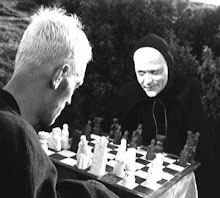
Friday, August 21, 2009

Western Civ. 101

(Ezra Pound/Canto XIV)


Io venni in luogo d'ogni luce muto;

The stench of wet coal, politicians
. . . . . . . . . . e and. . . . . n, their wrists bound to
their ankles,
Standing bare bum,
Faces smeared on their rumps,
wide eye on flat buttock,
Bush hanging for beard,
Addressing crowds through their arse-holes,
Addressing the multitudes in the ooze,
newts, water-slugs, water-maggots,
And with them. . . . . . . r,
a scrupulously clean table-napkin
Tucked under his penis,
and. . . . . . . . . . . m
Who disliked colioquial language,
stiff-starched, but soiled, collars
circumscribing his legs,
The pimply and hairy skin
pushing over the collar's edge,
Profiteers drinking blood sweetened with sh-t,
And behind them. . . . . . f and the financiers
lashing them with steel wires.

And the betrayers of language
. . . . . . n and the press gang
And those who had lied for hire;
the perverts, the perverters of language,
the perverts, who have set money-lust
Before the pleasures of the senses;

howling, as of a hen-yard in a printing-house,
the clatter of presses,
the blowing of dry dust and stray paper,
fretor, sweat, the stench of stale oranges,
dung, last cess-pool of the universe,
mysterium, acid of sulphur,
the pusillanimous, raging;
plunging jewels in mud,
and howling to find them unstained;
sadic mothers driving their daughters to bed with decrepitude,
sows eating their litters,
and here the placard ΕΙΚΩΝ ΓΗΣ,
and here: THE PERSONNEL CHANGES,

melting like dirty wax,
decayed candles, the bums sinking lower,
faces submerged under hams,
And in the ooze under them,
reversed, foot-palm to foot-palm,
hand-palm to hand-palm, the agents provocateurs
The murderers of Pearse and MacDonagh,
Captain H. the chief torturer;
The petrified turd that was Verres,
bigots, Calvin and St. Clement of Alexandria!
black-beetles, burrowing into the sh-t,
The soil a decrepitude, the ooze full of morsels,
lost contours, erosions.

Above the hell-rot
the great arse-hole,
broken with piles,
hanging stalactites,
greasy as sky over Westminster,
the invisible, many English,
the place lacking in interest,
last squalor, utter decrepitude,
the vice-crusaders, fahrting through silk,
waving the Christian symbols,
. . . . . . . . frigging a tin penny whistle,
Flies carrying news, harpies dripping sh-t through the air.

The slough of unamiable liars,
bog of stupidities,
malevolent stupidities, and stupidities,
the soil living pus, full of vermin,
dead maggots begetting live maggots,
slum owners,
usurers squeezing crab-lice, pandars to authori
pets-de-loup, sitting on piles of stone books,
obscuring the texts with philology,
hiding them under their persons,
the air without refuge of silence,
the drift of lice, teething,
and above it the mouthing of orators,
the arse-belching of preachers.
And Invidia,
the corruptio, fretor, fungus,
liquid animals, melted ossifications,
slow rot, fretid combustion,
chewed cigar-butts, without dignity, without tragedy
. . . . .m Episcopus, waving a condom full of black-beetles,
monopolists, obstructors of knowledge.
obstructors of distribution.


Note reference to the Reformer hisself! John Calvin, a "petrified turd." Scawee--especially when one considers that Calvinism remains (apart from a few rustic lutherans and arminian nitwits) the official creed of American WASPism. And alas, more than a few zionist-bankers and money-men reside down Malebolge-way, and Churchill and his goons--the "murderers of Pearse and MacDonagh" (of course, old wives' tales, merely metaphorical, ta ta). Or consider some techie-corporate pedazo de mierda like Issac Asimov: stuffed in a hole, according to Pound-code. Capiche?

'For Aristotle, knowledge is qualitative and observational. Today knowledge is quantitative and theoretical, at least as far as our leading natural scientists are concerned. Who is right ? That depends on what kind of information has privileged status and this in turn depends on the culture, or the 'cultural leaders' who use the information. Many people, without much thought, prefer technology to harmony with Nature ; hence quantitative and theoretical information is regarded as 'real' and qualities as 'apparent' and secondary. But a culture that centres on humans, prefers personal acquaintance to abstract relations (intelligence quotients, efficiency statistics) and a naturalists' approach to that of molecular biologists will say that knowledge is qualitative and will interpret quantitative laws as bookkeeping devices, not as elements of reality'. (Feyerabend, Against Method, 1993)

Thursday, August 20, 2009

Euler plagiarizes d'Alembert

"""[the volume] appeared with a series of articles by Euler including one on the precession of the equinoxes and three others on subjects that d'Alembert had enthusiatically described to Euler in their correspondence. D'Alembert quickly took alarm. All of his work was being stolen! Even his most important contribution, his book on the equinoxes, had not received a single mention from Euler.

D'Alembert was now thoroughly annoyed. Just at the time when his work with the Encyclopédie was achieving so much success, Euler apparently was not only obstructing his efforts, but also borrowing his ideas and claiming them as his own.""""


(American schoolkids learn of that good Berliner, Euler, but of d'Alembert--every bit as capable as Euler (d'Alembert's wave equation actually anticipates aspects of quantum theory)--they know little or nothing. Euler's good for business; the french encyclopedists are not. That wasn't always the case. Ben Franklin corresponded with d'Alembert, as our friends at the Infidels site remind us: "Franklin consorted chiefly with Freethinkers, among whom were Mirabeau, D'Holbach, D'Alembert, Buffon, and Condorcet. Respecting his religious belief, Parton classes him with Goethe, Schiller, Voltaire, Hume, and Jefferson, and says they would all have belonged to the same church."""

Franklin was not the only Framer who admired the French encyclopedists. Jefferson owned numerous texts of Voltaire, and kept a bust of Voltaire in his library at Monticello (it is still there)-- Bor-reeng to some in the Age of Tarentino, but a fact which serves as a correctio to those who consider the Founding Fathers squares, sunday-schoolers, or crypto-fascists (Voltaire was no deSadean nihilist, and consistently denounced military and monarchical despots, religious hypocrisy, and controls on the freedom of speech). John Adams, supposed conservative, took Le Grand Tour of France himself. Describing the embrace of Franklin and the aged Voltaire, he referred to Franklin and Voltaire as Solon and Sophocles (perhaps slightly ironic, but respectful). That nearly suffices as a counterargument to the biblethumpers who insist that orthodox Calvinists brought about the American revolution.

Wednesday, August 19, 2009

St. Cupertino


One of The Flying Saints.

"The masses then style unusual phenomena, "miracles," and partly from piety, partly for the sake of opposing the students of science, prefer to remain in ignorance of natural causes, and only to hear of those things which they know least, and consequently admire most. In fact, the common people can only adore God, and refer all things to His power by removing natural causes, and conceiving things happening out of their due course, and only admires the power of God when the power of nature is conceived of as in subjection to it." (Spinoza--anathema, according to the catholics, jews, and protestants).


Oper ist nicht für die Bauern, Mc Müll-mann

Tuesday, August 18, 2009

The dress of thought


A different language is a different vision of life. Federico Fellini


Learn a new language and get a new soul. Czech Proverb


But if thought corrupts language, language can also corrupt thought. George Orwell


If a language is corruptible, then a constitution written in that language is corruptible. Robert Brault

The PC [political correctness] movement exists not in order to improve the well-being of those whose oppression it purports to combat. Rather, its purpose is to wrap its proponents in a kind of verbal comfort-blanket. Erik Kowal

Learning preserves the errors of the past, as well as its wisdom. For this reason, dictionaries are public dangers, although they are necessities. Alfred North Whitehead

Every American child should grow up knowing a second language, preferably English. Mignon McLaughlin

Sarcasm I now see to be, in general, the language of the Devil; for which reason I have, long since, as good as renounced it. Thomas Carlyle

I speak Spanish to God, Italian to women, French to men, and German to my dog.
- Emperor Charles V


Like everything metaphysical the harmony between thought and reality is to be found in the grammar of the language.
Ludwig Wittgenstein


He who does not know foreign languages does not know anything about his own. Johann Wolfgang von Goethe, Kunst and Alterthum

Language is the dress of thought. Samuel Johnson

Language is the most imperfect and expensive means yet discovered for communicating thought. William James

Rident stolidi verba Latina. (Fools laugh at the Latin language). Ovid

We should have a great fewer disputes in the world if words were taken for what they are, the signs of our ideas only, and not for things themselves. John Locke

Philosophy is a battle against the bewitchment of our intelligence by means of language.
Ludwig Wittgenstein

Wunder f-n bar

Monday, August 17, 2009

Kind of Blue @ 50

(Kaplan/Slate).

""Miles Davis' Kind of Blue, which was released 50 years ago today, is a nearly unique thing in music or any other creative realm: a huge hit—the best-selling jazz album of all time—and the spearhead of an artistic revolution. Everyone, even people who say they don't like jazz, likes Kind of Blue. It's cool, romantic, melancholic, and gorgeously melodic. But why do critics regard it as one of the best jazz albums ever made? What is it about Kind of Blue that makes it not just pleasant but important?

On March 2, 1959, when its first tracks were laid down at Columbia Records' 30th Street Studio (the album would be released on Aug. 17), Charlie Parker, the exemplar of modern jazz, the greatest alto saxophonist ever, had been dead for four years, almost to the day. The jazz world was still waiting, longing, for "the next Charlie Parker" and wondering where he'd take the music.""


Kaplan knows the score on KOB: a definite classic featuring Bill Evans and the Miles Davis Band. Even at 100th spin or so, KOB still sounds fairly fresh (unlike the usual classic rock--say the Beatless--which was banal at 10 spins). That said, Davis' solos were pleasant, and on occasion poignant, but not spectacular. 'Trane's technique impresses, but he wasn't the greatest melodicist, and at times honks a bit. Adderly may win the horn shoot out: he understood Parker-like melodic phrasing and wit. Mr Evans of course sets the mood: brooding, imagistic, dark but not quite nihilism, like Ravel on heroin. A tune like Blue in green reveals a complex, harmonic dream-vision that few if any musicians of any genre will ever attain. The rhythm section did their job--minimal, tight, no rocker or Buddy Rich-like heroics with the stix. Sort of the official soundtrack for urban entropy.

Thursday, August 13, 2009

Phunn with Feyerabend, continued

""The most important consequence is that there must be a formal separation between state and science just as there is now a formal separation between state and church. Science may influence society but only to the extent to which any political or other pressure group is permitted to influence society. Scientists may be consulted on important projects but the final judgement must be left to the democratically elected consulting bodies. These bodies will consist mainly of laymen. Will the laymen be able to come to a correct judgement? Most certainly, for the competence, the complications and the successes of science are vastly exaggerated. One of the most exhilarating experiences is to see how a lawyer, who is a layman, can find holes in the testimony, the technical testimony, of the most advanced expert and thus prepare the jury for its verdict. Science is not a closed book that is understood only after years of training. It is an intellectual discipline that can be examined and criticised by anyone who is interested and that looks difficult and profound only because of a systematic campaign of obfuscation carried out by many scientists (though, I am happy to say, not by all). Organs of the state should never hesitate to reject the judgement of scientists when they have reason for doing so. Such rejection will educate the general public, will make it more confident, and it may even lead to improvement. Considering the sizeable chauvinism of the scientific establishment we can say: the more Lysenko affairs, the better (it is not the interference of the state that is objectionable in the case of Lysenko, but the totalitarian interference which kills the opponent rather than just neglecting his advice). Three cheers to the fundamentalists in California who succeeded in having a dogmatic formulation of the theory of evolution removed from the textbooks and an account of Genesis included. (But I know that they would become as chauvinistic and totalitarian as scientists are today when given the chance to run society all by themselves. Ideologies are marvellous when used in the companies of other ideologies. They become boring and doctrinaire as soon as their merits lead to the removal of their opponents.) The most important change, however, will have to occur in the field of education.""""
(from How to Defend Society against Science)


Bada boom; bada bing. Richard Dawkins, knocked down (then Dawk. probably knows less then Nurse Bernadettius does about endocrinology--). Dr. Feyerabend--a graduate student in physics before switching to philosophy of science-- wanted to facilitate citizens' access to scientific knowledge, and valued responsible, non-totalitarian scientists. (He's not a Luddite, though mistaken as such). He had little respect, however, for the right-wing Gurus (right-wing, even when DinkoCrats, or "marxists") and would-be Lysenkos who make up the majority of the academic science establishment. Contingencies grants there might be potential problems with Feyerabend Praxis--, at least in regards to difficult engineering or medical problems. PF's not rejecting Expertise, however. He's pointing out how science assists the forces of darkness, essentially.

Wednesday, August 12, 2009

Hecklers Unite

Lindorff/Counterpunch:

""""Many progressives are getting all bent out of shape over the "brown shirt" rabble organized by health industry PR firms to disrupt the so-called "town meetings" being organized all over the country by Democratic members of Congress.

What they are conveniently forgetting is that these are not really "town meetings" at all, at least in the sense of the town meetings I grew up with, and started out covering as a young journalist in Connecticut--that is, meetings called and run democratically, with leaders elected from the floor, open to all residents of a community.

These "town meetings" are really nothing but propaganda sessions run by members of Congress who are trying to burnish their fraudulent credentials as public servants, and trying to perpetrate a huge fraud of a health care bill that purports to be a progressive "reform" of the US health care system, but that actually further entrenches the control of that system by the insurance industry, and to a lesser extent, the hospital and drug industry.

ObamaCare is to health reform what bank bailouts are to financial system reform, which is to say it is the opposite of what its name implies.

The right-wing nuts who cry that ObamaCare is introducing euthanasia for the elderly and infirm, or that it is socialism, are ignorant wackos, to be sure, but they are right about one thing: Americans are about to be royally screwed on health care reform by the president and the Democratic Congress, just as they've been screwed by them on financial system "reform."

The appropriate response to this screw-job is the one the right has adopted: shut these sham "town meetings" down, and run the sell-out politicians out of town on a rail, preferably coated in tar and feathers they way the snake-oil salesmen of old used to be handled!

This is not about civil discourse. This is about propaganda. The Obama administration and the Democratic Congressional leadership have sold out health care reform for the tainted coin of the medical-insurance industry, and are holding, or trying to hold, these meetings around the country to promote legislation that has essentially been written for them by that industry--legislation that will force everyone to pay for insurance as offered, and priced, by the private insurance industry. What a deal for those companies--a captive market of 300 million people! There will be little or no effort to control prices, and the higher costs will be financed through higher taxes, and through cuts in Medicare benefits.

This isn't "reform." It's corruption, pure and simple."""""


Wow. Does Lindorff--a progressive, not a "tea-bagger" whatsoever -- mean to suggest the medical-insurance industry controls Obama's Democrats, as well as Republicans? Scary--and lacking the usual sophomoric bipartisan drama of the usual Dink-o-crat (now getting his usual fear-mongering on in regards to those evil town haller disruptors). That said, we don't agree that a Medicare would automatically solve the problems. One big VA type of system would be swell--but US corporations would (apparently--health care rather murky business to be sure) rake in millions by having their health care premiums reduced or rolled over to the govt.

Tuesday, August 11, 2009

The Wonder, Work, and Power Meme (Nietzsche, cont.).

"But what of the thing that the priest promises to the believer, the wholly transcendental "beyond"--how is that to be demonstrated?--The "proof by power," thus assumed, is actually no more at bottom than a belief that the effects which faith promises will not fail to appear. In a formula: "I believe that faith makes for blessedness--therefore, it is true." . . But this is as far as we may go. This "therefore" would be absurdum itself as a criterion of truth.--But let us admit, for the sake of politeness, that blessedness by faith may be demonstrated (--not merely hoped for, and not merely promised by the suspicious lips of a priest): even so, could blessedness--in a technical term, pleasure--ever be a proof of truth? So little is this true that it is almost a proof against truth when sensations of pleasure influence the answer to the question "What is true?" or, at all events, it is enough to make that "truth" highly suspicious. The proof by "pleasure" is a proof of "pleasure"--nothing more; why in the world should it be assumed that true judgments give more pleasure than false ones, and that, in conformity to some pre-established harmony, they necessarily bring agreeable feelings in their train?--The experience of all disciplined and profound minds teaches the contrary. Man has had to fight for every atom of the truth, and has had to pay for it almost everything that the heart, that human love, that human trust cling to. Greatness of soul is needed for this business: the service of truth is the hardest of all services.--What, then, is the meaning of integrityin things intellectual? It means that a man must be severe with his own heart, that he must scorn "beautiful feelings," and that he makes every Yea and Nay a matter of conscience!--Faith makes blessed:therefore, it lies. . . . "(from the AntiKhrist, Mencken's translation)
One could imagine some enthusiastic xtian, like one now bellowing out her support for Sarah Palin (or really, for B.O.), saying something like "I believe that faith makes for blessedness--therefore, it is true." That efficaciousness of faith (to borrow a term from Quine) in a sense suffices for the True Believer. The Griswold family marches into the First Church of The Redeemer, sings a few hosannas, listens to Pastor Sunday lecture on the Anglicized Gospels, and feels uplifted before getting back in the Yukon and heading towards Carrows, and the kids seem calmer, and well, blessed: what more proof does Pops Griswold need? That's a point which the madman Nietzsche understands-- and which the overly analytical skeptic --the Bertrand Russell sort--often has overlooked, regardless of his effective skewering of vague theological concepts.

Monday, August 10, 2009

Wagner Festival approved.

Except for Mike Antonovitch's nay vote, LA superviors gave a thumbs up to the 2010 production of Wagner's The Ring and other performances of Wagner's music. It's rather amusing to hear Anty, one of LA's most conservative politicians, whining about a few anti-semitic hints in Wagner (eastsiders know all about Asstonsilvitch's rightist, sheriff-loving, pro-development politics). Wagner actually had a number of jewish friends and associates. Even his most virulent essays were hardly Mein Kampf. The protests of The Ring exemplify typical bad LA politics--an opportunity for any ambitious bureaucrat to obtain some PR and cred. by making some obvious PC rant on the local media outlets.

We here at Contingencies do not pretend to be great opera buffs or Wagner buffs. After an hour or so of The Ring one starts to understand Mark Twain's comments regarding Wagner's music (--it's "better than it sounds",etc.). Wagner music does sound rather schmaltzy at times (like all that Disneyesque stuff with Tannhauser, etc). At certain points in Wagner's music-stream, however, something like beauty jumps out. The Parzifal theme, for instance, resonates--no Disney schmaltz there, but the Knight in the dark forest, headed for Chapel Perilous. Intense, really (but you've got to have the ears--or soul--to hear it) . The naive PC person thinks "that's Hitler's favorite composer," and doesn't really care what it sounds like. Yet Hitler also liked Beethoven (and others). So is Ludwig Van also in the banned composer list, merely because that crazy, murderous peasant aka Der Fuhrer approved of his melodies? Nein.


Last week, Antonovich had proposed a motion urging L.A. Opera to broaden the scope of the festival as a way of achieving "balance, historical perspective and a true sampling of operatic and musical talent." In the motion, he criticized festival organizers for celebrating the work of "a racist whose anti-Semitic writings were the inspiration for Hitler and the Holocaust."

Today's board meeting brought out a number of individuals who objected to what they see as a festival that will glorify Wagner and his anti-Semitic politics. "People make festivals for people they admire," said Peter Gimpel, a lawyer and classical scholar. "I'm horrified by the Orwellian tactics of L.A. Opera. What they are doing borders on historic revisionism, which is worse than anti-Semitism."

Carie Delmar, who runs a website that has protested the festival, said that the "festival is an affront to everything this city stands for."

Those who came to speak in favor of the festival emphasized the symposiums that will be held to discuss Wagner's racism. "It's because of his anti-Semitism that a festival like this should delve into the very issues that are important," said Seth Brisk, a director of the American Jewish Committee.

In the end, supervisors Yaroslavsky, Gloria Molina and Don Knabe voted in favor of the substitute motion, while Antonovich was the lone vote against Yaroslavsky's measure. (Supervisor Mark Ridley-Thomas was not present during the meeting.)

Following the vote, Stephen Rountree, the chief operating officer of L.A. Opera, said that he "couldn't be more pleased" with Yaroslavsky's motion. "We will continue to pursue partners for the festival and continue our efforts to achieve a level of introspection about Wagner's life," he said.

A spokesman for Antonovich said that "we were hoping L.A. Opera would be open to create a more balanced event. But we're pleased we were able to raise the issues in the minds of the people."


Wunderbar
"Target the natives," says McChurchill.


Target the natives for genetic enhancement
our goal is to make them thrive


So says one "Max"of Brave New Worlds. Max's pop-utopian doggerel depends not only on a big, stupid generalization (and thus a fallacy), but racism of a nearly Mengele sort. Which natives are those? All non-caucasians? Does McMax have the data showing the breakdown of scores of various ethnic groups on various tests, across the world? Nyet. It's really not even worth criticizing but brings to mind a few topics still current in the nature/nurture debate.

Richard Lewontin has offered some fairly intelligent criticism of what we might call naive genetic determinism. The Lewontin/SJ Gould faction had issues--they at times drift to a sort of ivy league marxism --but they at least understood that Darwinism and genetic determinism might pose a danger to human liberties. Winston Churchill had no problem quoting Darwin as justification for his eugenics plans (as did a few nazis). To say that genes cause everything (or most of everything) does not necessarily imply one supports eugenics or a Final Solution, but there does seem to be some relationship: most eugenicists of whatever political view have relied upon a notion of a superior race (usually caucasian), and that alleged superiority was supposedly owing mostly to "genetic factors". That's not to deny Darwinian evolution whatsoever, but to question its application to ALL human activities (especially higher sort of language, mathematics, or Justice). That said, Darwin probably knew less about genetics than the average high school biology teacher. Mendel and others developed the science of genetics a few decades after Darwin's demise.

Contingencies suggests genetic determinism usually functions as a sophisticated "naturalist fallacy", really. Consider the usual mafia melodrama, with some mamacita saying of her bad boy son-- after he shoots up some cops, etc-- that he's got his papa's sicilian blood (irish, scottish, italian, african, whatever). That's a typical variety of "folk psychology": not merely the character is inherited but nationality, according to many primitive cultures. That's been proven to be mostly nonsense. There might be something like shared characteristics--probably due to appearance, language, political/historical factors, etc--but the grand generalizations about race and nationality are not supported by evidence. Conditioning matters, greatly. Caucasian chess players most likely made generalizations about latinos or hispanics until a cuban, Capablanca, defeated the greatest chess players in the world, most of them caucasian or jewish. Capa. was not born a grandmaster, of course (though hereditary factors played a part, indirectly, at least: ie good chess players, like good professors generally come from nice bourgeois homes. That doesn't mean that the bourgeois are "better"--perhaps more fortunate, or for that matter, more successful predators).

Lewontin:

The most violent eugenicists, and in some ways racists, were geneticists who said, "Genes dominate everything, and if there are differences between groups and how rich they are, how much power they have, it must be in the genes." Only for a short period, during the Second World War, when the consequences of that ideology in the national socialist state in Germany became clear, did people back off that. When I was in high school during the Second World War, we got a pamphlet saying there really aren't any important differences between races, and so on; but that disappeared when the war was over. Within ten years of the end of the war, [genetic determinism] had come back again. Biologists in general are biological determinists. That has a very powerful ideological effect, because they speak to reporters, they talk on the radio, they have TV interviews, and they push over and over again the determinism of the gene.

My wife and I went yesterday to the Berkeley Art Museum, and there we saw an exhibit called "Gene Genesis." The poster for that exhibit, which is all over, has a quote from Jim Watson. And what does the quote say? It says, "We used to think our fate was in the stars, but now we know it's in our genes." Now, I mean, that's rubbish, you know, but that's what's pushed; and if you're a Nobel prizewinner like Jim, you get all the more credit for it.

So scientists had that ideology that as organisms, we are governed, body and soul, by our genes.

Secondly, more broadly, scientists want to make claims for the importance of what they do in the general sense. So Jim Watson wants to say, "You should support work on the genome, because after all, everything that's important in life is determined by genes." And that's not ideological; that's purely political. That is a crass way of trying to increase and guarantee the support of research.

The same is true for medical research. We're told over and over and over again that if we do this research people's lives will be saved. People will be cured. Well, obviously, medical cures do arise out of some kinds of research; nobody can deny that. But promises are made of an extreme sort which do not correspond to actual truth. This guy [William] Hazeltine, who is the head of one of these private genome organizations, finally said what everybody wanted to say but didn't have the nerve to say. He said, "Death is nothing but a succession of preventable diseases." Well, if death is nothing but a succession of preventable diseases, then if you give us enough money, you'll live forever. Now, no sensible person believes that. But that's the kind of appeal that is made. "Give us more. Give us more power, give us more money, and we will not postpone your death; we will prevent it."

There are a lot of sick people in the world. Most of them are sick, ultimately, because they're underfed and overworked. That's not the case for Americans. Most Americans are sick because they've lived a long time, and their machines are breaking down. You know, the transmission goes, and then you need a brake job, and so on. There's a tremendous public demand -- people are in pain, and there's a demand to relieve that pain and relieve that anxiety. Science cashes in on that in a very cynical way by making promises that can't be kept.


(to be continued...)

Sunday, August 09, 2009

The Yuppie Don, Michael Franzese.........sings

Franzese, ex-mafia boss, found Jeezuss while in prison and now lectures jocks on the evils of gambling and the mafia-connection to pro-sports of all types:

""At the peak of his criminal career during the 1980s, Franzese was rated by Fortune magazine among the top 20 most wealthy and powerful Mafia bosses and ran businesses that were generating a weekly turnover of about $7 million. With 12 bookmakers reporting directly to him, gambling contributed significantly.

So how does it happen? How do athletes become entangled in the web of organised crime? Franzese explains a typical scenario.

"I would get a call, 'Hey Mike, this certain player is in for us, $10,000, $15,000, $20,000, do you want me to stop him?' I would say, 'Of course not. Let him get into you for more, $100,000, $250,000. Let him bet'. We used to purposefully put him in the situation that we wanted.

"Before you know it this guy has nowhere to go. Finally, you say, 'OK this is exactly how we are going to work this out. Tomorrow night, you are favourites to win by 10 points, you make sure you win by six. I don't care how you do it – do whatever you have got to do. If you do this a couple of times, we're even. If you don't do this a couple of times then don't worry, you don't have to call me any more, I'll find you'."

According to Franzese, the competitive nature of sportsmen draws them to betting. Footballers in Britain certainly have a long culture of gambling while, in America, the issue was brought into sharp focus when basketball's Charles Barkley revealed losses of $10 million. The big danger, though, is when the money becomes owed to the wrong people.

"These guys are sophisticated in the sport that they play but, when it comes to their knowledge on the street, believe me they are babes in the woods," Franzese said. "When I speak to these guys, I say, 'I don't want to mess with you on the field, you would eat me up but, I tell you what, you come into my business, the business of gambling and I'll make a sissy out of you.

"We don't play by rules. There's no guy blowing a whistle'."

Franzese first became involved in organised crime at a time when his dad, Sonny, the Colombo family underboss, had been sentenced to 50 years in jail. The memory of taking his oath and becoming a sworn "made man" on Halloween 1975 remains vivid. "Money and power were the driving forces," he says. "I witnessed a lot of things that were unpleasant."

Franzese, though, was successful and being groomed to become the 'boss' of the entire Colombo organisation when, in 1984, he met his present wife, Camille. Eventually he decided to take a plea, do some jail time and left the mob in 1993. "All hell broke loose," he says.

"My dad disowned me, a contract was put out on my life. I should either be dead or in prison for the rest of my life, that's certainly what I earned. For some reason I got a second chance."""


FUGGETABOUTIT

(+Morricone/OUATITW

Saturday, August 08, 2009

12th Street Rag

12th street rag, big band version


(from the Jazz Journal, volume 4, number 1, dated 1951):
EUDAY L. BOWMAN and the 12th STREET RAG
By S. Brun Campbell

"Euday L. Bowman was born in Fort Worth, Texas, on November 9th, 1887, and was educated in public schools. Eventually he became an arranger for popular orchestras. His musical works were Eleventh Street Rag, Twelfth Street Rag, and Petticoat Lane Rag, all named after streets in Kansas City, Missouri, and Colorado Blues, Kansas City Blues, Fort Worth Blues, Tipperary Blues, Shamrock Rag, White Lily Dreams, and Old Glory On Its Way. He died in New York City on May 26th, 1949, while there on a business trip. In his later years he was in poor health, and in very bad financial circumstances. He lived with his sister, Miss Mary M. Bowman, at 818 So. Jennings Street, Fort Worth, Texas, in an old worn house with a few small rooms. The old car that Mr. Bowman used to collect and sell paper salvage stood in the backyard as evidence of his stranded financial straits.

Although Euday Bowman wrote the Twelfth Street Rag in 1914, it was not until 1948 that he realised any money from it. He first published it himself, then he sold it for $100.00 to the Jenkins Music Publishers of Kansas City, who published it for many years. In 1937 the rights reverted back to him. I have been informed by the Jenkins Music Co. of Kansas City that they were transferred to Shapiro-Bernstein Music Publishers of New York City, who now own the work for publication.

On Monday, August 14th, 1950, a treasure trove of memories were moved away from Euday Bowman’s old home for his belongings and those of his sister, were off sold at public auction. Furniture, dishes, and Euday’s piano which he had owned since 1895, and which he bought in Hartford, Connecticut, were among the items that were auctioned off. One of his old friends, Mrs. Myrtle Stewart, bought the piano for $46.00. His accordion, and 600 new records of the Twelfth Street Rag, which Bowman played himself, were some of the other items, along with the family Bible, that went under the auctioneer’s hammer. His friend, Ed Lally, played Twelfth Street Rag on Bowman’s old piano as a farewell to the composer as the household goods were sold to settle the estate.

Reports at the auction were that the estate got $3,000.00 in on the Twelfth Street Rag in July of 1950, alone. But for Bowman, the money from his composition came almost too late, as he was in poor health and had to spend some $2,000.00 with doctors the first month after his royalties started coming in, Ironi-cally, the new things the Bowman’s had bought, went along with the old things, under the auctioneer’s hammer.

But the tall, lanky Texan, Euday Bowman, will always be remembered for his famous Rag, for it has proved to be one of the most popular pieces
of ragtime ever written. Very few people knew that his sister, Mary, who was a music teacher, wrote part of the tune, and shared in whatever profits were derived from it. It is too bad that both had to die just as they were commencing to enjoy the royalties that they both had waited for so many years.

I understand that Bowman and his sister have no heirs, and if such is the case, the royalties no doubt will go into the A.S.C.A.P. treasury, for he was an A.S.C.A.P. member. Whoever the lucky person was who bought Mr. Bowman’s 3-foot high collection of old music and the original Twelfth Street Rag manuscript, which he wrote, should be as proud of that wonderful collection as he was.

He was the last of the early Ragtime composers. It seems strange that Scott Joplin, the composer of the Maple Leaf Rag and Euday Bowman, composer of Twelfth Street Rag, should both be born in Texas. Joplin was born at Texarkana, Texas, in 1868."


That's 12th Street, Kansas City. Pendergast turf, and Mr. Bowman actually played in some of the nicer KC bordelloes, at least for a few years. Jazzmen from 'Nawlins to New York knew this tune well. Louis Armstrong played it (even in 50s and 60s).

Wednesday, August 05, 2009

Miércoles con Feyerabend

All Ideologies must be seen in perspective, said Feyerabend.

"""""I want to defend society and its inhabitants from all ideologies, science included. All ideologies must be seen in perspective. One must not take them too seriously. One must read them like fairy-tales which have lots of interesting things to say but which also contain wicked lies, or like ethical prescriptions which may be useful rules of thumb but which are deadly when followed to the letter.


Now, is this not a strange and ridiculous attitude? Science, surely, was always in the forefront of the fight against authoritarianism and superstition. It is to science that we owe our increased intellectual freedom vis-a-vis religious beliefs; it is to science that we owe the liberation of mankind from ancient and rigid forms of thought. Today these forms of thought are nothing but bad dreams - and this we learned from science. Science and enlightenment are one and the same thing - even the most radical critics of society believe this. Kropotkin wants to overthrow all traditional institutions and forms of belief, with the exception of science. Ibsen criticises the most intimate ramifications of nineteenth-century bourgeois ideology, but he leaves science untouched. Levi-Strauss has made us realise that Western Thought is not the lonely peak of human achievement it was once believed to be, but he excludes science from his relativization of ideologies. Marx and Engels were convinced that science would aid the workers in their quest for mental and social liberation. Are all these people deceived? Are they all mistaken about the role of science? Are they all the victims of a chimaera?

To these questions my answer is a firm Yes and No.

Now, let me explain my answer.

My explanation consists of two parts, one more general, one more specific.

The general explanation is simple. Any ideology that breaks the hold a comprehensive system of thought has on the minds of men contributes to the liberation of man. Any ideology that makes man question inherited beliefs is an aid to enlightenment. A truth that reigns without checks and balances is a tyrant who must be overthrown, and any falsehood that can aid us in the over throw of this tyrant is to be welcomed. It follows that seventeenth- and eighteenth-century science indeed was an instrument of liberation and enlightenment. It does not follow that science is bound to remain such an instrument. There is nothing inherent in science or in any other ideology that makes it essentially liberating. Ideologies can deteriorate and become stupid religions. Look at Marxism. And that the science of today is very different from the science of 1650 is evident at the most superficial glance."""""


A Richard Dawkins would probably do a spit-take with his Earl Grey to hear science called an "ideology." And even Contingencies grants Feyerabend's "social constructivism" does at times present problems to a westerner's sense of Truth, whether empirical-scientific or logical. However the Dawkins or Carl Sagan sort of techie nerds--the types who take Star Trek to be some dee-eeply symbolic work of art, man (like this little Nixonian-on-crack)-- generally misread Feyerabend, especially his classic "Against Method"--assuming they bother to read anyone apart from like their fave Heinlein or Asimov space-dreck.

Feyerabend does not, as do some postmodernists, deny scientific realism per se. Though he's not fond of Kuhn, he does understand, as did Kuhn, the provisional nature of scientific knowledge (whether in terms of theories, or nomenclature itself. 00001001 works for 9). He's not saying knowledge is impossible, or claiming "there's nothing outside the text". Bridges work. Planes fly; CPUs spin. Feyerabend does however question the ideology of science, especially in regards to how the scientific establishment functions, whether in terms of economics, politics or education. Scientific knowledge--whether that of bio-chemistry, or experimental physics, or CPUs, even the "science"of undergraduate micro and macro-economics-- has become an institution, closely aligned with industry, and dare we say capitalism. Patents are big business, whether in terms of pharmaceuticals or software or CPUs.

Feyerabend jacks the Institution, really. And it was a Jack worthy of Marx and Engels (though not quite as hysterical, or dangerous). Understanding Science as a sort of handmaiden to industry and business may not be that radical, but Feyerabend wants to show us that the Big Guns of science are really not gurus. We should not mistake the local software engineer for the high point of human civilization (then, neither is the french professor). There's a lot one could say on this (and more shall be said), but I think a key element of Feyerabend's critique relates to how scientists control and take advantage of institutions and universities, and how their code of efficaciousness (to use Quine's favorite criteria) has percolated throughout all human activity.

Consider an experimental chemist. What she does in a lab is not that difficult. Yes, memorizing the formulas and equations required work and study--perhaps a great deal of work (though like most of her colleagues she's probably from an upper-class home, which allowed her the time, comfort and money to become an egghead, more or less). Yet the end result--a new medicine, or fertilizer, or weapon--is what counts. She, like her colleagues, dedicates herself to results. Anything which does not work, doesn't matter. Obviously that's important, even crucial in some fields (like medicine). But that results-oriented, experimental knowledge does not represent the sum total of human knowledge, though it is mistaken as such.

Tuesday, August 04, 2009

Las Llaves del Reino de los Cielos

"Y yo te digo que tú eres Pedro y sobre esta roca, Yo edificaré mi Iglesia y el poder del infierno no prevalecerá contra ella. A ti te daré las llaves del Reino de los cielos; y todo lo que atares sobre la tierra será también atado en los cielos; y todo lo que desatares sobre la tierra será también desatado en los cielos." (Mateo 16 18-20)

(vulgate: 18 Et ego dico tibi, quia tu es Petrus, et super hanc petram ædificabo Ecclesiam meam, et portæ inferi non prævalebunt adversus eam.

19 Et tibi dabo claves regni cælorum. Et quodcumque ligaveris super terram, erit ligatum et in cælis: et quodcumque solveris super terram, erit solutum et in cælis.)

en el griego: κλεῖδας τῆς βασιλείας τῶν οὐρανῶν. κλεῖδας/kleidas: keys/claves/llaves. βασιλείας/basileias-- kingdom, reign (cognate with basilica). οὐρανῶν/"ouranon"--plural. air, heaven, sky. Like Uranus! Father Ouranon. Ouranon also appears in the writings of greek philosophers such as Plato, where he uses the term without the mythological connotations. Ouranon is the realm of the Platonic forms ...and one might say, the Idea.

We hold to the Greek primacy thesis regarding the New Testament, btw. That was all greco-romanic territory (the Romans, even after subduing the greeks, still used the koine greek). Even jewish people (assuming JC was even jewish, which is debatable--) grew up learning greek. Hebrew was not a complete language, and rarely used, except by a very few rabbis--the Septuagint was actually the "official" text . Aramaic was a sort of street dialect (which later evolves into hebrew). Phoenician--punic, more or less-- was still in use, but the greek rulers of egypt were after Alex, speaking, yes, greek. The writing of the NT itself was nearly definitely in koine greek--not quite the classic hellenic greek of Plato, but a merchant's tongue, though not lacking a certain eloquence at times.

St. Jerry translates "ouranon" to latin cælorum--plural. Luther calls it Himmel--singular; finally to Heaven via anglo. Muy feo.

cælorum--plural "sky," skies, heavens, though "celestial"implied as well.

ligatum: bind, tie (atares, sp, bound)

New Contingencies Edition, Revised: "And I say to you that you are Peter, and on that rock I will build my church, and the power of perdition itself will not prevail against it. And to you I give the keys of the King of the celestial realms, and all that holds about the earth also holds to the celestial realms, and all that is undone on earth shall be undone in the celestial realms."

(JC, monarchist? tal vez)

Monday, August 03, 2009

Buh bye Belle-Ron

Whoa, the mormon subluxanator and quack got his feelings hurt. Touched a nerve, by like pointing out the lack of data or evidence to support you or your palsie's undergraduate stalinist-Freud lite? And as I mentioned, liar, Popper and others pointed that out, years ago. You don't know jack about psychology, just like you don't know jack about first-order logic, or real science (your nursey courses from 25 years ago in Casa Grande don't mean jack either) Now, make shit up Kissingerius. Anything to keep the attention off your fraud and tax shelter. You're just another Tea-bagger, phony, as DU peeps now know as well (and we've also traced you at far right, anti-tax sites, Tea-ron, byatching about health-care premiums).

The Belle-ron usual: when somebody says something logical which ruins his little fraudulent ideology, lie,libel, and defame. Or plagiarize people! Or start quoting the Good Book (we have your Hagee fundie-racist church ID'd as well. Capiche?).

Your sweat-shop business is finito, fraud.

Per the democrats, and labor board, and Sac Bee (heh heh). Capiche, Schwarzenegger boy? (your lies and fraud have been exposed on DU as well! heh heh. Bad news, eh Schwarzi-wannabe).

And the HW chiropractor-quack site has been exposed to whistle blowers including--CA consumer affairs.

Capiche, mormon-mason misogynist? You might consider tickets back to Provo, occultist. Take yr dreck with you.

Now, get ready for trabajo (and regular tests for crack or tweek, basura)


Thursday, July 30, 2009

Off with their heads (Queen Feinstein on health care)


""Senator Dianne Feinstein has already taken a hammering from Dems and health care reform advocates for casting doubts on the prospects of President Obama’s health care reform efforts. MoveOn, for instance, aired an ad against her in California, demanding she show some leadership and fight harder to get the president’s reform plan passed.

Now Feinstein has hit back at the criticism from the left in an article about lefty groups targeting Dems for waffling on key components of health care reform:

“I do not think this is helpful. It doesn’t move me one whit,” she said. “They are spending a lot of money on something that is not productive.”

That sharply dismissive tone won’t exactly smooth over tensions......""""


DiFi whines in her predictably centrist-DINO tone. Just as predictable has been the blogocrat reluctance to criticize the DINOcrats and the blue dog types, who like, this pedazo de mormon mierda, cunningly argue for a conservative sort of taxpayer-funded plan which would release business owners from their obligation to pay ever-increasing healthcare premiums for their employees (premiums have recently gone up on all businesses, due to actions which the Demo's voted in). Brighamius is of course too stupid to realize even the Leahy plan will keep the higher premiums on businesses intact for most part (Leahy sort of dissed Medicare).

In effect, a single-payer plan--even Medicare, supposedly "socialized medicine"-- could be a windfall for corporate America, if the DINOs pass on the premium cost to normal citizens by substantially increasing Fed taxes (as Obama seems to favor). The Tri-committee plan--perhaps similar to Hillary's plan-- does appear to provide citizens with the most coverage, though financing has not been worked out. It does not seem nearly as "centrist" as Obama's own bill, which does give many big corporations the windfall (Contingencies has not as of yet mastered the murky waters of the healthcare Lagoon). The blue dogs are stalling on it, of course, mostly because they don't want to piss off the business owners, insurancemen, and doctors. Instead of passing off the tax-increases to the public or, in DiFi style, appeasing the nobles of business and medicine , they should grow some spine, and DEMAND higher premiums on companies to cover it, and also ensure that companies don't merely slash wages to pay for it. Curtailing or capping management salaries might work...

Monday, July 27, 2009

Churches are trade unions (ACGrayling)

This blasphemous, bawling piece of british garbage gent entertains at least:

So I repeat: in a free society people must be allowed to believe what they like, even stupid, ignorant and absurd things, provided they do no harm to others. Religious organisations have every right to exist and have their say, just as any other self-selected, self-constituted interest group does, such as trade unions and political parties. But religious organisations have to recognise that they are such groups, and nothing more than such groups – that they are civil society organisations like trade unions, existing to protect and promote their own interests – and although they have the same rights, they do not have any greater rights.

And here is the problem: the religions think they have much greater rights than anyone or anything else – rights to be heard, to be exempt from laws, to be awarded special privileges, to be given our tax money to run their own schools, to have representatives in the House of Lords (26 bishops plus all those retired bishops and archbishops who are now life peers), to be given hours and hours of air time on publicly funded radio every week, to have charitable status, to have their hospital chaplains paid for by the public purse, and so on and endlessly on, getting a huge slice of the pie out of all proportion to the realities: which – as an indication of the overall picture – are that about 3% of the population go to Church of England services every Sunday, less than 10% of the population going weekly to any church, temple, mosque or synagogue. And the state goes along with it!

How can this be tolerable? All religious organisations should be relegated to the status of private self-selected and self-constituted NGOs like trade unions and other lobby groups, should survive on what money they can raise from their adherents, should have the same and no more than the same rights and entitlements as any other such organisation and should stop getting privileges, money and an amplification for their views (views, never forget, derived from the beliefs of illiterate goat-herds in ancient times) from government.""""


Contingencies also agrees that voluntary self-euthanasia should be a right, though a carefully delineated right.

Thursday, July 23, 2009

Bellum omnium contra omnes

(James Poulos)
""""One drawback of Leviathan is that Hobbes, the great theorist of the individual, doesn’t theorize the kind of individual that emerges in real life in the wake of, say, Napoleon. (This is a kind of individual different yet from the one we associate with the Revolution itself.) Already within Hobbes is the promise that great freedom awaits those savvy enough to surrender their political liberty. Yet the specific interests and passions of individuals ready to dump political liberty today, of course, look rather different than they did in Hobbes’ time. Now, the character of these differences could be summed up as, or chalked up to, certain developments in capitalism or technology — to the outworking of the relations between man and money on the one hand and man and nature on the other. On the other hand, we could consider that the rise of individuality as a moral ideal has been changing the way we relate to one another in a way that’s more cause than consequence of the man-money and man-nature relationship. It’s significant that this development remains only implicit in Hobbes."""""


And to think some Contingencies fans considered references to Hobbes obscure and antiquated! Actually Poulos perceives a different Hobbes than we do. He also makes rather extreme demands by suggesting that TH (or any thinker ) failed to anticipate some historical event X . Regardless, the classic reduction of the state of nature in Leviathan, and the material concerning "omnia bellum contra omnes" hints at a anarchistic world of Napoleons (or would-be Napoleons):

“ the life of man, solitary, poor, nasty, brutish, and short..."

Hobbes thus did consider potential Napoleons--both in the pre-society, state of nature (see the brief paragraph in Book XV contra-Aristotle's "magnanimous man"--i.e. frat boy tories the world over, of whatever race), and in civil society--with a tyrant or dicatator who no longer upholds the citizens' covenants are considered nulled/overturned. Indeed at times a protestant "leveller" aspect appears in Hobbes--probably one reason the royalists distrusted him (though the puritan levellers took him to be a...royalist). Leviathan is not Machiavelli--tho' Poulos seems more drawn to machiavellian politics than to Hobbes contractualism. It just goes to show that one never knows even old, dead white philosophers like Hobbes still matter to some in cyberland.
Ave atque vale


Gidget, known for the tagline ‘Yo quiero Taco Bell,’ died from a stroke.

Monday, July 20, 2009

Here come those santa ana winds again....

Dan days


"The seasonal Santa Ana winds are hot, dry, strong gusts which blow westerly across Southern California between September and February. "Santa Ana" is Spanish for "Saint Anne" and refers to the Santa Ana Canyon near San Diego where the winds were thought to originate (in reality they come from near the Rocky Mountains). A boon to surfers but a nemesis to firefighters and homeowners, the hot winds are said to fuel aggression and can even foretell a coming earthquake — the so-called "shake and bake" syndrome."

steelydandictionary

Ray Chandler called it Red Wind:

""There was a desert wind blowing that night. It was one of those hot dry Santa Anas that come down through the mountain passes and curl your hair and make your nerves jump and your skin itch. On nights like that every booze party ends in a fight. Meek little wives feel the edge of the carving knife and study their husbands' necks. Anything can happen. You can even get a full glass of beer at a cocktail lounge.""

Saturday, July 18, 2009

Plutocracy, ObamaCo-style

"""""Goldman Sachs exemplifies the domination of the banks over government policy and both political parties. It has supplied the top personnel for government economic policy-making in the Democratic Clinton, Republican Bush and Democratic Obama administrations. Bush’s treasury secretary, Henry Paulson, formerly the CEO of Goldman, saw to it that the government bank bailout paid especially rich dividends to his former company. This included a bailout of AIG that allowed the company to pay off billions of dollars in derivatives debts to Goldman at 100 percent.

The list of former Goldman Sachs employees holding top positions in the Obama administration includes:

• Mark Patterson, a former Goldman Sachs lobbyist, who is the chief of staff to Treasury Secretary Timothy Geithner (himself the former president of the Federal Reserve Bank of New York).

• Reuben Jeffery III, former managing partner at Goldman Sachs, who holds the post of undersecretary of state for economic, business, and agricultural affairs.

• Neel Kashkari, former Goldman Sachs vice president, who is the assistant secretary of the treasury for financial stability, responsible for administering the TARP funds.

• Dianna Farrell, former financial analyst at Goldman Sachs, who serves as deputy director of the National Economic Council.

There is a word to describe this type of socio-economic order: Plutocracy, i.e., rule by the rich. This is the reality behind the increasingly thin veneer of democracy in America.

The Obama administration in an instrument of the plutocrats, and the American people are the victims.

There is no way this can be reversed within the framework of capitalism. The only social force that can end the dictatorship of the banks is the working class. It must be mobilized as an independent and revolutionary political force in opposition to Obama and both parties of big business.

The fortunes obtained through fraud and socially destructive means must be expropriated and directed toward providing social relief, rebuilding industry and the country’s infrastructure, and guaranteeing jobs, education, housing and decent living standards for all. The practices of the banks, hedge funds, CEOs, big investors and speculators must be investigated and exposed to public view, and those responsible for the economic disaster held accountable.

Socialist policies are needed to break the stranglehold of the financial aristocracy. The banks must be nationalized and turned into public institutions, under the democratic control of the working population. Only on this basis can economic life be organized according to social need, rather than private profit and the accumulation of personal wealth by a small minority.""""""


Contingencies usually agrees with the marxist diagnosis of the disease of finance capitalism but not always with the proposed marxist treatment (there are to be sure groups more radical than WSWS). The financial aristocracy needs to be dismantled though that doesn't mean Labor and a few marxist academics are the only ones who can stop it. Marx hisself was no syndicalist or worshipper of the trade unions. The bolsheviks arguably came into power precisely because they refused to kowtow to the union bosses of the time (though they were stronger in Europe than the czar's Russia). VI Lenin may have communicated with the De Leonist sorts, but the bolsheviks were quite aware of the drawbacks of De Leonism, and other types of syndicalism (including the anarchist sort). One drawback may be called "Norma Raeism," for lack of a better word.

The WSWS itself seems prone to Norma Raeism. WSWS has been fairly active in so-cal politics--though you wouldn't know that reading the HuffPo or daily celebrity snatch news. They were involved in the grocery worker strike of 2003-2004, and other labor issues. Unfortunately, the WSWS type of labor-leftists tend to be controlled by Norma Raes dedicated to union style politics and the holy concept of Seniority. The long-time unionist does not really approve of progressive leftists--even radical, bolshevik sorts. Her leftism is not that of the University, of the scientist or philosopher, but of truck drivers, meat workers, fruit and vegetable packers, agriculture workers, los Migros. For Norma Raes (or Normitas) La Huelga does not depend on what a Zizek or Chomsky has to say--she probably has never read a word of a german philosopher--, but on the union jefes, who are--I contend--more like De Leonists than bolsheviks or trotskyites (to toss around a bit of jargon)--though even in CA there are somewhat maoist unionists as well.

Thursday, July 16, 2009

From the biography of L. Ron Hubbard

"....shows a man who was incapable of telling the truth: a pathological liar who hated and despised humanity; a sociopath caught between the conflicting desires to earn the admiration of humanity, and his desire to inflict great pain and misery upon those who ignored him and refused him his self-perceived due measure of honor and reverie (which was and is 99.999% of his fellow human beings).
As such, Mister Hubbard was constantly trying to purchase glory and recognition when he had the funds to make the attempt, or stole that recognition by lying and deceiving when money wasn't enough.

Mr. Hubbard was driven by greed and megalomania. He was a devout racist who wrote in praise of South African Apartheid; he was a crazed misogynist who insisted women were inferior intellectually--- later in life his venereal disease (caught from a whore while on leave from the Navy) instilled within him a fear and dread of womankind that expressed itself in insanity and impotency......"""""


L-Ron also counted Heinlein as his pal, and though some RAH fans deny it, Heinlein--a hawk on 'Nam, and Reagan supporter--remained fairly close to L-Ron, up until Hubbard's rather odd demise (CoS doctrine forbids drugs, yet the autopsy showed that L-Ron's bloated corpse was pumped full of barbituates). See also the fairly well-known story of L-Ron's association with Jack the Quack Parsons, rocket scientist, and one of the founders of Cal Tech and JPL (Mike Davis' City of Quartz describes it effectively). Both L-Ron and Parsons had an interest in the occult--that is, until Parsons blew himself up in his Pasadena garage.

The CoS remains a force, in entertainment, and online, unfortunately--as with this untalented nut, who has taken to writing a sort of stoner operetta featuring a Battlefield Earth-like "libretto" (with some great staging hints--"a million years passes"), and some bad garage band-like rock. Holu McXenu Batman, thorazine on the way. You know you're dealing with an Appliantologist type of crypto-nazi occultist when you're reading something with anthropomorphized stars and planets, and that old saxon "sky" (ascendit ad caelos, as the orison went---or descendit ad infernalis, in McNut's case). Let's not forget many mormons also support the CoS quack cult. Combine Hubbard and Moroni, and voila: All-American psychotic.

Sunday, July 12, 2009

Ezranomics, cont. (con musica)

"""The Puritans were Bible-crazy, but they did not bring the Hebrew Scriptures only. The culture of Adams and Jefferson is a Latin culture with a mixture of Greek. Otis wrote a Greek Grammar which he destroyed, or which was lost for the lack of a competent printer. During the prosperous colonial era the arts of silversmithing, furniture making, and architecture developed. The houses, although made of wood, were a Greek dream. Numbers of them burned down. From Germany came groups of religious sectarians. They brought with them the art of glassmaking, and organised, at least once a year, a Bach Festival. Monticello is full of refinement. The polygrapher longed for a complete civilization equal to that of an Italian Court, ceremonies omitted, of the Fourteenth Century. He got into debt.

Adams was frugal, and used the weather-boards of his attic study as a handy file for his correspondence. For at least a century New England took as an idea: “Low Living High Thinking”.

Usury spoiled the Republic. Usury has been defined as too high an interest on money. The word finance became fashionable in the bank-paper era. And it is to this that Jefferson alludes in the phrase: “No one has a natural right to be money-lender save him who has it to lend.” With the “financial” era the word usury disappeared from polite conversation.

There is no greater imbecility than to leave one’s own bank-account or one’s own sources of information in the hands of an enemy, or an irresponsible man.

The struggle between the people and the exploiters, in America, was waged around these forms of imbecility.

A handful of people, who lived on little and did not run into debit brought to, and preserved in America, a rather high, severe culture, and a civic sense nourished by the traditions of English legal liberty, that is, by a centuries-long conquest in which the traditions of North European tribes and Roman Law converge.""""


(Ezra Pound,
An Introduction to the Economic Nature of the United States).

To reiterate: """The polygrapher longed for a complete civilization equal to that of an Italian Court, ceremonies omitted, of the Fourteenth Century."" Jefferson the Polygrapher. Yo le gusta.

Domingo-dia de Dios muzak! Stomping at the Savoy. ah yass

Friday, July 10, 2009

O'REILLY?????????

Bill has some spine at least, unlike most WASP pieces of mierda.

O'Reilly criticized Jackson for "incredible selfishness -- spending hundreds of million dollars on himself while singing 'We Are the World,'" and said that it "should make any clear-thinking American nauseous."

Speaking to guest analyst Marc Lamont Hill, a black FOX commentator, O'Reilly also addressed race as an issue at the memorial service: "Why are Jesse Jackson and Al Sharpton making this a racial deal? Jackson bleached his own skin. And then chose white men to provide existence for his in vitro children. Give me a break with all this.

The two debated for quite some time on whether Jackson had helped in uniting black and White Americans. The debate, however, turned into a shouting match with O'Reilly proclaiming: "If he's such a black American icon, why did he have his kids with white men!?"
..........


Word. Rational humans realize that Jackson's pop-hype's not worth discussing; he's about as much as a hero as say the Bee-gees were. Did you like lose sleep when Elvis or Sinatra died? (a bit before my time, but, like, connect the dots). At least Sinatra and his cronies produced some interesting and complex muzak on occasion. Would say Ralph Ellison have given his blessings to MJ, or joined in the insta-elegy? I rather doubt it (not that it matters overly much). Bienvenidos a Perdido, puto.

........

sabado-noche GIGANTE

Thursday, July 09, 2009

Walmartization.

In a few decades, about everyone will have a Wallymart vest, except for the Uber-executive-celebrities in Wally-mart towers and gated enclaves, and maybe some red-rebels in a few third world nations (No se quiero El Wally!). The academic-left went through a Walmart-fetish phase a few years ago, so this topic may be boring to some; regardless of a few whines from marxist sorts or journalists, however, Walmartization does not appear to have abated much (though paraphrasing Iggy Pop, I don't have time to like check the demographics). Walmart marches on, regardless of war, economic collapse, revolutions, or water and environmental issues (building one of the super-stores--and it's the brokering, building and contracting that brings in the big shekels, not the mere day-to-day retail biz--requires more energy, water, and resources than many towns will use in a few years).

W-mart also functions psychologically, we suggest. As the Super-stores shut down the Ma and Pa shops as well as the mid-sized retail--best buy, circuit city (gone from eastside), pep boys, k-mart, various restaurants--the herd congeals, and becomes a sort of ersatz proletariat. Of course wally-bots (aka employees) are not allowed to unionize, per their employment contract, and usually are pink-slipped if they show any inclination towards collective bargaining.

The small town or 'burb sort of becomes a Walmart-feeder--the host to the Wally-parasite. One might say the Consumer does not consume the commodities offered by the store-machine, but that the store-machine--and waxing marxista for a few nanoseconds, the capitalist-owners, aka the Waltons, and their managers--consumes the towns and cities, urban areas, and finally entire regions, producing a class of 'Merican-bots, usually obese, addicted to fast-food, booze, various narcotics, firearms, bad movies, muzak, and cheap technology. Or something like that.

Sunday, July 05, 2009

From Orwell's Politics of the English Language:

"""Now that I have made this catalogue of swindles and perversions, let me give another example of the kind of writing that they lead to. This time it must of its nature be an imaginary one. I am going to translate a passage of good English into modern English of the worst sort. Here is a well-known verse from Ecclesiastes:

I returned and saw under the sun, that the race is not to the swift, nor the battle to the strong, neither yet bread to the wise, nor yet riches to men of understanding, nor yet favour to men of skill; but time and chance happeneth to them all.


Here it is in modern English:

Objective considerations of contemporary phenomena compel the conclusion that success or failure in competitive activities exhibits no tendency to be commensurate with innate capacity, but that a considerable element of the unpredictable must invariably be taken into account."""


Whoa. Orwell knew the score on liberal bloviation decades before the DailyKOS boutique or postmodernists arrived (tho' yes, the Limbaugh-right bloviates, tho' they tend to stick to monosyllables).

Saturday, July 04, 2009

Ezranomics

From Ezra Pound's An Introduction to the Economic Nature of the United States

"""History, as seen by a Monetary Economist, is a continuous struggle between producers and non-producers, and those who try to make a living by inserting a false system of book-keeping between tile producers and their just recompense. The Bank of England was based on the discovery that instead of loaning money, the Bank’s paper could be put out on loan. The Philadelphia financiers, not entirely severed from their friends in foreign countries, saw the possibility of speculation and the monopolizers of money tried their usual tricks on a thick-headed public.

“Financiers and Congressmen bought a great quantity of soldier’s pay certificates which had been issued during the war. The certificates were simply printing press money without anything of value behind them. Years had passed since their date of issue and, as their hope for redemption went down, their value went down, and down. In 1789 they could be bought for 10 or 15 cents to the dollar. Alexander Hamilton proposed that the Continental certificates be redeemed at par.”[1] And then the nation “assumed” the responsibility of paying them as proposed. These were the famous certificates of pay due to the Veterans. This constituted the “Scandal of the Assumption.”

England was trying diverse methods of usury and sanctions. The lack of caution on the part of the great property owners of the South, reduced them to indebtedness. Slavery became less profitable than the new industrial system, in which the owner did not have to take care of his employees.

Let us note that at the beginning of the Nineteenth Century the “Mercantile” concept still retained traces of decency. Adams judged it “hardly mercantile” to do business on borrowed capital. At that time individualism had its own probity, a modest but secure income was called an “independence”.

History taken as a lesson, and taking into account the difference between certainty and supposition, would be an exposition of the nature of events, rather than a chronicle of names.""""

(yo le gusta!).


""""The true history of the economy of the United States, as I see it, is to be found in the correspondence between Adams and Jefferson, in the writings of Van Buren, and in quotations from the intimate letters of the Fathers of the Republic. The elements remain the same: debts, altering the value of monetary units, and the attempts, and triumphs of usury, due to monopolies, or to a “Corner”.

In order to please those who love to gamble, the Exchange permits Mr. A to sell to Mr. B what Mr. A does not possess; on condition that Mr. A. succeeds in buying it and consigning it to Mr. B within a determined time.

The Americans have chosen this game instead of bull-fighting. And naturally, if a group of financiers succeeds in inducing simpletons to sell more than actually exists, or to sell more of it than can be obtained, the late-comers can be made to “pay through the nose”. In 1869, Gould, Fisk and others almost succeeded in monopolizing the available gold in New York. Roosevelt followed Jim Fisk.

The speculators boast about their courage or temerity, but this courage is a different kind of courage from that displayed at the Roulette, or other games of chance; for, by speculating on wheat and other commodities these gamblers are not just gambling among themselves, they are deciding on the prices the public must pay for its necessities."""


(Yo le gusta, tambien)


""""From the War of Secession up to now, the economic history of the United States has consisted in a series of exchange manoeuvers in New York and in Chicago; attempts to impose monopolies, corners, variations in the prices of the shares of new industries, and of the means of transportation. In the beginning they speculated on the value of land. An inflation in its value was stimulated without bothering about the difficulty, or the impossibility of transporting products from distant fields to the market. Then they speculated on the values of the railroads.

If it is in the interest of the common worker, producer, or citizen to have an equitable and fixed price, this is not at all in the interest of the speculator or broker. “Hell”, he says, “I don’t want a still market. I couldn’t make any money.”

Like a patient fisher, the broker waits for the rise or fall of even ¼ or 1/8 per cent, and there is his fifty or one hundred dollars.

He waits for a “break”. It may come once in a life time. This may be the starting point to a fortune. The great Morgan, during the Civil War, bought on credit a certain quantity of damaged rifles from the War Department in Washington, and sold them to a Military Command in Texas, and was paid by the latter before he had to pay the former. He made $75,000.00 profit. Later he was even sentenced, but that did not prevent his becoming the great Mahatma of Wall Street, and a world politico-economical power. Such is the material of which the economic and human history of the United states is made.""""


Bastante, por ahora

Saturday, June 27, 2009

SCOTUS declares Strip-search Unconstitutional

From the LA Times:

"""Justice David H. Souter, in what could be his final opinion before his retirement, said a strip-search is "categorically distinct" from other efforts to find drugs or weapons on campus because it is embarrassing and humiliating to the children who are targeted.

In the past, the court has said school officials can search purses, backpacks or lockers if they have reason to believe a student has drugs. And twice, justices have upheld mandatory drug testing of high schoolers, including athletes, even when there was no reason to think any of them was using drugs.

But requiring a student to remove her clothes goes too far, Souter said. He suggested such a search would be justified only if a school official had strong reason to believe a student was hiding a dangerous drug or a weapon in his or her underwear."""

The SCOTUS made the obviously correct decision in Safford. Of course, educational bureaucrats and local cops regularly conduct KGB-like search and seizures, and this decision is unlikely to stop them. Americans who value (and understand) the 4th might take a look at Clarence Thomas's rather cop-like dissent, however. Thomas claimed the local edu-crats have the right to make the judgement call, and suggests they shouldn't be overly concerned with the mere Constitution. Thank Osiris a few of the SCOTUS geniuses understood the real meaning of the 4th--to protect the accused (in the Safford case, a 13 yr old schoolgirl), regardless of the accused's age, race, socio-economic standing, or political affiliation (Due Process applies even to the non-Democrat--a concept many Sally Fields liberals can't quite grasp).

Anyone who has been shaken down by cops--or, better, had some city pig's Glock an inch away from one's temple--for "reasonable suspicion" of drugs or a firearm realizes the 4th is pretty much a joke, unless one's driving a Hummer or new Benz, and has a high-powered defense attorney riding shotgun (Donde esta Dr. Gonzo?). Read a few police reports and one soon discovers nearly all search and seizure methods currently in use for dope cases (and most firearms) are unconstitutional. They can search your car if they suspect something (even that arguably BS), but in theory the cops can't then go to your house and upturn everything, unless you're in the Gambino crime family, or they take the time to obtain a warrant. But those sort of warrantless Gestapo or KGB searches do go down every day. The judicial business of course depends on the cop-goons, and the black gown posse rarely questions the police power, even in regards to that supposedly sacred 4th. If it's your word vs. the boys in blue, you'll lose.

Wednesday, June 24, 2009

Obama’s War on Terror
JoshFrank/Counterpunch
"""No longer can the blame for the turmoil in Iraq and Afghanistan rest at the feet of George W. Bush alone. This is now Obama’s War on Terror, fully funded and operated by the Democratic Party.

The bill that passed the House on Monday, once approved by the Senate, will not be part of the regular defense budget as it’s off the books entirely. Following the attacks on September 11, 2001, Congress has passed similar emergency spending bills to finance US military ventures in the Middle East. The combined “supplementals” are fast approaching $1 trillion, with 30% going to fund the war in Afghanistan.

In addition to the latest increase in war funds, Obama is also asking for an additional $130 billion to be added on to the defense budget for the new fiscal year starting on October 1. The president is upholding his campaign promise to escalate the war in Afghanistan, which also means increasing the use of remote controlled drone planes in neighboring Pakistan that are to blame for hundreds of civilian deaths since Obama took office last January.

Despite Obama’s historic (albeit rhetoric filled) speech in Cairo, the new Commander in Chief is still not about to radically change, let alone reform, the US’s long-standing role in the Middle East. A master of his craft, Obama is simply candy coating the delivery of US imperialism in the region. Given the lack of opposition to Obama’s policies back home, it is becoming clear that he may well be more dangerous than his predecessor when it comes to the US’s motivations internationally."""""

Counterpunchers such as Frank (who has written some decent stuff on the California oil business) remind us that the authentic progressive should not be mistaken for a card-carrying, union-worshipping LBJ-democrat. Instead of napalm--invented by nazis, prohibited by Geneva conventions, yet approved by both LBJ, and Nixon-Kissinger--the Demopublican masters of war now wield Drones.

Friday, June 19, 2009

Vivan Las Moscas

PETA peoples in the house:

""""""The group People for the Ethical Treatment of Animals wants the flyswatter in chief to try taking a more humane attitude the next time he's bedeviled by a fly in the White House.

PETA is sending President Barack Obama a Katcha Bug Humane Bug Catcher, a device that allows users to trap a house fly and then release it outside.

"We support compassion even for the most curious, smallest and least sympathetic animals," PETA spokesman Bruce Friedrich said Wednesday. "We believe that people, where they can be compassionate, should be, for all animals.""""""""


Obviously most out in Consumerland read this as another example of PETA's media politics of hysteria, but Friedrich does raise a slightly interesting point. We protest cats or monkeys used in lab experiments--rightly, in most cases. We might also object to mass-produced extermination of cattle, pork via slaughterhouse, or poultry in abattoirs, though that doesn't necessarily mean one thereby agrees to the premises of vegetarianism, or to Peter Singer-like sentimentality. The division of labor issue should be noted however. Mammals appear, prima facie, to be at least slightly sentient and not merely automatons (birds not quite as much).

Insects, however, do seem a bit less deserving of our respect than mammals. They aren't too attractive for one; instead of fur, or feathers, flies have chitin. They lack the interesting sensitive eyes that cats or cows possess. In comparison to cats or cows, they are very small. They bite, or swarm, or annoy greatly, and do not appear intelligent whatsoever but more like evolutionary mistakes. Waking up to find a massive column of fire-ants on the kitchen counters, most humans, even granola-munchers probably reach for the Raid and have no problem exterminating 10,000 or so in a few minutes. PETA reminds us that exterminating does have some spiritual consequence, however paltry it might seem. Ergo, utter a prayer, to whatever deity, or dharma may be responsible for the insect spirit world, and hopefully you don't meet some ant or fly-headed creature in the hereafter.

Wednesday, June 17, 2009

The Eugenics code of Brighamius

Pop-science factoid of the day:

"""According to Duke University psychologist Mark Leary, the feeling of being disliked, ostracized or rejected was specially designed by evolution to be particularly painful; subjectively speaking, being evaluated negatively by others can feel even worse than physical trauma. The reason that others’ negative evaluations affect us so deeply, Leary believes, has to do with our primate past.

Unlike virtually every other species, the hominids could not rely on speed, flight, strength, arboreal clambering, burrowing or ferocity to evade predators. Many theorists in psychology, anthropology and biology have noted that human beings and their hominid ancestors survived and prospered as species only because they lived in cooperative groups. Given the importance of group living, natural selection favored individuals who not only sought the company of others but also behaved in ways that led others to accept, support and help them.


"""In other words, for a human being, only death itself ensures a speedier genetic demise than stigma and exclusion. To ensure that our ancestors were ever wary of their tenuous dependence on others, Leary proposes that they evolved a sort of subjective, psychological gauge that served to continually monitor their fluctuating “relational value,” an affective index of where the self stood in the eyes of other ingroup members. Generally speaking, the higher one’s relational value, the greater one’s reproductive opportunities and genetic fitness. Just as it continues to do today, this hypothetical “sociometer” generated emotional states that, collectively, were translated into what’s popularly known as our “self-esteem.” Assuming our sociometer isn’t broken or impaired, negative self-esteem is a kind of warning, then, that one is at serious risk of social (and therefore genetic) exclusion.""""


"It Takes a Village" pop-psychology, updated via some lightweight eco-anthropology. You want to be happy? Be fruitful and multiply, and be a happy, helpful contributor to the community! These pathetic insta-studies do not really merit refutation, but, one, self-esteem is not quantifiable. Choosing to be an outsider, or loner, or even a recluse does imply that one thereby feels sad, or lonely, or "suffers from low self esteem." Outsiderness may be--and often is--a conscious choice. The researchers beg the question of intentionality, anyway: given their own assumptions of genetic determinism it would seem that all human decisions--or apparent decisions-- were simply the result of bio-chemical processes anyway, beyond the individual's control.

For that matter, anthropologists have no business making assumptions about humans' evolutionary motivations, nor suggesting that some sullen outsider who chooses to "not join" suffers in some way: it's often the happy joiners--or their children----who suffer, when they succumb to peer pressure, oneupsmanship, endless competition of the mediocre suburbanite. Humans may not be Cartesian ghosts, but they aren't merely primates: they possess something like moral autonomy--the ability to choose, make decisions, envision future events. The Duke comrades in fact rely on the old social darwinist fallacy that what nature suggests as evolutionary "proper" for certain animals or primitive man must be right for contemporary humans: even Nietzsche objected to that sort of crypto-eugenics code.

Monday, June 15, 2009

Mullahocracy

Hitchens/Slate

""Iran and its citizens are considered by the Shiite theocracy to be the private property of the anointed mullahs. This totalitarian idea was originally based on a piece of religious quackery promulgated by the late Ayatollah Ruhollah Khomeini and known as velayat-e faqui. Under the terms of this edict—which originally placed the clerics in charge of the lives and property of orphans, the indigent, and the insane—the entire population is now declared to be a childlike ward of the black-robed state. Thus any voting exercise is, by definition, over before it has begun, because the all-powerful Islamic Guardian Council determines well in advance who may or may not "run." Any newspaper referring to the subsequent proceedings as an election, sometimes complete with rallies, polls, counts, and all the rest of it, is the cause of helpless laughter among the ayatollahs. ("They fell for it? But it's too easy!") Shame on all those media outlets that have been complicit in this dirty lie all last week. And shame also on our pathetic secretary of state, who said that she hoped that "the genuine will and desire" of the people of Iran would be reflected in the outcome. Surely she knows that any such contingency was deliberately forestalled to begin with."""'


However irritating Hitchens may be on occasion, he may be correct, at least in this instance (though not when blessing Bushco, as he did in 2003). Objecting to muslim theocracy does not imply that one thereby supports Israel, however (not lacking in theocratic aspects, either). Dame Hillary's tame remarks on the Iranian vote did sound rather accomodating.

Political reality does not lend itself to truth functionality, to the facile dichotomies preferred by naive leftists (or rightists)--not dialectical, but poly-lectical.

Saturday, June 13, 2009


Bergson

"....Bergson's original training was in mathematics. Bergson won the first prize in mathematics for the prestigious “Concours Général,” which led to the publication of his solution to a problem by Pascal in 1877. Bergson nevertheless chose to prepare for the École Normale in the letters and humanities section. His math teacher, disappointed, famously claimed, “you could have been a mathematician; you will be a mere philosopher”"".


""""Bergson's position is illustrated — and what is to be said in criticism may also be aptly illustrated — by Zeno's argument of the arrow. Zeno argues that, since the arrow at each moment simply is where it is, thereforethe arrow in its flight is always at rest. At first sight, this argument may not appear a very powerful one. Of course, it will be said, the arrow is where it is at one moment, but at another moment it is somewhere else, and this is just was constitutes motion. Certain difficulties, it is true, arise out of the continuity of motion, if we insist upon assuming that motion is also dis-continuous. These difficulties, thus obtained, have long been part of the stock-in-trade of philosophers. But if, with the
mathematicians, we avoid the assumption that motion is also discontinuous, we shall not fall into the philosopher's difficulties. A cinematograph in which there are an infinite number of films, and in which there is never a next film because
an infinite number come between any two, will perfectly represent a continuous motion. Wherein, then, lies the force of Zeno's argument ?

Zeno belonged to the Eleatic school, whose object was to prove that there could be no such thing as change. The natural view to take of the world is that there are things which change ; for example, there is an arrow which is now here, now there. By bisection of this view, philosophers have developed two paradoxes. The Eleatics said that there were things but no changes ; Heraclitus and Bergson said that there were changes but no things. The Eleatics said there was an arrow, but no flight ; Heraclitus and Bergson said there was a flight but no arrow. Each party conducted
its argument by refutation of the other party. How ridiculous to say there is no arrow ! say the " static " party. How ridiculous to say there is no flight ! say the " dynamic " party. The unfortunate man who stands in the middle and maintains that there is both the arrow and its flight is assumed by the disputants to deny both ; he is therefore pierced, like St. Sebastian, by the arrow from one side and by
its flight from the other. But we have still not discovered wherein lies the force of Zeno's argument.


Zeno assumes, tacitly, the essence of the Bergsonian theory of change. That is to say, he assumes that when a thing is in a process of continuous change, even if it is only change of position, there must be in the thing some internal
state of change. The thing must, at each instant, be in-trinsically different from what it would be if it were not changing. He then points out that at each instant the arrow simply is where it is, just as it would be if it were at rest.
Hence he concludes that there can be no such thing as a state of motion, and therefore, adhering to the view that a state of motion is essential to motion, he infers that there can be no motion and that the arrow is always at rest.

Zeno's argument, therefore, though it does not touch the mathematical account of change, does, prima facie, refute a view of change which is not unlike M. Bergson's.
How, then, does M. Bergson meet Zeno's argument ? He meets it by denying that the arrow is ever anywhere. After stating Zeno's argument, he replies : " Yes, if we suppose that the arrow can ever be in a point of its course. Yes again, if the arrow, which is moving, ever coincides with a position, which is motionless. But the arrow never is in any point of its course " (C. E., p. 325). This reply to Zeno,
or a closely similar one concerning Achilles and the Tortoise, occurs in all his three books. Bergson's view, plainly, is paradoxical ; whether it is possible, is a question which demands a discussion of his view of duration. His only argument in its favour is the statement that the mathematical view of change " implies the absurd proposition that movement is made of immobility " (C. E., p. 325). But the
apparent absurdity of this view is merely due to the verbal form in which he has stated it, and vanishes as soon as we realise that motion implies relations. A friendship, for example, is made out of people who are friends, but not out of
friendships ; a genealogy is made out of men, but not out of genealogies. So a motion is made out of what is moving, but not out of motions. It expresses the fact that a thing may be in different places at different times, and that the places
may still be different, however near together the times may be. Bergson's argument against the mathematical view of motion, therefore, reduces itself, in the last analysis, to a mere play upon words. And with this conclusion we may pass
on to a criticism of his theory of duration. """""


Russell on Bergson, though perhaps not quite getting it. The description of the event does not equal the perception of the event; the perception of event is not the Event itself. Change Zeno's arrow to a cannonball, however, and given a certain force of detonation, the trajectory may be mapped out, kill count estimated, whether one calls it motion or not.
Custom Search

Blog Archive